


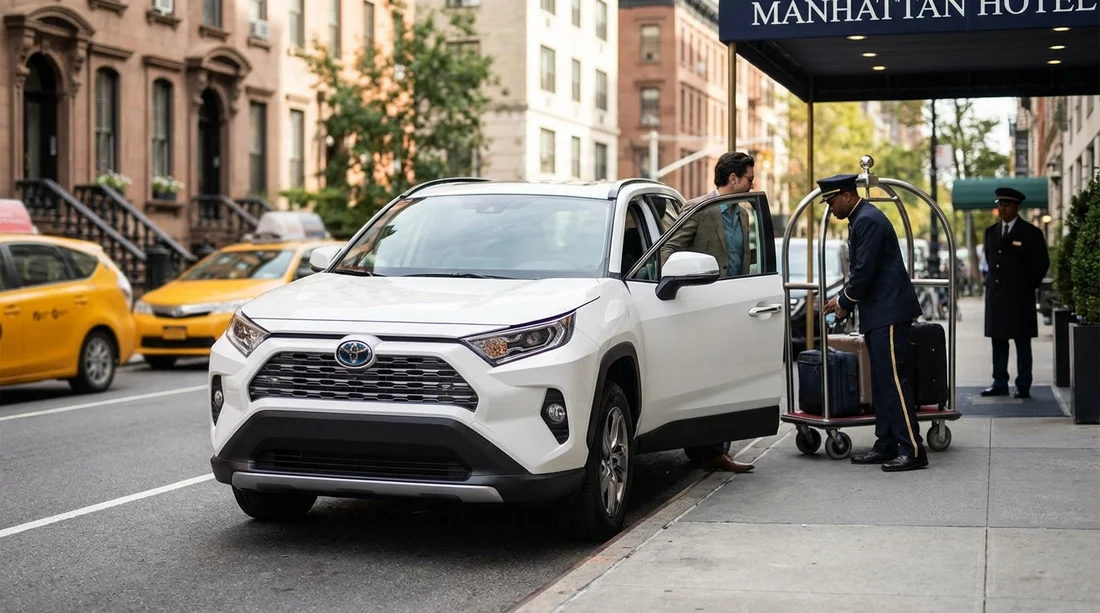
Quick Summary:
- Use signed passenger drop-off or loading zones, and obey time limits.
- Never stop by hydrants, crosswalks, bus stops, or blocked driveways.
- If kerb space is impossible, circle once, then use a nearby garage.
- Ask hotel staff about their loading bay, doorman rules, and peak times.
Manhattan hotel drop-offs can feel like a trap for visitors using car hire. Streets are tight, traffic is constant, signs change block by block, and enforcement is fast. The good news is that you can usually manage a legal, low-stress stop if you follow a few practical rules of thumb and plan for what you will do if there is no legal kerb space.
This guide focuses on short, luggage-style stops at hotels in New York, especially Manhattan. It is not legal advice, and signage always wins. If the sign says no standing or no stopping, keep moving, even if other cars are doing it.
Start with the kerbside sign, not what other drivers do
On Manhattan blocks, the pole-mounted sign is your first decision tool. Many visitors assume “hazard lights” makes a stop acceptable. It does not. New York distinguishes between stopping, standing, and parking, and the signs use those exact words. As a rule, “No Stopping” is the strictest, then “No Standing”, then “No Parking”. If you are unsure, do not stop.
Look for three details on the sign before you pull in: the restriction type (stopping, standing, parking), the hours and days it applies, and any special use such as buses, trucks, or authorised vehicles. If a restriction is only during peak hours, you may be able to stop outside those hours, but you must read carefully, including arrows showing which part of the block the sign controls.
If you are arriving after a flight, build in time to read kerbside rules and make one extra loop. Picking up your vehicle at an airport location can help you start on a clear plan, for example via car rental New York JFK or car rental airport Newark EWR, then heading into Manhattan when you are ready rather than rushing a last-minute kerbside stop.
Loading zones: your best friend for brief hotel drop-offs
When people ask “where can I stop briefly without a ticket?”, the most practical answer is “a signed loading zone that allows your vehicle type, for the time you need”. Manhattan has loading zones intended for deliveries, but many blocks also work for quick passenger luggage unloading if the sign does not prohibit it and you keep it genuinely brief.
Here are workable, visitor-friendly rules of thumb:
Prefer spaces signed for loading or metered parking over unmarked kerbs. Unmarked does not mean allowed, and many corners and mid-block segments are controlled by additional signs you might have missed.
Stay with the vehicle. In New York, being in the car matters. A quick stop with a driver present is far less risky than leaving the vehicle while you check in. If the hotel wants you to bring bags inside, ask staff to watch the kerb, or use luggage assistance while you remain with the car.
Keep the stop short and active. “Standing” generally relates to waiting. A legal short stop looks like doors opening, bags moving, passengers stepping out, then the vehicle leaving. If nothing is moving, you are effectively waiting, which can trigger a ticket even if you think you are “only there for a minute”.
Do not block commercial work. If a truck is clearly trying to use the loading zone, yield and move on. Apart from courtesy, it avoids conflict and horn pressure that leads to poor decisions.
Some hotels have a recessed entry, service road, or a marked loading bay. These are ideal because you are off the main flow. Still, follow any posted private-property rules and keep the lane clear for emergency access.
Clearances to remember: hydrants, crosswalks, corners, bus stops
If you remember nothing else, remember this: Manhattan tickets often come from stopping near places that must stay clear. Even a “just drop and go” pause can be enough for enforcement if you are in a prohibited area.
Fire hydrants: Never stop next to a hydrant, even briefly. Keep well away so the hydrant is fully accessible. Visitors sometimes mistake a hydrant for a small bollard in bad weather, so scan the kerb line early.
Crosswalks and corners: Do not stop on the crosswalk markings or within the corner area where visibility matters. If you are dropping at a hotel entrance on a corner, look for a legal mid-block space instead, then walk luggage with the group.
Bus stops: Avoid any signed bus stop zone. These areas are heavily enforced, and your stop can also force buses to load passengers in traffic, which creates immediate conflict.
Driveways and building access: Never block a driveway, garage entrance, or a marked access point. In Manhattan, many hotels share blocks with garages and deliveries, and blocked access often leads to immediate escalation.
Bike lanes: Do not stop in bike lanes. Even when the kerb looks “free”, a bike lane makes it a no-go, and it is a major safety issue.
Because these restrictions cluster around hotel-heavy avenues, you may find the safest drop-off is not directly outside your hotel door. A legal stop half a block away is usually faster than searching for the perfect spot while traffic piles up behind you.
When there is no legal kerb space: a simple plan that works
Sometimes there truly is nowhere legal to stop near your hotel, especially at peak check-in times, during street cleaning windows, or when construction closes half the kerb. In those moments, the goal is to stay calm and avoid the two common mistakes: double-parking and blocking a lane while you negotiate with passengers.
Use this three-step plan:
1) Do one full loop. Keep moving, complete the block, and re-check the opposite side and mid-block segments. Signs vary, and a legal metered space can open up quickly.
2) Switch to a “walk-in” drop. If you find any legal space within a few minutes’ walk, take it. Drop passengers and a couple of bags, then have the driver handle the vehicle while others start check-in. This reduces kerbside pressure.
3) Use a nearby garage. If the area is impossible, go straight to a paid garage and unload there if allowed. Many garages are used to hotel guests doing a quick luggage transfer, and it can be cheaper than a ticket plus stress. Call ahead if you can, or ask the hotel for a recommended garage that can accept your vehicle size.
If you are travelling with a larger group and more luggage, consider vehicle size and manoeuvrability before you arrive. Options like a people carrier can be convenient, but they can also be harder to place kerbside. If you are comparing larger vehicles for airport pick-up, see van rental New Jersey EWR for a sense of what you might be driving into Manhattan.
Hotel drop-off tactics that reduce ticket risk
Most ticket-prone situations happen because the driver is trying to do too many things at once. These tactics make the stop controlled and brief:
Call the hotel 10 minutes out. Ask if they have a loading bay, a service entrance for arrivals, or a preferred side street for drop-offs. Some properties have staff who can step out and guide you into an appropriate space.
Assign roles in the car. One person handles doors and bags, another keeps an eye on the sign and traffic, and the driver stays focused on movement. Decide in advance who takes what bag, so you are not sorting luggage at the kerb.
Prepare before you reach the kerb. Remove the luggage you will unload first from the boot order, have the room confirmation ready on a phone, and ensure children are unbuckled only when you are stopped legally.
Do not let the group “vote” you into a bad stop. Passengers will often say “just here is fine”. In Manhattan, “fine” can become an expensive lesson. If the sign is restrictive or the space is risky, keep moving and explain you will stop legally around the corner.
Avoid shift-change moments. Early evening in Midtown, theatre times, and weekend brunch periods create intense kerbside competition. If you can time arrivals slightly off-peak, you will find legal space more easily.
Common Manhattan sign scenarios, translated into plain English
No Standing Anytime: Do not stop, even for a passenger drop. Keep moving.
No Standing, Except Trucks Loading and Unloading: If you are not a truck, do not stop there. Find another space.
No Parking (with hours): A brief stop to load or unload passengers may be allowed during the restriction, but do it quickly and stay with the vehicle. Outside the restricted hours, parking may be allowed, subject to meters or other rules.
Hotel or commercial loading only: Treat as reserved. If the hotel confirms it is for guest drop-off and staff is directing you, follow their guidance, but still comply with posted rules.
Metered parking: Often the easiest legal option for a short stop. Even if you will be there for minutes, paying the meter or following the posted payment method reduces risk.
Enforcement is also affected by vehicle type and plates. Rental vehicles are not exempt, and in tourist corridors enforcement is routine. If your car hire is coming from Newark, you may be comparing providers and pick-up processes, such as Enterprise car rental Newark EWR or Avis car rental New Jersey EWR, but once you are in Manhattan the kerbside rules apply equally.
What not to do, even if you see locals doing it
Do not double-park for “two minutes”. This is one of the fastest ways to trigger both a ticket and a confrontation with traffic.
Do not stop in a travel lane with hazards on. It still blocks traffic, and enforcement can treat it as standing or stopping illegally.
Do not argue with an enforcement officer at the window. If you are already stopped illegally, the best move is to leave safely as soon as possible. Arguing rarely changes outcomes and can distract you from traffic.
Do not assume a doorman wave makes it legal. Hotel staff are helpful, but they cannot override street rules. Use them for spotting spaces, carrying bags quickly, and advising on better approach streets.
Do not unload into the bike lane. Always unload on the kerb side if you are legally stopped, and check for cyclists before opening doors.
Choosing an approach route that makes stopping easier
Manhattan avenues can be punishing for drop-offs because traffic moves quickly and kerb space is scarce. A calmer side street approach often gives you better sight lines for signage and more time to decide without pressure.
If your hotel is on an avenue, consider approaching from the nearest cross street that has lower traffic and fewer bus zones. Navigation apps can route you onto the hotel frontage in a way that forces an abrupt stop. Instead, aim for the block before the hotel, then make a controlled final turn onto the street where you want to search for legal kerb space.
Also consider your exit plan. Once passengers are out, you may be heading straight to a garage, another borough, or an airport. Knowing your next move avoids lingering, and lingering is what turns a legal stop into a violation.
FAQ
Can I stop outside a Manhattan hotel to unload luggage? Yes, if the kerbside signage allows stopping or standing for loading, and you keep it brief and active. If the sign says no standing or no stopping, you must not stop.
Is it legal to put hazard lights on and stop briefly? No. Hazard lights do not make an illegal stop legal in New York. Your legality depends on the sign rules and whether you are blocking a restricted area.
How far should I stay from a fire hydrant or crosswalk? Treat both as strict keep-clear areas. Do not stop by a hydrant at all, and avoid stopping on or near crosswalks and corners where visibility is needed.
What if there is genuinely nowhere legal to pull over near my hotel? Circle once, then switch to a walk-in drop a short distance away, or use a nearby paid garage for a controlled unload. This is usually cheaper than a ticket.
Are loading zones okay for passenger drop-offs? Sometimes, but it depends on the exact wording. If it is restricted to trucks or specific vehicles, do not use it. If it permits loading and you are actively unloading, it can work for a very short stop.




























































































