


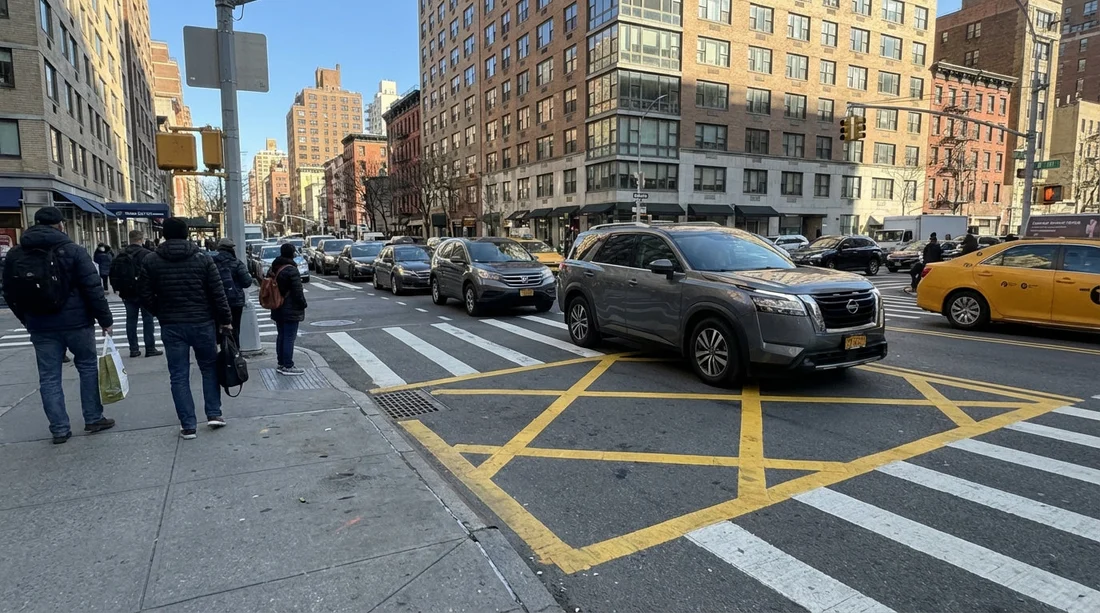
Quick Summary:
- Only enter if there is full car-length space beyond crosswalk.
- Use a two-second, two-car rule to confirm your exit stays clear.
- If trapped, stop before crosswalk, keep wheels straight, wait calmly.
- Avoid following turning traffic that may stall mid-intersection in Manhattan.
In New York, “block the box” enforcement targets drivers who enter an intersection when traffic is backed up, then end up stopped inside it. In Manhattan gridlock, it can happen in seconds, especially around popular avenues, bridges, tunnels, and Midtown crosstown streets. If you are using car hire in New York, the key is not driving faster, it is making a better go or no-go decision before your front bumper crosses the crosswalk line.
First, a quick reset on what you are trying to avoid. The “box” is the intersection area between the crosswalks, including the marked pedestrian crossing zone and the space where vehicles traverse. The problem is not that you entered on a green, it is that you stopped in the intersection and prevented cross traffic, pedestrians, or turning vehicles from moving when they have the right of way. Cameras and traffic agents focus on that final outcome.
If you are collecting a vehicle outside Manhattan, you may not hit dense gridlock until you are closer to Midtown. Planning helps, but you still need a reliable, repeatable method for judging whether you can clear the intersection. If your pick-up is at an airport location, it can be useful to review your route before you drive into the most congested areas. Hola Car Rentals has helpful landing pages for arrivals, such as car rental at New York JFK and car rental at Newark EWR, so you can orient yourself before facing Manhattan timing and lane rules.
What counts as “blocking the box” in NYC
In simple terms, you block the box when you enter an intersection without a clear exit, then stop inside the intersection. It can happen on a green light, and it can still be a violation even if you are only partially in the intersection. In heavy traffic, that includes being stopped on a crosswalk, in the middle of a junction, or with your rear wheels still inside the box so cross traffic cannot pass.
It is important to understand that NYC intersections often have multiple competing flows: pedestrians crossing both ways, vehicles turning left across oncoming traffic, vehicles turning right through a crosswalk, and buses pulling out. When any one of those flows slows, the “space beyond the intersection” you thought you had can disappear. Your strategy should assume that space is fragile.
The clearance test: how to judge if you can clear the intersection
Use a three-part clearance test every time traffic is not obviously flowing.
1) Look past the intersection, not at the light. A green light is not permission to enter if the downstream lane is stopped. Your eyes should be on the lane you will occupy after the junction. If you cannot see a gap, you do not have one.
2) Confirm “one full car length plus buffer” beyond the far crosswalk. You need enough space so your entire vehicle fits beyond the far crosswalk line, with a small safety buffer. In Manhattan, gaps shrink quickly when drivers merge, taxis pull over, or delivery vehicles double-park. If the gap is exactly your car length, treat it as not enough.
3) Apply the two-second, two-car rule. Before you commit, check that the gap beyond the junction will still exist in two seconds. Also check that at least two vehicles ahead of you are continuing to move, not just creeping. If the cars ahead are “accordion braking”, that is a warning that you will be forced to stop.
Practically, this means you sometimes wait through a green. That feels wrong if you are used to the rule “green means go”, but in NYC it is often the safest and most legal choice. You are not obligated to enter an intersection you cannot clear.
Where drivers get trapped: pedestrians, turning traffic, and lane blockages
Most block-the-box mistakes are not reckless, they are optimistic. Here are the common traps and how to handle each one.
Trap 1: pedestrians extend the crossing phase
In Manhattan, a surge of pedestrians can spill into the crossing late. If you enter on green expecting to clear, then pedestrians slow the turning traffic ahead of you, the lane beyond the intersection may stop. To avoid this, watch the far-side crosswalk and the near-side pedestrian flow before you move. If the crosswalk is packed, assume turning vehicles will hesitate or stop.
If you are already rolling and you see pedestrians stepping off the kerb in volume, your priority is to avoid stopping inside the box. If you have not crossed the near-side crosswalk line yet, stop before it. If you have crossed it, continue only if your exit is still clear. If you must stop, stop as close as you safely can to the far side without entering the far crosswalk, leaving pedestrian space.
Trap 2: left-turners freeze the whole lane
NYC left turns can be messy, especially when oncoming traffic is heavy and drivers edge into the intersection waiting for a gap. If you follow a vehicle that is positioned to turn left and it stalls, you can be stranded behind it. Your defence is lane choice and patience.
When approaching an intersection, identify whether the vehicle ahead is committed to going straight or might turn. Signs include the left indicator, wheel angle, and placement in the lane. If the front vehicle is offset toward the centre line, it may be preparing to turn. Do not “piggyback” into the intersection behind a potential left-turner unless you have independent confirmation that your exit is clear.
Trap 3: right turns blocked by pedestrians and bikes
Right turns in NYC often require yielding to pedestrians and, in many places, cyclists. A turning car can stop abruptly at the crosswalk, even on green, and the vehicles behind may then be stuck in the intersection. If you are going straight, avoid sitting behind a vehicle that might turn right when the near-side crosswalk is busy. If you are turning right, delay entry until you can complete the turn into a clear lane without stopping in the junction.
Trap 4: the gap disappears due to merging or double-parking
Manhattan lanes can “compress” because a vehicle pulls over, a delivery van blocks a lane, or a taxi stops suddenly. The gap you saw might not be stable. When you judge clearance, scan for hazards in the next half-block: active kerbside loading, vehicles with hazard lights, ride-share drop-offs, or a bus stop where a bus is signalling to re-enter traffic.
If you are unfamiliar with how quickly NYC traffic patterns change, a larger vehicle can make judgement harder. If your group is using a larger car hire option, consider extra buffer for clearance because your vehicle may take longer to accelerate and occupy more space. For travellers arriving with family or luggage, Hola Car Rentals lists options such as minivan hire at New York JFK, which is useful context when considering stopping distance and available gaps.
What to do if you are already in the intersection and traffic stops
Sometimes, despite good judgement, you get caught. The objective becomes reducing obstruction and staying predictable.
1) Do not continue creeping if the far crosswalk is occupied. Creeping forward can put you into the pedestrian crossing and worsen the violation. If you cannot clear the far side, stop before the far crosswalk line if possible.
2) Keep your wheels straight while stopped. This is a safety best practice in any city. If you are hit from behind, straight wheels reduce the chance of being pushed into cross traffic.
3) Leave space for pedestrians where possible. If you are stuck, do not block the crosswalk completely. Even a partial opening helps reduce conflict with pedestrians and may reduce escalation with traffic agents.
4) Do not reverse. Reversing in a congested intersection is risky and can create a collision. Stay put, wait for the lane ahead to open, and clear the junction as soon as you can do so safely.
5) Avoid “blocking to be polite”. You might be tempted to stop in the box to let a vehicle merge. That is generous but dangerous in NYC because it is exactly what can trigger a blockage. Prioritise clearing the intersection first.
Common “yellow box” mistakes in Manhattan, and the safer alternative
People often describe NYC’s rule as a “yellow box” concept. Whether or not the junction is marked, the behavioural mistake is the same. Here are the most common errors, with a practical replacement habit.
Mistake: Following the car in front as soon as it moves. In gridlock, the vehicle ahead may move only half a car length, then stop again. Alternative: Wait until you can see a stable gap beyond the far crosswalk that fits your whole vehicle.
Mistake: Entering on late yellow to “save the cycle”. Late yellow often coincides with pedestrians finishing their crossing and turning vehicles hesitating. Alternative: Treat late yellow as a prompt to reassess clearance, not to commit.
Mistake: Entering because you have right of way. Right of way does not protect you from being stuck. Alternative: Only enter when you can complete the movement without stopping.
Mistake: Assuming cross traffic will wait because they are also blocked. NYC drivers will often use any opening aggressively when their light changes. Alternative: If you cannot clear, do not enter, even if you think nobody can go.
Mistake: Getting drawn into “intersection creep” behind a turning vehicle. Left-turn queues often occupy the box. Alternative: Hold back at the stop line until the turning vehicle has actually cleared.
Extra tips for car hire drivers new to NYC
Know your intersection types. Some Manhattan junctions are larger than they look because of wide avenues and multiple turn lanes. A gap that fits a small saloon might not fit an SUV. Use the road markings: the far crosswalk is your key reference line for “fully clear”.
Expect sudden lane changes. Drivers may cut in to reach a turn lane at the last second. If you are relying on a narrow gap beyond the junction, a last-second merge can remove it.
Be careful near bridges and tunnels. Approaches to the Queensboro Bridge, Holland Tunnel, and Lincoln Tunnel can generate stop-start waves that propagate back through multiple intersections. In those zones, assume you will need to wait through more than one green cycle.
Use navigation, but do not let it rush you. Satnav prompts can pressure you to “make the light”. In NYC, missing a light is usually better than entering and stopping in the box.
Allow more time than you think. The best way to avoid block-the-box pressure is scheduling. If you are not racing the clock, you are more willing to wait at the line until you can truly clear.
If you are comparing pick-up points, travellers sometimes choose Newark for certain routes into New York and New Jersey. Hola Car Rentals provides information pages such as car hire in New Jersey at EWR and supplier options like Avis car hire at Newark EWR, which can help you plan where you enter the densest city traffic.
A simple checklist to run at every busy Manhattan junction
As you approach a junction with slow traffic, run this quick mental checklist.
Can I see a clear landing space beyond the far crosswalk? If no, stay behind the line.
Is that landing space big enough for my entire vehicle plus a buffer? If no, wait.
Is the vehicle ahead likely to turn and stop? If yes, create more space and delay entry.
Are pedestrians or cyclists likely to force turning traffic to pause? If yes, assume your lane could stall.
If the lane stops, where will my car end up? If the answer is “in the intersection”, do not go.
Mastering this judgement takes only a little practice. Once you stop treating the green light as the primary signal and start treating “clear exit space” as the true permission, block-the-box risk drops sharply.
FAQ
Do I break the rule if I enter on green but end up stuck? Yes, you can still be cited if you stop in the intersection and obstruct traffic, even if the signal was green when you entered.
How do I know if my car is fully clear of the intersection? Your whole vehicle should be beyond the far-side crosswalk line, with no part of the car over any crosswalk markings.
What if the car in front stops unexpectedly and I am already in the box? Stop as safely as possible without blocking the far crosswalk, keep wheels straight, and wait. Do not reverse or weave around pedestrians.
Is it acceptable to wait through a green light if I cannot clear? Yes. In heavy NYC traffic, waiting is often the correct and safest choice if the lane beyond the junction has no space.
Are some areas of Manhattan worse for block-the-box problems? Midtown avenues and crosstown streets are common hotspots, especially near bridge and tunnel approaches where queues can back up through multiple intersections.




























































































