


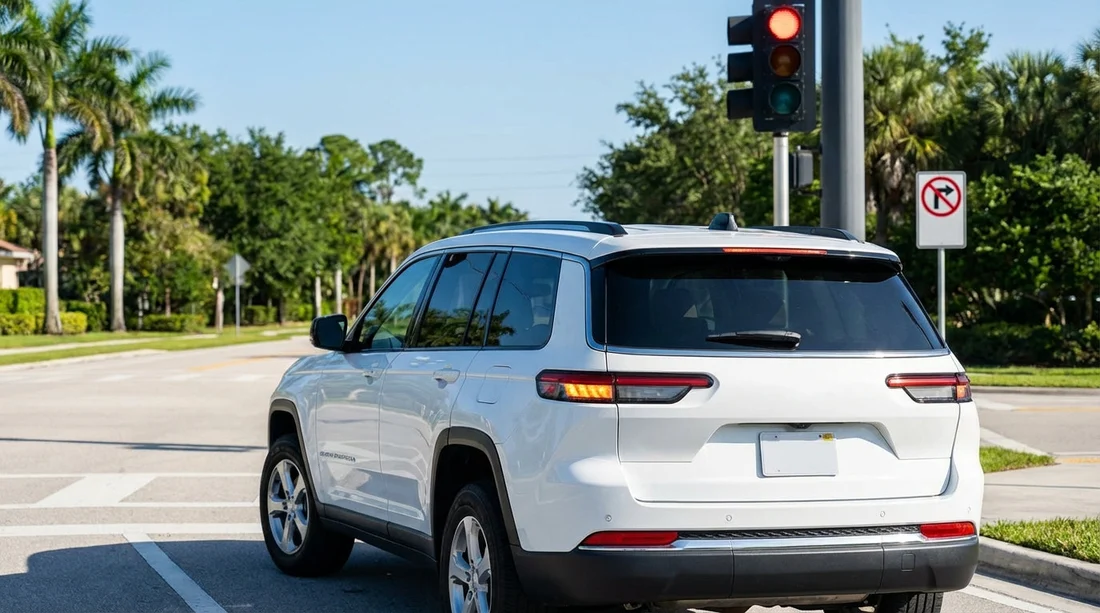
Quick Summary:
- Right on red is allowed after a full stop, unless a sign bans it.
- Never turn on red where signs say “NO TURN ON RED”, including timed versions.
- Stop behind the line, yield to pedestrians, then creep forward to check.
- Miami enforcement focuses on failure to stop, crosswalk conflicts, and cameras.
If you are visiting Miami and driving on car hire, turning right on a red light can feel like a trick question. In Florida it is often legal, but only if you do it the right way and only if the junction allows it. The rule is simple on paper, yet drivers still collect citations because they treat it like a rolling give way, miss a sign, or enter a crosswalk while pedestrians have the right of way.
This guide explains the practical right-on-red rules in Florida, the most common “strictly banned” situations you will see around Miami, what real signs look like, and how enforcement tends to work. Use it as a mental checklist each time you approach a red light with the option to turn.
Is right on red allowed in Florida?
Yes, in Florida you may turn right on red after coming to a complete stop, unless a sign at that junction prohibits it. You must yield to any pedestrians in the crosswalk and to any traffic with a green light that would conflict with your turn.
The important part for visitors is “after a complete stop”. It is not a slow roll. Think of the same discipline as a stop sign, then proceed only when the way is clear.
If you are collecting your vehicle near the centre, the junction density can be high. The first 30 minutes out of car hire airport downtown Miami areas is where people tend to make avoidable mistakes, because there are pedestrians, cyclists, buses, and complex signal phases.
The step-by-step method that keeps you legal
Use this sequence every time you consider a right on red in Miami:
1) Scan for prohibition signs first. Before you even stop, look to the right side of the signal pole and the far side of the junction. Miami commonly uses a clear white rectangular sign reading “NO TURN ON RED”. Some junctions add timing such as “7AM-7PM” or “WHEN PEDESTRIANS PRESENT”. If you see any version of that message, the turn is banned for the condition shown.
2) Stop fully at the correct place. Stop behind the thick white stop line. If there is no line, stop before the crosswalk. If there is no crosswalk, stop before entering the junction. A common enforcement scenario is a driver stopping with their bumper in the crosswalk, which can be ticketed even if no one is crossing.
3) Yield properly. Yield to pedestrians who are crossing, about to step off the kerb, or have a walk signal. Yield to cyclists travelling straight through the junction and to vehicles with the right of way. In Miami, also watch for buses pulling into the lane and for vehicles turning left across your path.
4) Creep forward only to improve sight lines. After your full stop, you may inch forward to see around parked cars or street furniture, but keep the crosswalk clear. Many right-on-red near-misses happen because the driver creeps too far and blocks a pedestrian refuge.
5) Turn into the correct lane. Turn into the nearest available lane unless road markings or signs direct otherwise. Wide Miami streets can tempt drivers to swing into a further lane. If you do, you risk cutting across another vehicle also turning on green.
When right on red is strictly banned in Miami
In practice, right on red is “strictly banned” whenever the junction specifically tells you it is banned, and you should expect Miami to use those signs where conflict risk is higher. Here are the main scenarios to recognise.
1) “NO TURN ON RED” signs, including timed bans. This is the clearest prohibition and the one visitors most often miss. Timed versions might read “NO TURN ON RED 7:00 AM-7:00 PM”, or indicate school hours. Treat it as a full ban during the listed times. If you are unsure what time it is or whether the condition applies, the safest approach is not to turn on red.
2) “RIGHT TURN SIGNAL” or red arrow control. Some junctions control right turns with a dedicated signal head. A red right arrow means you must not turn. Even if the main signal is red and you would usually be allowed to turn, the red arrow is a specific prohibition for that movement.
3) Where the signal face is aimed at your lane with special instructions. You may see signs like “STOP HERE ON RED”, often used near rail corridors or where the geometry is tight. If you cannot stop at the normal line, do not pull forward into a pedestrian space. The instruction is about where to stop, but it often appears at junctions where right on red is restricted.
4) When you cannot yield safely due to blocked visibility. If you cannot see cross traffic without entering the crosswalk or edging into the live lane, you should wait for green. Florida’s permission to turn right on red still requires you to yield. If you cannot confirm it is clear, you cannot legally proceed.
5) Complex pedestrian environments. In areas with heavy footfall, you will often find right-on-red restrictions because pedestrians are constant. Miami Beach, downtown shopping streets, and areas around parks use bans more frequently. If your trip includes coastal driving after collecting a car in the city, it is useful to know that signage density can increase around tourist centres. For example, visitors picking up from Enterprise car hire Miami Beach locations often encounter more pedestrian-heavy junctions where bans are posted.
Real sign wording to look for (and how to interpret it)
Signs are your legal trigger. In Miami you will typically see one of these formats:
“NO TURN ON RED” means never turn right on red at that junction.
“NO TURN ON RED 7AM-7PM” means outside those hours it may be allowed, after stopping and yielding.
“NO TURN ON RED WHEN PEDESTRIANS PRESENT” means if anyone is in the crosswalk, waiting to cross, or the pedestrian phase is active, you must not turn. In busy areas, assume pedestrians are “present” more often than you expect.
Red right arrow means do not turn. Wait for a green arrow or a green light as indicated for your lane.
Common Miami junction traps for visitors
Rolling stop at red. The biggest issue is treating the red light like a UK give way. Florida requires a full stop first. Officers watching a junction can spot a rolling stop instantly, and some camera setups are sensitive to it.
Stopping beyond the line. Many drivers stop late and end up in the crosswalk. Even if you are “trying to be cautious”, it can obstruct pedestrians and trigger enforcement.
Missing a second sign on the far side. Some junctions place the “NO TURN ON RED” sign in a less obvious spot, especially if there are multiple sign panels. Build the habit of checking both near-side and far-side poles.
Confusing permissive right turns with protected phases. When another direction has a protected left turn, your right on red may conflict with vehicles that are accelerating through on a green arrow. Even if you technically have space, drivers may not expect you. Yield conservatively and avoid forcing anyone to brake.
Multi-lane right turns. Miami has junctions where two lanes can turn right. If you are in the rightmost lane, turn into the nearest right lane. If you are in the second right-turn lane, you should usually turn into the next lane left. Cutting across is a collision risk and can be cited as an improper turn.
Slip lanes and channelised turns. Some corners have a separate right-turn slip lane with its own yield sign. Do not assume the red-light rule applies the same way. If you are in a slip lane, you often have a yield condition rather than a signal-controlled stop, but pedestrians still have priority.
How enforcement works in Miami, and what gets ticketed
Enforcement around right on red generally targets behaviours that create conflict:
Failure to stop before turning. This is the most straightforward violation. An officer can stop you, and in some places camera enforcement can capture the movement.
Ignoring a “NO TURN ON RED” sign. If the sign is posted, turning is a clear violation. Tourists often say they did not see the sign, but missing it is not a defence.
Blocking or endangering pedestrians. Entering the crosswalk while people are crossing, or forcing a pedestrian to alter their path, is taken seriously. Miami’s busiest areas have frequent crossings, so take your time.
Improper lane use on the turn. Swinging wide, crossing lane markings, or turning into the wrong lane can be cited, and it is also a common cause of minor crashes.
If you are driving across the wider South Florida area, you will notice enforcement patterns vary by municipality. Roads around airport corridors can also be closely monitored. Visitors collecting from car hire Fort Lauderdale FLL locations and driving south into Miami should keep the same stop, scan, yield routine, because signage and right-turn arrow usage can differ junction to junction.
Practical tips for car hire drivers in Miami
Set your “default” to wait unless you are sure. You are never required to turn right on red. If traffic behind you honks, ignore it. Your obligation is to be safe and legal, not fast.
Watch for pedestrians stepping in late. In Miami, people may start crossing on the last seconds of a flashing countdown, or step off the kerb as you begin to move. Look twice before you commit.
Be careful at night in entertainment areas. Low visibility and unpredictable pedestrian movement make right on red riskier. If you cannot clearly see the crosswalk and the near lanes, wait for green.
Know your vehicle’s size and turning circle. If you are in a larger hire, such as an SUV, your turn may take longer and you may block a lane while completing it. That can tempt you to hurry. If you are considering a bigger vehicle, compare how it feels in city junctions, for instance with SUV rental downtown Miami options.
Do not let sat nav rush you. Navigation apps may call for an immediate right at a busy light. If the junction is confusing, continue straight and reroute safely rather than forcing a questionable turn.
What to do if you are unsure at the light
If you cannot confidently confirm all three of these, do not turn: there is no prohibition sign or red arrow, you have fully stopped behind the line, and you can yield without entering the crosswalk or forcing others to brake. Waiting for the green light is always legal, and in tourist-heavy Miami it is often the least stressful choice.
If you are planning a route that includes quieter neighbourhoods and suburban junctions, you may find right on red easier because visibility is better. Even then, keep the same discipline, because a single overlooked “NO TURN ON RED” sign can appear on an otherwise empty road.
FAQ
Do I have to turn right on red in Florida? No. It is permitted in many places after a full stop and yielding, but you can always wait for green.
Is a “rolling stop” allowed before turning right on red? No. You must come to a complete stop behind the stop line or before the crosswalk.
What if there is a red right arrow? Treat a red right arrow as a strict ban. Do not turn until the arrow or signal indicates you may proceed.
How do timed “NO TURN ON RED” signs work? The ban applies only during the listed hours or conditions. Outside that window, right on red may be allowed if you stop and yield.
Can I turn right on red if pedestrians are waiting to cross? If pedestrians are in the crosswalk or the sign says “when pedestrians present”, wait. When allowed, you must still yield and keep the crosswalk clear.




























































































