


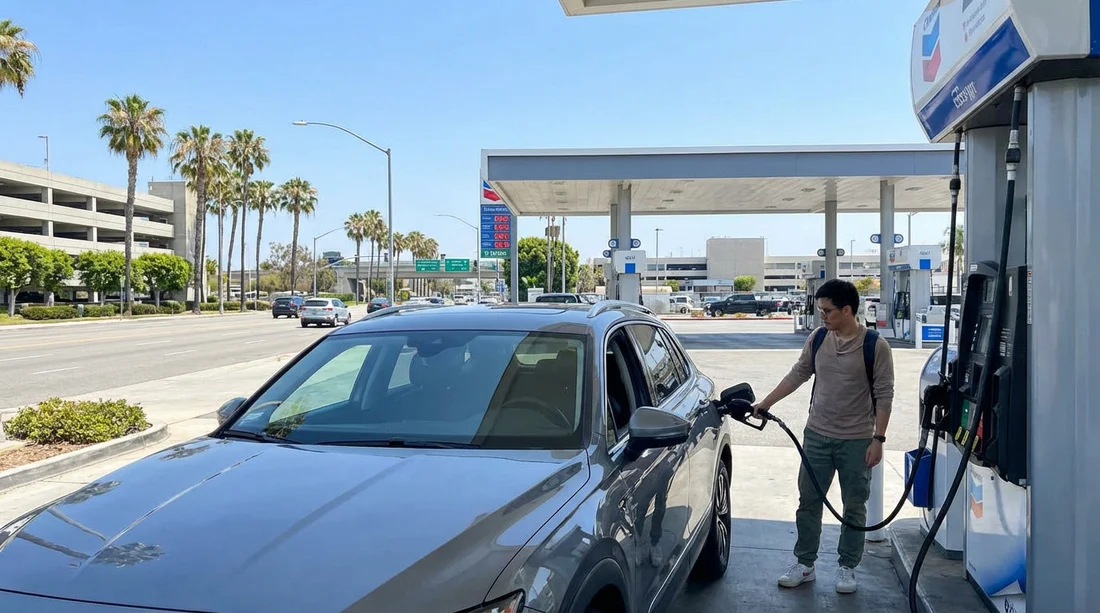
Quick Summary:
- Aim to refuel 2 to 4 miles from LAX, then return.
- Avoid stations on airport property, prices often jump significantly.
- Use Sepulveda or Aviation, both minimise one-way loops near terminals.
- Allow 20 to 35 minutes for fuel, traffic, and rental return.
Returning a car hire at Los Angeles International Airport can feel like a final-level puzzle. You need a quick top-up, but you do not want to get trapped in terminal-only lanes, pay inflated airport-adjacent prices, or end up on a one-way loop that adds ten minutes for no benefit. The good news is that LAX is surrounded by straightforward fuel options if you pick the right approach roads and build a small time buffer.
This guide maps the easiest areas to refuel near LAX, explains the common road layouts that cause accidental detours, and suggests how much time to allow before you join the rental car return queue. It is written for typical petrol and diesel car hire returns, and it also works for hybrids that still need a small top-up.
If you are organising your Los Angeles car hire logistics, start with your pick-up and return details on Hola Car Rentals LAX car hire. Different providers use the same general return corridors, so the strategy below stays useful even if your exact return bay changes.
Why “closest to LAX” is often the wrong choice
The stations that look closest on a map are frequently the least efficient. Anything on airport property, or directly at the terminal loop entrances, tends to have three problems: higher prices, slow access due to traffic controls, and awkward exits that force you into the wrong lane group. You may also find yourself behind rideshare queues or buses, which eats the minutes you thought you saved.
A better rule is “close enough, with an easy exit”. In practice that means fuelling about 2 to 4 miles from the rental car return, ideally along a road that connects directly back to the return route without sending you through the horseshoe terminal loop.
The easiest refuel corridors near LAX
Rather than naming a single station, use corridors. Specific forecourts change prices by the hour, remodel, or temporarily restrict access. Corridors stay stable, and you can choose the best-priced option on the day.
1) Sepulveda Boulevard (CA-1) north and south of LAX
Sepulveda Boulevard is one of the simplest “last fill” routes because it runs along the west side of the airport and connects quickly to the standard return approach. You can find multiple stations in both directions, and most have easy in-and-out driveways.
Best for: a predictable exit back towards the airport, and avoiding terminal-only lanes.
Watch out for: rush-hour congestion and short left-turn pockets. If you miss your turn, do not try a risky U-turn, continue to the next safe intersection and loop back.
Time tip: if you are already north of LAX, refuel north of the airport and then drop straight down Sepulveda to your return. If you are south of LAX, do the opposite. Crossing around the airport at the wrong moment can cost time.
2) Aviation Boulevard and Imperial Highway (near the rental car zones)
Aviation Boulevard has a cluster of services that many drivers use for a final top-up, especially if they are approaching from the south or the 105. This area is functional rather than scenic, which is exactly what you want when you are focused on getting the car hire returned on time.
Best for: direct access from the 105 and a short hop back to airport approaches.
Watch out for: complicated multi-lane junctions near Imperial Highway. Get into the correct lane early, and follow signs for LAX rental return rather than “Arrivals” or “Departures”.
3) Lincoln Boulevard (CA-1) and the Westchester area
Lincoln Boulevard runs through Westchester and is often a good option if you are coming from the beaches or from the north-west. You get a variety of stations, and it is usually easier to avoid the densest terminal traffic compared with heading directly into the central airport roads too early.
Best for: drivers coming from Santa Monica, Venice, Marina del Rey, or Westchester itself.
Watch out for: busy intersections and short slip roads. Keep your sat-nav zoomed in for the final mile so you do not miss the entrance to the station you chose.
4) Century Boulevard, only if you know your lane plan
Century Boulevard sits on the north side of LAX and is lined with hotels and airport services. It can be convenient, but it is also where people accidentally feed into the terminal horseshoe or end up doing an extra circuit when a lane becomes “Terminals Only”.
Best for: a quick top-up if traffic is light and you are comfortable with airport lane discipline.
Watch out for: sudden lane commitments. If you see signs for “Arrivals” and “Departures” splitting, you have gone too far into terminal routing. Look for rental car return signage and stay calm, it is usually faster to follow the loop and correct than to cut across lanes.
Avoiding one-way loops and “forecourt traps” near LAX
LAX road design is efficient for terminals, but not always for quick refuelling. The main traps are predictable, and you can avoid them with a simple checklist.
Trap 1: following “Departures” too early. Many drivers see “Departures” and assume it is the right way back to the airport for returns. Rental returns are not terminal departures. Once you enter the terminal horseshoe, you may have no easy exit for a while.
Trap 2: missing the rental return turn and being forced into terminal lanes. If you are relying on a last-second sat-nav instruction, you may miss the correct slip and end up committed. Reduce this risk by setting your navigation to the exact rental return address before you leave the station car park, then follow road signs as your primary guide in the last mile.
Trap 3: choosing a station with a hard-to-exit driveway. Some forecourts near busy junctions are easy to enter but painful to exit, especially if you need to turn left across traffic or merge immediately. When you pull in, note which exit will let you leave with a simple right turn or a signalised junction.
Trap 4: chasing the absolute lowest price. Saving a few cents per gallon is not worth it if you burn ten minutes rerouting. Pick a station that is “good value and easy”, not “cheapest but awkward”.
If you are comparing providers for LAX car hire, the return experience can vary slightly by brand, but the refuelling strategy is the same. Hola’s landing pages for common LAX providers are helpful for confirming return instructions, for example Hertz car hire at LAX, Enterprise car hire at LAX, and Thrifty car hire at LAX.
How much time to allow for refuelling before drop-off
Time planning matters more than the final few pence on the pump. Use these realistic buffers for a last-fill near LAX, then adjust for your day and time.
Minimum buffer, quiet periods: 20 minutes. This assumes you choose a station 2 to 3 miles away, there is no queue, and you already know the return route.
Typical buffer: 30 minutes. This covers a short queue, a bit of traffic, and one imperfect lane choice.
Heavy traffic or unfamiliar route: 35 to 50 minutes. If it is weekday rush hour, holiday weekends, or you are returning at a peak flight bank, treat the last few miles as unpredictable.
Also factor in the rental return itself. Even if fuelling is quick, you may need extra time for checking the vehicle, photographing the fuel gauge and mileage, waiting for staff, then taking the shuttle or walking to your terminal. The earlier you do your last fill, the less stressful all of that becomes.
Practical refuelling steps for a smooth car hire return
1) Confirm what “full” means for your agreement. Most car hire contracts require the tank to be returned full, usually “full to full”. Do not assume that “three-quarters looks fine”. If the gauge is one notch below full, some systems treat it as not full.
2) Keep the receipt. Even if you fill up close to LAX, keep the fuel receipt until your final invoice is settled. If there is a dispute about refuelling, a timestamped receipt near the airport can help.
3) Do a top-up, not a long stop. Use pay-at-pump if available, or choose a forecourt with multiple pumps. Avoid stations that combine small forecourts with heavy convenience-store foot traffic.
4) Set navigation after you finish, not before. Many people set the destination while still at the pump, then drive off distracted. Finish fuelling, pull into a safe spot, then set your route to the rental return.
5) Know your lane goal. In the last mile, your goal is “rental car return” signage, not terminals. If you see the split for arrivals and departures, you are close to terminal circulation, and you should be cautious about lane commitments.
When it can be smarter not to refuel near LAX
There are cases where the best move is filling earlier in the day, then driving to the airport with a mostly full tank. This can be smarter if you are staying far from LAX, if you will be stuck in traffic anyway, or if you want to avoid any uncertainty during a tight schedule.
If you are coming from Orange County, for example, fuelling in Santa Ana or along your route north can remove the LAX stress entirely. If you are planning a multi-stop itinerary, Hola also covers nearby airport areas such as car hire at Santa Ana SNA, which can be useful for comparing logistics across Southern California.
Common mistakes that trigger extra charges
Returning “almost full”. A gauge that looks close to full can still be recorded as under full. Add a small final splash at a convenient station rather than guessing.
Using the wrong fuel type. It sounds basic, but it happens, especially with unfamiliar models. Check the fuel door label before you start. If you are driving a diesel, double-check the pump handle colour and labelling rather than relying on instinct.
Forgetting about rental lot idling time. The tank can dip slightly after a lot of stop-start driving and idling. If you fill up too early and then sit in traffic, the gauge might drop a hair. That is why the 2 to 4 mile rule works well.
Not accounting for forecourt access. A station can be close “as the crow flies” but awkward due to one-way streets and median barriers. Prioritise stations with easy turns and signalised exits.
FAQ
Q: How close to LAX should I refuel for a car hire return?
A: Aim for 2 to 4 miles from the rental return. It is close enough to keep the gauge at full, but far enough to avoid the busiest airport-only roads.
Q: Are petrol stations right next to LAX usually more expensive?
A: Often, yes. Stations on airport property or immediately at terminal approaches can carry higher prices, and they may be slower to access because of traffic controls.
Q: Can I rely on sat-nav to avoid the LAX terminal loop?
A: Use sat-nav, but prioritise “rental car return” signs in the final mile. Navigation apps can route you into arrivals or departures lanes if you miss a turn.
Q: How much extra time should I allow for fuelling and returning the car?
A: Plan 30 minutes for the last fill plus the drive to return. In heavy traffic, allow 35 to 50 minutes, then add time for vehicle check-in and terminal transfer.
Q: What should I keep as proof I refuelled near LAX?
A: Keep the fuel receipt showing time and location until your final charges are confirmed. A quick photo of the fuel gauge at return can also help.




























































































