


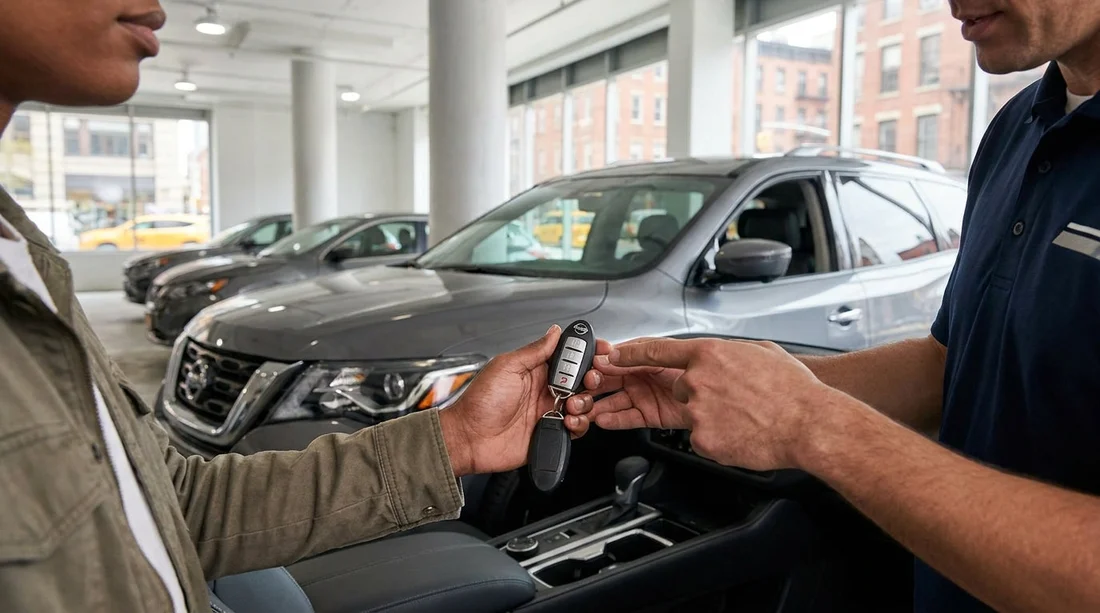
Quick Summary:
- Ask how many keys and fobs are issued for your vehicle.
- Test lock, unlock, boot release and panic button beside the car.
- Confirm the spare key policy and replacement fees are recorded in writing.
- Check keyless start, alarm behaviour, and any app pairing before driving.
At a busy New York pick-up, it is easy to accept whatever is handed over and head straight for the exit. But spare keys and key fobs are one of the most common sources of avoidable problems in car hire, from being locked out in a garage to unexpected fees if a fob goes missing. A few minutes at the counter and beside the vehicle can confirm you have everything you are meant to have, and that it all works.
Whether you are collecting at JFK or Newark, the routines are similar. If you are arranging car hire around flights, it helps to know the usual processes at New York JFK and Newark EWR, because desk handover styles vary between locations and suppliers. The checklist below is designed to be used at the counter, then repeated quickly at the car before you sign and leave.
1) Confirm exactly what you should receive
Start by asking a simple question: “How many keys and fobs are issued for this car?” Do not assume it is two. Many modern vehicles are supplied with a single smart key, and the spare may be held by the branch for operational reasons. That is not automatically wrong, but you want clarity before you walk away.
Ask the agent to state what is included for your booking: one key, two keys, a physical key plus a remote fob, or a key card. If the branch policy is one key only, ask them to note it on the rental agreement or check-out sheet, so you are not later held responsible for a “missing” spare you never received.
If you are being upgraded to a different category, re-ask the question. An SUV, for example, may come with different fob functions than a small saloon, and some trims have power tailgates or remote start. If you are comparing vehicle types for New York driving, SUV hire at JFK listings can hint at what features you might encounter, but the physical key set in your hand is what matters at pick-up.
2) Identify the key type and learn its quirks
Before you even get to the car, look at what you have. Is it a traditional blade key with buttons, a flip key, or a smart key for keyless entry and start? Does it have a detachable emergency key inside? Many people do not realise a small mechanical key slides out of the fob, and that is the only way to unlock the driver’s door if the fob battery dies.
Check for any labels that indicate “Valet” or restricted keys. If the key set is in a plastic pouch, open it and make sure there are no extra pieces you are expected to return. If there is a key tag with the car’s registration or barcode, keep it attached. Removing tags can lead to disputes during return if the branch expects the key tag back.
3) Do the counter checklist before you sign
At the counter, request these details and have them written down or printed as part of the agreement where possible:
Replacement charges and procedure. Ask what the fee is for a lost key or fob, and whether towing is required if the only key is lost. In New York, a locked car in a garage or at kerbside can quickly become expensive, so you want to know the official process rather than relying on assumptions.
Spare key policy. If the branch keeps a spare, ask what support exists if you lock the key inside the car or the fob fails. Some suppliers can dispatch assistance, but response times vary.
After-hours support. If your flight arrives late, confirm who you contact if the fob stops working outside desk hours. This is especially relevant at large airports where returns and exits are automated.
Supplier rules differ. If you are picking up from a specific brand desk, it can help to review practical pick-up expectations on supplier pages such as Dollar at JFK or Alamo at Newark, then still verify the exact key policy at handover.
4) Test every button beside the vehicle
Do not wait until you are at a petrol station. Stand by the car and perform a full function test. This takes under a minute and can prevent the most common “fob works sometimes” issues.
Lock and unlock. Press lock, then unlock, and watch the mirrors and door pins. Try both the driver’s door and passenger door handles if the vehicle is keyless. If only one side responds, the car may be in a partially locked state or a door sensor could be faulty.
Boot or tailgate release. If the fob has a boot button, test it. On some cars, a long press is required. Confirm the tailgate opens and closes properly, especially on SUVs where powered tailgates can stop mid-way if misaligned.
Panic button. If present, press it briefly, confirm the alarm triggers, then immediately cancel it. This tells you the alarm system is active and that you know how to stop it. Do this away from crowds where possible, and be considerate in a busy New York garage.
Remote start or other features. If the fob has extra icons, ask the agent which ones are enabled. Some functions may be disabled by the rental company, but you should know what to expect so you do not mistake normal behaviour for a fault.
5) Verify keyless start and drive-away readiness
Get into the car with the fob and confirm it starts consistently. If the car is push-button start, test start, stop, then start again. Watch for messages like “Key not detected”, “Place key near start button”, or “Key battery low”. Any warning at pick-up should be raised immediately. A low fob battery can still let you drive, but it increases the risk of being stranded later, especially if you make frequent stops in the city.
6) Check the physical emergency key and keyhole access
Even with a smart key, you should confirm the emergency blade is present. Slide it out and look for damage or bending. Then locate the physical keyhole. On many vehicles it is hidden behind a small cover on the driver’s door handle. Knowing where it is matters if the fob dies, or if the car’s battery goes flat.
7) Confirm alarm and central locking behaviour
Alarms can behave differently depending on how you lock the car. Some systems arm only when you use the fob, not when you press the interior lock button. Others will re-lock automatically if you unlock but do not open a door within 30 seconds. That can surprise you if you are loading bags at the kerb and the car re-locks with the key inside.
To reduce risk, practise your routine at pick-up. Unlock, open the driver’s door, then lock and unlock again. If the car has walk-away locking, confirm whether it is enabled. If it is, decide whether you want to rely on it in New York. Busy pavements and tight parking spaces increase the chances of accidental button presses and unintended locking.
8) Protect yourself from “missing key” disputes
Before leaving, take a quick photo of the key(s) and any tag next to the rental paperwork, showing the date on your phone screen if possible. This is not about distrust, it is about clarity if something goes wrong. If you receive only one key, photograph that single key and the contract section where it indicates the number of keys provided, if available.
FAQ
Q: Will I always get a spare key with car hire in New York? A: Not always. Many branches issue only one smart key, with any spare retained on-site. The key point is to have the number of keys provided clearly recorded.
Q: What fob functions should I test before leaving the rental lot? A: Test lock, unlock, boot release and the panic button if fitted. Then confirm keyless entry and push-button start work consistently without warning messages.
Q: What if the key fob battery warning appears at pick-up? A: Raise it immediately and ask for the battery to be replaced or for another fob. A weak battery can cause intermittent “key not detected” problems during your trip.
Q: How can I avoid locking the only key inside the car? A: Keep the fob on your person, not in bags or cupholders, and learn the car’s auto re-lock behaviour. Avoid leaving the key in the boot while loading luggage.
Q: If I was given one key, how do I protect myself at return? A: Photograph the single key and the paperwork noting key count, then return it exactly as instructed. If using a drop box, record a short photo of the key being deposited.




























































































