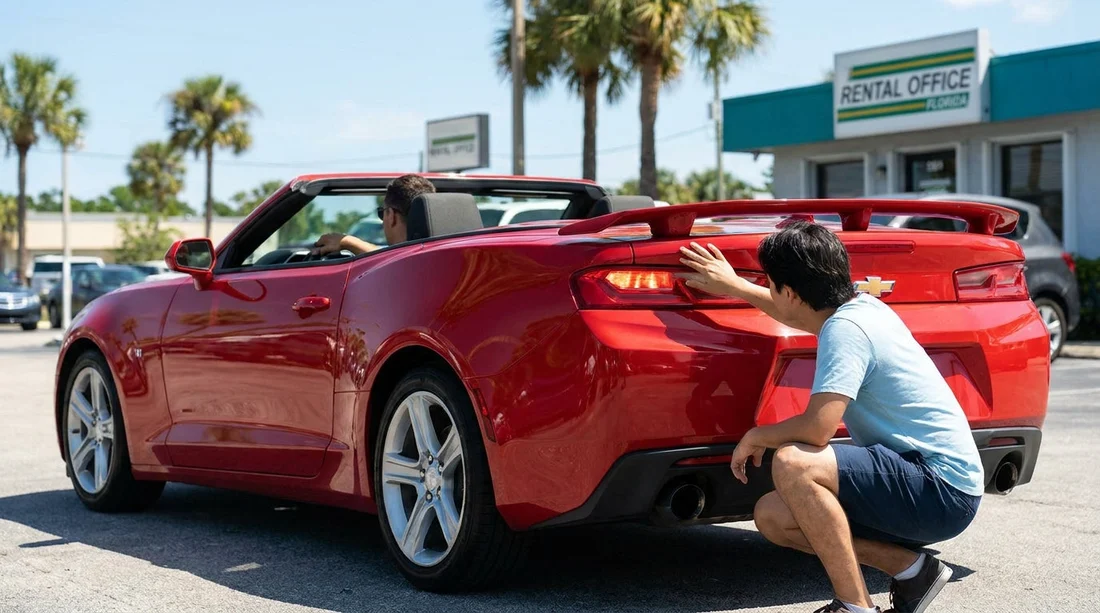
Quick Summary:
- Test low and high beams, and confirm dashboard icons respond correctly.
- Check both indicators front and rear, including any mirror repeaters.
- Switch on hazards and verify every corner flashes evenly and brightly.
- Confirm brake lights using a helper, reflection, or quick phone video.
Before you pull out of a car hire bay in Florida, spend two minutes confirming every essential light and signal works. It is not just about avoiding a ticket, it is also about being visible in heavy rain, at dusk, and on fast multilane roads. A quick check helps you spot simple issues such as a switched off light setting, a loose bulb connection, or a confusing control layout on an unfamiliar model.
Florida driving can shift quickly from bright sun to sudden storms, and visibility becomes a safety issue for you and everyone around you. Rental vehicles are maintained, but bulbs can fail between inspections, and settings can be changed by the previous driver. Doing the check while you are still on the rental lot makes it easy to ask staff to confirm a fault and switch you into another vehicle if needed.
If you are collecting near Miami, you can compare vehicle options and collection points on Florida car rental Miami (MIA). If you are flying into Fort Lauderdale, see car hire Fort Lauderdale (FLL). Knowing where you are collecting helps because lighting checks are easier in a shaded bay or next to a wall.
1) Headlights: low beam and high beam
Start with the basics, because headlamps do the heavy lifting for night driving and poor weather. On many modern cars, the headlight switch has multiple positions, including Off, Auto, sidelights, and low beam. Do not assume Auto means the lights are on right now. In bright Florida daylight, Auto may keep lights off.
How to test: with the engine on, set the switch to low beam. Step out and look at both headlamps. You want an even brightness left and right. Next, switch to high beam. You should see a clear change in intensity, and you should also see a blue high beam icon on the dash.
What to watch for: one side out, a flicker, or a headlight that is aimed oddly low or high. If one lamp is out, do not drive off expecting it to sort itself out. Ask for a swap or assistance.
2) Front and rear indicators (turn signals)
Indicators matter in Florida because lane changes are frequent, speeds can be high, and other drivers rely on clear signalling. You should test both sides, front and rear. Many vehicles also have mirror repeaters, and these can fail even if the front and rear bulbs work.
How to test: turn on the left indicator and walk around the vehicle. Confirm the front left, rear left, and any mirror repeater flash. Repeat on the right. Listen to the click speed inside. A much faster click than normal often suggests a bulb is out.
Extra tip: check the dash indicator arrows too. If the arrow blinks rapidly, treat it as a warning. Do not ignore it, especially before joining highways.
If your collection is around Miami Beach and you want to reduce surprises, browse pickup details for car hire Airport Miami Beach (MBC) or Budget car rental Miami Beach (MBC). Busy areas are exactly where clear signalling helps most.
3) Hazard warning lights
Hazards are a simple but important safety tool. In Florida, they are useful if you need to stop due to a sudden downpour, a breakdown, or a minor incident while you find a safe place to pull over. They also help you stay visible if traffic slows unexpectedly.
How to test: press the hazard button, usually marked with a red triangle. Walk around and confirm all four corners flash. Look for consistent timing and brightness. If one corner does not flash, it may be a single bulb issue, but it can also indicate an electrical fault. Either way, sort it before leaving.
4) Brake lights, including the high mounted stop light
Brake lights are harder to self check, but they are essential. Florida traffic often involves close following distances, and if your brake lights are not working, you risk a rear end collision and liability disputes.
How to test if you have a helper: with the engine on and the car in Park, press the brake pedal and ask the other person to confirm both rear brake lights illuminate, plus the centre high mounted light near the rear window or boot lid.
How to test alone: park near a reflective surface such as a glass storefront, a clean window, or a light coloured wall. Press the brake pedal and look for the red glow reflected behind you. Another method is to use your phone camera on video with the rear of the car in frame, then press the brake pedal and review. If you cannot confidently confirm the brake lights, ask rental staff to check them before you go.
What about tail lights? Tail lights come on with your headlights. When you test low beams, also walk behind the vehicle and confirm both rear tail lights glow. This is important at dusk and in rain when visibility drops.
5) Reverse lights and daytime running lights
Reverse lights help others see you when backing out of a space. Daytime running lights are common on newer cars, but they can create a false sense of security because the front looks lit while the rear may be dark.
Reverse lights: with the engine on and the brake pressed, shift into Reverse while stationary, if it is safe and permitted in the bay. Confirm white lights illuminate at the rear, then shift back to Park. If you are not comfortable doing this, ask a staff member to guide you.
Daytime running lights: if the front lights are on but your dash is dim and rear tail lights are off, you are likely seeing daytime running lights only. For evening or rain, switch on low beams so the rear lights are on as well.
7) If something fails, handle it before you exit the lot
If any light or signal does not work, document it and raise it immediately. It is much easier to change vehicles at the desk than later on the roadside.
Practical steps: take a quick photo or short video showing the issue, then notify staff. Ask them to confirm the fault with you present. In some cases it is a simple setting, such as headlights left in Off. In other cases the best answer is a different vehicle.
Do not attempt DIY fixes: avoid pulling bulbs or panels on a rental. Even if you are capable, it can create liability questions. Let the provider handle it.
FAQ
Do I need to test lights even if the car looks new? Yes. Bulbs and LEDs can fail without warning, and settings can be changed by the previous driver. A two minute check reduces risk before you leave the lot.
What is the fastest way to check brake lights when travelling alone? Use a reflection from a window or pale wall, or record a short rear facing video on your phone while pressing the brake. If you cannot confirm, ask staff to verify.
If a turn signal clicks fast, does that always mean a bulb is out? Usually it indicates an exterior indicator is not working, but some cars also alert you on the dashboard. Treat fast clicking as a fault to be checked immediately.
Are daytime running lights enough in Florida rain? No. Daytime running lights may not illuminate rear lights. In rain or reduced visibility, switch on low beams so tail lights are on too.
What should I do if hazards work but one rear light is dim? Report it before driving off. Uneven brightness can indicate a failing bulb, an LED module issue, or a poor connection, and it should be fixed or the car replaced.