


Quick Summary:
- Ask the agent to retry the chip, then try contactless or swipe.
- Manual authorisation may be possible, but some desks refuse it.
- Expect credit-card-only deposit rules, debit cards are often declined.
- Bring a backup credit card and matching ID to avoid delays.
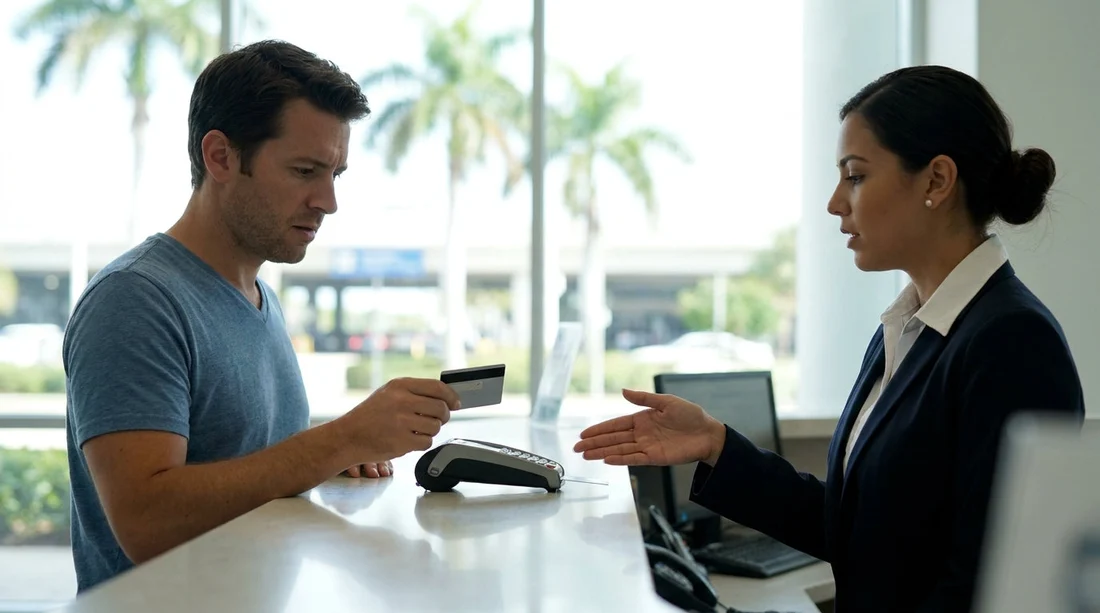
Arriving for car hire in Miami, you typically expect a quick handover, confirm your details, place a deposit pre-authorisation, and collect the keys. When the chip on your credit card fails at the counter, the process can slow down because the deposit pre-authorisation depends on reliable card verification. Most rental desks are set up to accept chip-and-PIN or chip-and-signature transactions, and many require a credit card in the main driver’s name for the security deposit.
A chip failure does not automatically mean you cannot rent, but it does mean the desk has to follow stricter payment and fraud-prevention steps. The outcome depends on the terminal’s behaviour, the issuing bank’s response, the rental brand’s policy, and whether the desk can obtain a valid authorisation for the deposit amount.
Why the chip matters for deposits at pick-up
For car hire, the card payment at pick-up is often not a purchase, it is a deposit pre-authorisation (sometimes called a hold). The terminal requests an authorisation for a set amount to cover potential charges such as fuel, toll admin fees, late returns, damages, or contract breaches. If the chip cannot be read, the terminal may not be able to confirm the card’s authenticity in the standard way, which increases the risk for the merchant and can trigger declines.
In Miami, this can be particularly time-sensitive because pick-up locations are busy and queues can build quickly. Even when the rental price has been paid in advance, the desk still usually needs a valid authorisation for the deposit. That is why a chip problem often becomes a pick-up problem, not merely a payment problem.
What usually happens at the counter when the chip fails
Most agents will follow a simple sequence to get a successful authorisation without changing the policy. First, they will ask you to reinsert the card and hold it steady until the terminal completes the read. If it still fails, they may try a different terminal or change the way the card is inserted. If the terminal supports it, the next attempt may be contactless tap-to-pay, which can sometimes complete an authorisation even when the chip is temperamental.
If neither chip nor contactless works, some terminals allow a magnetic stripe swipe as a fallback. However, for deposits and higher-risk transactions, swipe can be blocked by policy. In practice, swipe acceptance varies, and even when the swipe reads, the issuing bank may still decline because it expects chip verification.
Manual authorisation, what it is and why it can be limited
Manual authorisation is a method where the agent keys card details into the payment system or uses a voice authorisation process to request approval from the card network or bank. It is sometimes used when a terminal cannot read the chip, or when connectivity issues prevent normal processing. From a customer perspective it can feel like a straightforward workaround, but it is usually treated as higher risk.
Because manual entry can increase chargeback exposure, some rental brands restrict it, especially for deposits. Even if a manual authorisation is technically possible, the merchant may require additional verification such as matching photo ID, the physical card present, and a signature. The agent might also need a supervisor override, which can take time.
Credit-card-only requirements, and why debit often does not help
Many rental desks in Miami specify a credit card for the deposit, especially when the driver is using standard cover or intends to rely on an external excess policy. A debit card can behave differently at authorisation stage, and some issuers handle holds in ways that are unpredictable for rental merchants. Even when a debit card works for a purchase, it can fail or be declined for a deposit hold.
That is why, when your chip fails, switching to a debit card is not always a solution. If the desk policy is credit-card-only, the agent may not be able to accept debit for the deposit even if the terminal can read it. If you only have debit available, you may face additional requirements, higher deposit amounts, or the rental may be refused altogether, depending on the specific desk rules and vehicle category.
Practical steps to avoid delays with the deposit pre-authorisation
The best approach is to reduce the chance of a failed authorisation and to bring options. Before travelling, check that your credit card is active for international use and that your bank is not blocking US merchant categories. A simple card test purchase at home does not always predict a successful rental deposit authorisation, but it can highlight a damaged chip early.
Carry at least one backup credit card in the main driver’s name. If the primary card chip fails, a second card can save significant time at the counter. Also ensure your driving licence and any required ID match the driver name on the card, because manual authorisation and higher-risk fallbacks often involve extra identity checks.
Finally, keep an eye on available credit. A deposit hold reduces available credit, even though it is not a charge. If your card is near its limit, the authorisation can fail, and it may look like a chip problem when it is actually a credit availability issue.
Local context, busy Miami pick-ups and choosing the right location
In a high-traffic city, queues are common, and payment issues can add pressure. If you are collecting near central neighbourhoods, it can help to arrive with extra time so a card verification issue does not disrupt your schedule. You can also choose a pick-up point that suits your arrival plan and allows breathing room for any deposit checks. For example, travellers staying near Brickell may look at car hire airport Brickell, while others prefer a central option such as car rental downtown Miami.
If you are based west of the city or near business districts, car hire Doral can be convenient. For larger groups, a dedicated people-carrier option like van rental Miami may have different deposit levels, so ensuring your credit limit comfortably covers the hold matters even more.
FAQ
Will I definitely be refused car hire in Miami if my chip does not work? Not necessarily. The desk may retry the chip, use contactless, or accept another credit card. If no compliant deposit authorisation can be obtained, the rental can be refused.
What is a deposit pre-authorisation and why is it needed? It is a temporary hold on your card’s available credit to cover potential extra charges. It is standard at pick-up even if the rental price was paid in advance.
Can the counter just key in my card details if the chip fails? That is manual authorisation. Some desks allow it, others restrict it for deposits due to fraud and chargeback risk, and it may require extra ID checks.
Does using a debit card solve the problem if my credit card chip fails? Often no. Many Miami car hire desks require a credit card for the deposit, and debit cards can be declined for holds even when they work for purchases.
How can I prevent delays at pick-up? Bring a backup credit card in the driver’s name, ensure sufficient available credit for the hold, and confirm your bank allows US rental deposit authorisations before you travel.




























































































