


Quick Summary:
- Assume 25 mph on NYC streets unless a speed limit sign says otherwise.
- Look for lower limits near schools, parks, and dense residential blocks.
- Expect higher posted limits on parkways, bridges, and major arterials.
- Speed cameras target normal-looking corridors, especially downhill and wide lanes.
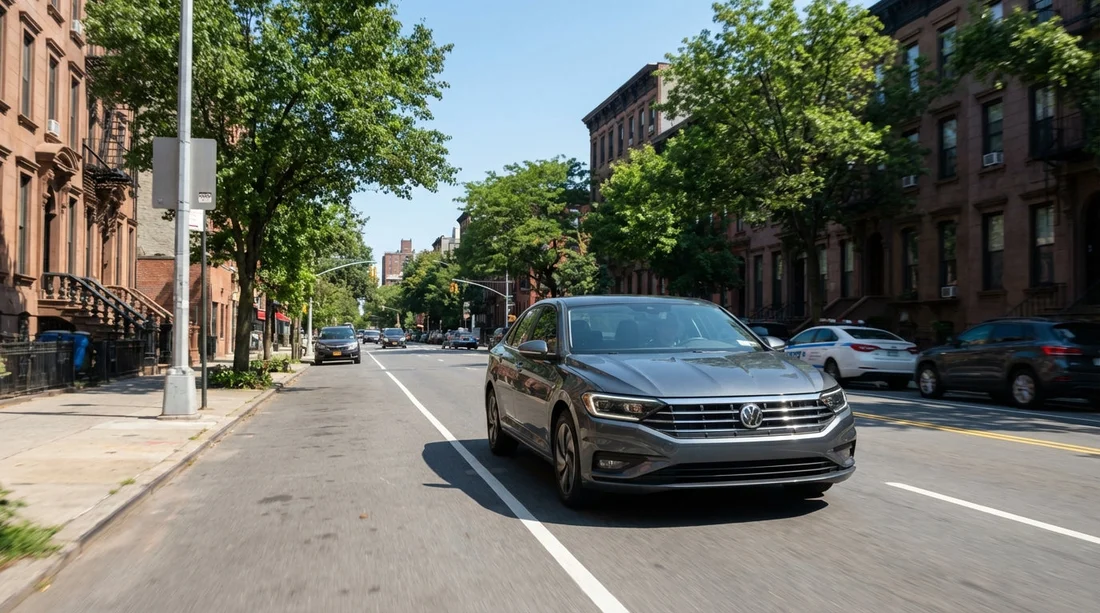
If you are arranging car hire in New York, one rule catches visitors out more than almost any other, NYC’s default speed limit is 25 mph. The tricky part is not the number. It is understanding where the default applies, where posted signs override it, and why speed enforcement can feel inconsistent from one block to the next. Many tickets come from streets that look like they should be 30 or 35 mph, but are still 25 mph unless clearly signed.
This guide breaks down the 25 mph default, the places you should expect signed limits to differ, and the common patterns behind speed camera “gotchas”. It is written for drivers who are comfortable on motorways but new to New York City streets, where lane widths, one-way grids, and sudden pedestrian activity can make speed judgement difficult.
What NYC’s 25 mph default speed limit actually means
NYC’s 25 mph limit is the citywide default for most local streets. In practice, that means if you are driving on a typical street in a neighbourhood and you do not see a speed limit sign, you should assume 25 mph. Visitors often expect every road to be signed. In New York, many ordinary streets have no signs at all, yet the default still applies.
Two important implications follow. First, a wide, straight street can still be 25 mph. Second, if you leave a signed corridor and turn onto a side street, your speed target usually drops back to 25 mph even if the previous road was signed higher. It is on these transitions, arterials to local streets, or bridge approaches to surface streets, where drivers accidentally carry speed into a camera zone.
Where the 25 mph default typically applies
For most visitors, the default applies in the places you will spend the most time, Manhattan cross streets and avenues (unless posted differently), Brooklyn and Queens neighbourhood grids, and the surface streets around hotels, restaurants, and tourist areas. If you are doing airport pickups and drop-offs, it also applies quickly after you leave the airport roadway system and start using surface streets.
If you are collecting a vehicle for car hire at JFK, note that airport roads and nearby connectors may be signed differently, but the moment you are on ordinary city streets, 25 mph becomes the safe assumption. If you want to plan your pickup and exit route in advance, these pages can be helpful: car rental at New York JFK Airport and New York JFK car rental options.
When signed limits override the default
You should treat posted speed limit signs as the authority for that road segment. Where confusion starts is that signed limits are more common on roads designed to move traffic, while residential grids often have no signs. The result is a patchwork: you might drive 35 mph on a major approach for a few minutes, then make a turn and immediately be back in 25 mph territory.
As a general pattern, look for signed limits in these categories:
Major arterials and wider corridors. Some broad streets and avenues are posted above 25 mph. They may feel like “city highways”, with multiple lanes, longer signal spacing, and fewer parked cars. Even then, do not assume a higher limit just because the road looks big. Confirm by signage.
Bridges and bridge approaches. Many bridge segments and approaches have posted limits, and the driving environment can encourage faster speeds, especially on downhill approaches or where lanes widen. After the bridge ends, speeds usually drop again as you re-enter street grids and encounter pedestrians.
Parkways and limited-access roads. New York has parkways that function like express routes. These are typically signed. They are also heavily enforced, and speed differentials can be large between free-flow traffic and the posted limit, which tempts visitors to follow the pack. Rely on signs, not traffic flow.
Work zones and temporary restrictions. Even if the “normal” sign is higher, work zones can introduce a lower limit. Temporary signs are easy to miss when you are also watching merging traffic and cones.
Parks, school zones, and why “quiet” streets still get tickets
Visitors are often surprised by how often enforcement appears near places that feel calm, parks, greenways, and school-adjacent streets. These areas can have heavy foot traffic at unpredictable points, people stepping off kerbs, cyclists overtaking, and delivery vehicles stopping without warning. A street bordering a large park can look like an open run, but it may be watched closely for speed compliance.
School speed enforcement is a special case because the risk profile is high. If you see school-related signs, flashing beacons, or clusters of schools, assume heightened enforcement and drive conservatively even if you think you have left the immediate block. Some camera locations are set on approaches, not just directly outside entrances.
How speed cameras catch visitors on normal-looking streets
Speed cameras tend to be placed where drivers naturally drift above the limit. You do not need to be driving aggressively to trigger one, you just need to be a little too fast in the wrong place. Common patterns include:
Wide lanes with long sight lines. Streets that look like they were built for higher speeds invite 30 to 35 mph cruising. If the limit is 25 mph, even a small “comfortable” overshoot can be enough to generate a ticket.
Downhill sections. Gravity does the work. If you maintain pedal pressure, you will often exceed your target without noticing, particularly in an unfamiliar car where the throttle feels lighter than expected.
End of bridge or express segment transitions. You leave a faster environment and re-enter a neighbourhood grid. Your eyes stay up for merging and pedestrians, and speed management becomes secondary, which is exactly when a camera can catch you.
Camera corridors near schools and parks. These are chosen because foot traffic is likely and compliance is a priority. The road can still appear “ordinary”, which is why visitors are caught out.
A practical habit is to check your speed at every light change and after every turn. NYC blocks are short. You rarely need to accelerate hard to keep pace. Smooth, low-speed driving is often faster overall because it reduces harsh braking and missed signals.
Bridges, tunnels, and airport routes, what to expect
If your trip includes crossings between boroughs or to New Jersey, expect rapid changes in road type. Approaches can look like motorways, then quickly become surface streets. Add toll signage, lane splits, and navigation prompts, and speed becomes easy to neglect.
If you are comparing pickup locations, travellers sometimes choose Newark for price, availability, or convenience for New Jersey driving. If that is your plan, these resources can help orient you: car hire at Newark EWR and Hertz car hire at Newark EWR.
Regardless of pickup point, treat the first 30 minutes as an acclimatisation window. You will be learning the car, reading lane markings, and adapting to local driving rhythm. Keeping your speed deliberately under the limit during this period reduces risk and stress.
Ticket traps: real-world situations to watch for
These are not “secret” traps, but they are situations where visiting drivers routinely misjudge speed:
Following NYC traffic flow. In light traffic, the fastest car sets a pace that others match. In NYC, that pace can easily drift above 25 mph on a broad street. The safest approach is to let faster drivers go and keep your own reference on the speedometer.
Right after a turn onto a wide avenue. You may turn from a narrow side street and immediately feel the road open up. The car feels stable, and your speed rises quickly. Check the speedometer within the first few seconds after turning.
Approaching a green light from a distance. The temptation is to “make the green” by gently increasing speed. On a 25 mph street, that small increase can be enough to cross an enforcement threshold, especially if the camera is placed before the junction.
Using adaptive cruise control. If your vehicle has driver assistance, avoid setting cruise in the city. It can hold a speed that is technically fine but inappropriate for pedestrians, cyclists, and sudden stops, and it can distract you from reading signs.
Practical driving habits that reduce speed-camera risk
Drive the block, not the boulevard. NYC is a sequence of short blocks and frequent stops. Aim for steady progress rather than bursts of speed. Even if you are late, accelerating between lights rarely saves time.
Reset your “default” after every major road. If you have been on a signed 35 or 40 mph segment, consciously reset to 25 mph when you turn off. Say it to yourself if needed, “back to 25”. It sounds simplistic, but it works.
Use navigation audio cues. Looking at the map can pull your eyes away from speed. Audio prompts let you keep your gaze up and your speed controlled, especially in unfamiliar borough grids.
Leave extra following distance. Tailgating encourages inconsistent speed and sudden braking. Extra space helps you maintain a calm, compliant pace.
What happens if you do get a speed-camera ticket in a hire car
Speed-camera enforcement is automated, and the notice is generally issued to the vehicle’s registered owner. With car hire, that usually means the rental company receives the notice, then passes it to the renter under the rental agreement terms. Processing can take time, so you might not hear about it until after your trip.
If you receive a notice, read it carefully for the location, timestamp, and recorded speed. Keep any supporting documents from your trip, including the rental agreement and driver details, as these are often relevant to how the ticket is assigned and paid. If multiple drivers used the car, decide in advance how you will handle any post-trip correspondence to avoid missed deadlines.
Choosing the right vehicle for city driving
In NYC, smaller cars are often easier to place in tight lanes and parking spaces, which indirectly helps with speed control because you are not wrestling the vehicle. If you are travelling as a family or with a lot of luggage, a minivan can still work well, just plan for wider turns and slower manoeuvres. If you are comparing people-carrier options, see minivan rental at New York JFK.
Whatever you choose, take a minute before you leave the lot to locate the speedometer readout, understand mph versus km/h displays, and learn how the car alerts you to speed limit changes if it has road-sign recognition. Do not assume the system is correct everywhere, but it can provide a useful prompt.
FAQ
Does NYC’s 25 mph default speed limit apply in all boroughs? Yes, it is the default across New York City unless a road segment is posted with a different limit. Signed limits on major roads, bridges, and parkways override the default where they apply.
If I do not see a speed limit sign, what should I drive? On most NYC streets without signs, assume 25 mph. Visitors are often ticketed because they expect a posted sign on every street, but many local streets are unsigned.
Are speed cameras only near schools? School areas are a common focus, but cameras can also appear on corridors near parks and on wide streets where drivers tend to drift above 25 mph. Treat any ordinary-looking wide street as a potential enforcement zone.
How much over the limit triggers a speed camera ticket? Thresholds and rules can change, so do not rely on a “buffer”. The safest approach is to keep your speed at or under the posted limit, especially on 25 mph streets.
Will a speed-camera ticket reach me after my New York car hire ends? It can. The notice usually goes to the vehicle owner first, then the rental company passes it on according to the rental agreement terms, so it may arrive after you return home.




























































































