


Quick Summary:
- Use terminal Departures kerb for quickest drop-off, no waiting permitted.
- For pick-ups, favour Arrivals outer lanes, keep wheels moving.
- Avoid idling, double-parking, or leaving the vehicle unattended, tickets are common.
- If kerb lanes block, divert to the JFK Cell Phone Lot.
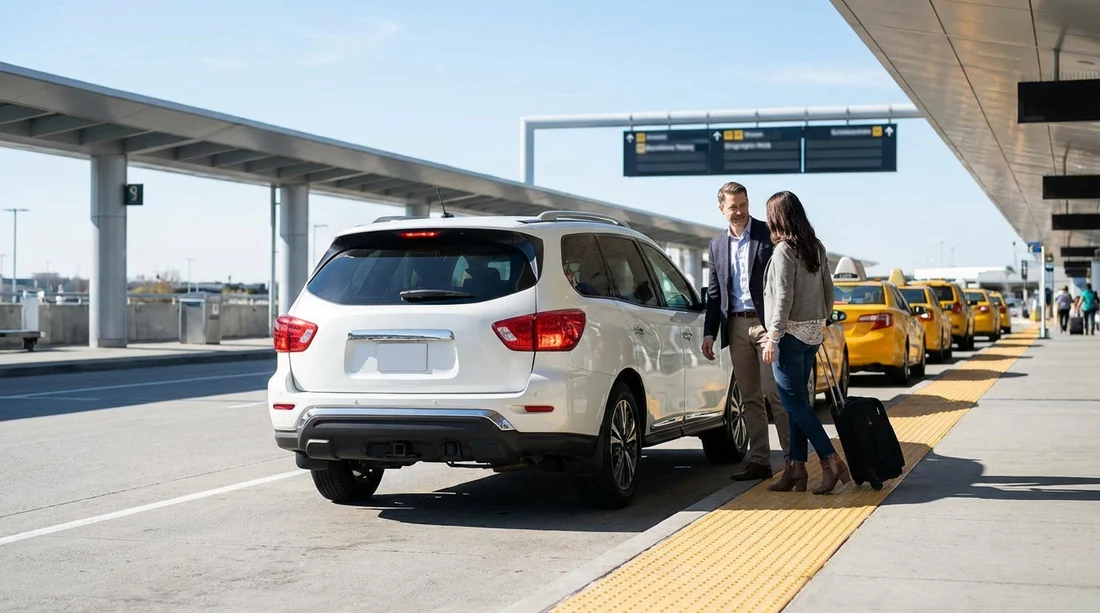
Picking up or dropping off at JFK can feel like a driving test under pressure. Traffic officers and Port Authority staff focus on keeping kerbside lanes flowing, so the practical rule is simple: stop only for active loading, and move on immediately once your passenger or bags are in or out. For New York car hire, that means planning the exact terminal kerb you will use, knowing what triggers citations, and having a fallback if the kerb is blocked.
If you are arranging car hire around JFK, these Hola Car Rentals pages can help you compare options and location details: JFK airport car rental and car hire at New York JFK. Even if your rental is off-airport and you are only doing a passenger pick-up, the kerb rules below still apply.
Before you enter JFK, set yourself up to stop legally
Choose Arrivals or Departures based on your goal. Departures is usually best for drop-offs because passengers can get out quickly with carry-on, but you cannot wait. Arrivals is usually better for pick-ups because people need time to reach the kerb, but you still cannot stage at the kerb.
Use a “call me when you see the kerb” rule. The biggest mistake is arriving before your passenger is curbside-ready. JFK kerb areas are not designed for waiting, and you may be waved on within seconds.
Know the universal kerbside do-not list. Do not double-park, do not stop in crosswalks, do not block bus lanes, do not stop in taxi-only areas, and do not stop where signage says “No standing” or “No stopping.” Officers interpret “standing” as waiting, even if you are in the vehicle.
Have the Cell Phone Lot as your default hold point. If the kerb is jammed, go there rather than looping endlessly. It is also the safest place to coordinate a pick-up without risking a ticket.
Terminal-by-terminal kerbside stopping plan
JFK terminals can change with construction, but the kerbside pattern is consistent: upper-level roadways are Departures, lower-level roadways are Arrivals, and each terminal has signed zones for private vehicles, buses, taxis, and commercial traffic. Treat the kerb like a conveyor belt: you can load or unload, but you cannot pause the belt.
Terminal 1
Drop-off: Aim for Departures. Stay in the general passenger-vehicle lane, signal early, and pull fully into an open space at the kerb. Keep hazards on only while actively unloading. If your passenger has multiple bags, pre-stage them in the boot so the kerb stop is under a minute.
Pick-up: Use Arrivals, but only enter the kerb road once your passenger confirms they are outside at the correct door. If the inner kerb lane is full, use an outer lane and merge in only when a space opens. Do not stop in an active lane, even “for ten seconds.”
High-risk spots: Taxi stands and bus bays near the doors. If your passenger drifts toward a taxi queue, do not stop there, have them walk a few doors down to a normal private-vehicle section.
Terminal 4
Drop-off: Departures is often busiest because Terminal 4 serves many long-haul carriers. Commit to the correct lane early, because last-second lane changes are what cause kerb blockages and officer interventions. Pull in, unload, and pull out.
Pick-up: Arrivals can be chaotic when multiple flights land together. A workable approach is to tell your passenger to wait until they are at the kerb with luggage in hand, then you enter the Arrivals roadway. If the kerb is gridlocked, do not join a stationary line. Exit and use the Cell Phone Lot to reset your timing.
Safer alternative: If you are repeatedly missing your passenger at the kerb, agree to meet at a specific numbered door area on Arrivals, but only once they are physically there. This reduces slow kerb searching, which often leads to illegal stopping.
Terminal 5
Drop-off: Departures stops can be quick if your passenger is checked in on their phone. Stay alert for signs reserving kerb for authorised vehicles, and keep your stop brief.
Pick-up: Arrivals works best if you minimise kerb time. If your passenger is delayed at baggage claim, wait off-airport, not at the terminal roadway. One clean kerb pass is safer than three frustrated loops.
Common failure: Drivers stop short of the kerb because a car is half-in, half-out. Do not join them. Keep moving and circle back or divert to the Cell Phone Lot.
Terminal 7 and Terminal 8
Drop-off: Both terminals see heavy peak periods. Use Departures, and do not attempt to “save” a space by stopping in the lane with your indicator on. Officers treat that as stopping in a travel lane.
Pick-up: For Arrivals, plan a single pass timed to your passenger being ready. If your passenger is travelling with children or oversized luggage, agree they will stand directly at the kerb edge only when you are two to three minutes out, not earlier, because kerb staff may push them back from the roadway if they linger.
Good habit: Ask for a clear description of the door area, such as “Arrivals, centre doors near the next pillar,” rather than “I’m outside.” Better precision reduces slow crawling, which sometimes tempts drivers into prohibited stopping.
What gets drivers ticketed at JFK, the common citation triggers
Idling at the kerb. If you are stopped without active loading, you are effectively waiting. Even with the engine on and a driver in the seat, that can be treated as standing. Keep the stop strictly transactional.
Unattended vehicle. Leaving the car, even for a minute, is a common and expensive mistake. If your passenger is not at the kerb, drive on. Do not park at the kerb and go inside.
Double-parking or stopping in a travel lane. When the kerb line is full, some drivers stop in the lane beside it. This blocks emergency access and buses, and it is one of the quickest ways to be waved on or cited.
Stopping in taxi, bus, or commercial zones. The signage is frequent but easy to miss when you are scanning for a passenger. If the paint markings or signs indicate taxis or buses, keep moving.
Crosswalk and fire lane violations. These are low-tolerance areas. A “quick stop” to load bags at a crosswalk is still a stop.
Blocking kerb ramps or accessibility areas. These spots may look like open kerb space, but they are not for general loading. If you stop there, you can draw immediate attention from staff.
Safer alternatives when kerb lanes are blocked
Use the JFK Cell Phone Lot. Treat it as your staging base. Wait there until your passenger texts that they are outside and ready. This reduces loops, reduces stress, and keeps you away from enforcement hotspots. When you leave the lot, you can time your approach to arrive as they step to the kerb.
Do a clean loop rather than stopping. If you miss your passenger, continue and loop back. It feels inefficient, but it is safer than stopping illegally. A loop costs minutes, a citation costs money and time.
Meet at the right level. If Arrivals is gridlocked, sometimes Departures is clearer, or vice versa. If your passenger can move between levels inside the terminal, agree a switch before you enter the terminal road, not while you are already stuck at the kerb.
Consider the official rental car shuttle area for rentals. Many car hire pick-ups use shuttle buses to off-airport facilities. If you are collecting a car hire vehicle, follow your supplier’s instructions and use the designated shuttle or pick-up point rather than attempting kerbside collection where it is not permitted.
If you are also comparing nearby airport options for car hire, these Hola Car Rentals pages can be useful for planning: car hire at Newark EWR and Avis at Newark. Newark can sometimes be simpler for kerbside logistics depending on your route in and out of New York.
Timing and lane tactics that keep you legal
Approach in the correct lane early. Last-second merges cause sudden braking, which causes the “I will just stop here” temptation. Pick your lane calmly and commit.
Keep your passenger moving too. Tell them: stand at the kerb, bags zipped, phone in hand, and enter the car immediately when you pull in. If they are still reorganising luggage at the kerb, you will be told to move.
Use the kerb only for loading, not for conversations. Hellos, goodbyes, and route discussions belong after you have left the terminal loop, not at the kerb.
If you need to sort a child seat, do it away from the kerb. Fitting a seat takes time and looks like waiting. If you must do it, pull away to a permitted parking area rather than holding the kerb.
How this affects car hire returns at JFK
Car hire returns are usually not made at the terminal kerb. Most providers use dedicated return facilities, commonly off-airport, connected by shuttle. The key takeaway is that terminal kerb rules are for passenger loading and unloading, not for completing a rental return process.
If you are planning your overall car hire timing at JFK, allow extra time for the shuttle back to your terminal, and do not assume you can be dropped at the terminal and then drive to a return facility without checking directions. For specific location notes, you can reference Payless at New York JFK if that matches your provider.
FAQ
Can I wait at the kerb if I stay in the driver’s seat? Usually no. Kerbside rules are enforced as “active loading only,” and waiting, even in the vehicle, can be treated as standing or obstructing traffic.
Is Arrivals or Departures better for a quick stop? Departures is typically easier for fast drop-offs. For pick-ups, Arrivals is more appropriate, but only when your passenger is already outside.
What if my passenger is not at the kerb when I arrive? Do not stop. Complete a loop or use the Cell Phone Lot, then return when they confirm they are curbside-ready.
Can I pull over in a bus or taxi lane for a moment? No. Those lanes are reserved and monitored, and stopping there commonly results in being moved on or cited.
How do I avoid kerbside stress when collecting a car hire vehicle? Follow your provider’s pick-up instructions and use the designated shuttle or facility. Terminal kerb areas are for passenger loading, not rental paperwork or waiting.




























































































