


Quick Summary:
- Ask for make, model, year, and rear-seat LATCH positions.
- At pick-up, check seat bights for labels and metal bars.
- Confirm top tether anchors, then match them to your seat.
- Test-fit briefly to ensure tight installation and easy belt access.
Sorting child-seat fit during car hire in California is easier when you know the terms and where to look. In the US, you will usually hear “LATCH” rather than ISOFIX. They are closely related, but not always identical in how top tethers and weight limits are handled. The aim before pick-up is simple, confirm the car has lower anchors in the positions you need and, for forward-facing seats, confirm there is a usable top tether anchor.
Because rental fleets change, you often cannot guarantee an exact model in advance. Still, you can reduce uncertainty by requesting the key details that determine compatibility, then doing a quick physical check at the desk and on the car park. If you are collecting at a major hub, you can also plan extra time for inspection, for example at Los Angeles LAX airport car hire where family travellers may want to verify anchors before leaving the lot.
ISOFIX vs LATCH, what the terms mean at US pick-up
ISOFIX is the international name for the standardised attachment points built into a vehicle’s rear seat. In the United States, the system is referred to as LATCH, which stands for Lower Anchors and Tethers for Children. The “lower anchors” are a pair of metal bars located where the seat back meets the seat cushion, the seat bight. The “tether” is a strap on most forward-facing child seats that connects to a dedicated anchor point in the vehicle.
When you ask a California rental counter about ISOFIX, some staff may be unfamiliar with the term. Using “LATCH” and “top tether anchor” is more reliable. If you are bringing a UK or EU seat that can use ISOFIX, the lower attachment points usually line up, but you still need to confirm the seating position and top tether arrangement, plus any manufacturer limits for your particular child seat.
What to confirm before you arrive at the rental counter
Before travel, list what you need from the vehicle, then translate that into questions that a rental agent can answer quickly. The most useful details are the vehicle make, model, and year, plus the exact seating position where you will install the child seat. Not every rear seat position has lower anchors. Many vehicles have LATCH in the two outboard rear seats only, with the centre seat using a seat belt installation instead.
Ask these specific questions when confirming your car hire in California:
1) Which vehicle model is being assigned today? If they cannot guarantee a model, ask for the class and likely models. This gives you a shortlist to verify.
2) Does it have LATCH lower anchors in the rear outboard seats? If you need the centre, ask that specifically.
3) Where are the top tether anchors located? Common locations include the rear shelf in sedans, the back of the rear seat, the floor behind the seat, or the back of the seat in front for some layouts.
4) Can you view the vehicle before paperwork is final? Many locations allow a quick look, especially if you explain you are checking child-seat anchors.
If you are collecting from other California gateways, similar planning helps, such as at Santa Ana SNA car hire where families often drive to beach areas and want a smooth exit from the airport.
How to physically check for LATCH lower anchors at pick-up
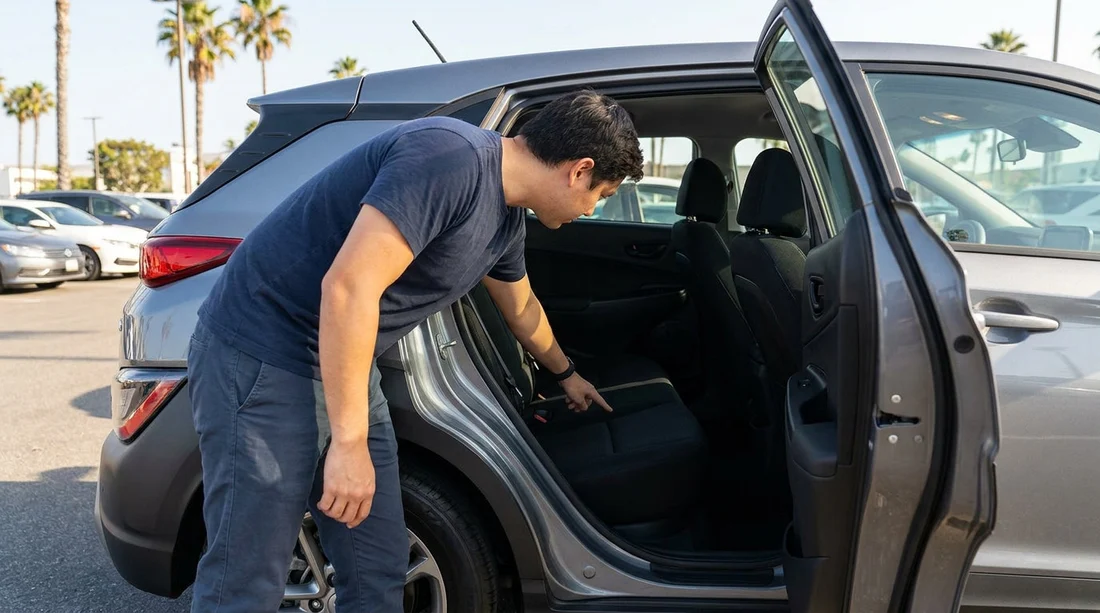
Once you are with the vehicle, start in the second row. Move the front seats forward to create space, then look at the junction between the rear seat cushion and seat back, the seat bight. Many cars have small fabric or plastic tags that say “LATCH” or show a child-seat symbol. These tags indicate the approximate location of the metal bars.
Use your fingers to feel for two solid metal bars spaced roughly the width of the child seat’s connectors. They are usually fixed and do not move. If you only feel flexible wires, plastic trim, or seat springs, keep searching along the bight or check the labels again. In some vehicles, the anchors sit slightly deeper, and you need to press into the seat crease to reach them.
Confirm you have a matched pair. One bar on each side is required. If you find one bar but cannot locate the other, you may be between seating positions or looking at a centre seat without lower anchors.
How to check for top tether anchors, the crucial step for forward-facing seats
If your child uses a forward-facing seat with a harness, the top tether is a major safety element and is part of the LATCH system. Identify where the tether anchor is and whether it is accessible. Look for an anchor symbol, a small metal loop, or a bolt with a marked bracket depending on the vehicle.
Check that the tether point corresponds to the seating position you plan to use. Some cars have tether anchors for all rear positions, others only for certain seats. If you are considering a larger vehicle for extra seats and luggage, it can be helpful to compare options like van rental at Los Angeles LAX, where the number of tether points may differ by model.
Bring the right info, what to ask for in the vehicle handbook
Even if you can physically find anchors, the vehicle handbook can answer two practical questions: which positions are approved for lower anchors, and any stated child weight limits for using lower anchors instead of the seat belt. In the US, many child seat manufacturers specify switching to seat belt installation after a certain child weight, even if the anchors are present.
In a rental car, the handbook may be in the glovebox or provided digitally in the infotainment system. Look for sections labelled “Child Restraints”, “LATCH”, or “Top Tether”. If you cannot find the handbook quickly, prioritise the physical anchor check and install method you know is correct for your seat.
Do a fast test-fit before leaving the lot
A visual check is not enough. Allocate a few minutes to place the child seat on the intended rear seat and confirm you can achieve a secure install. For rear-facing and forward-facing seats, the practical benchmark is minimal movement at the belt path when you tug firmly side-to-side and front-to-back. If the seat slides easily, reassess your routing, tension, and whether you are using the correct anchors for that position.
If the assigned vehicle changes, repeat the anchor check. This is especially common at busy airport counters. Allow time if collecting at a hub such as San Jose SJC car hire, where inventory can turn over quickly at peak times.
FAQ
Is ISOFIX the same as LATCH in California rental cars? LATCH is the US term you will hear in California. The lower anchors are broadly compatible with ISOFIX-style connectors, but you still must confirm seating positions and top tether availability for your child seat.
Where exactly are LATCH lower anchors located in most cars? They are usually in the rear seat bight, where the seat cushion meets the seat back, often marked by small “LATCH” tags. Feel for two fixed metal bars, one on each side of the seating position.
Do I always need a top tether anchor? You generally need a top tether for forward-facing harnessed seats, because it reduces forward movement in a crash. Rear-facing seats typically do not use the vehicle’s tether anchor, unless your seat’s manufacturer specifies an alternative method.
What if my rental car does not have LATCH in the centre rear seat? Use the seat belt installation method if your child seat allows it. Many vehicles only provide lower anchors for the outboard seats, and a properly tightened seat belt install can still be secure.
Can I check anchors before I accept the car? Often yes. Ask to see the specific vehicle on the lot and inspect the rear seats and tether points before you finalise the handover, especially if you are travelling with multiple child seats.




























































































