


Quick Summary:
- Some California EV chargers place temporary pre-authorisation holds on your card.
- Keep extra available credit beyond your car hire deposit hold.
- Use one card for the rental deposit and one for charging.
- Check network rules, as holds can exceed the session cost.
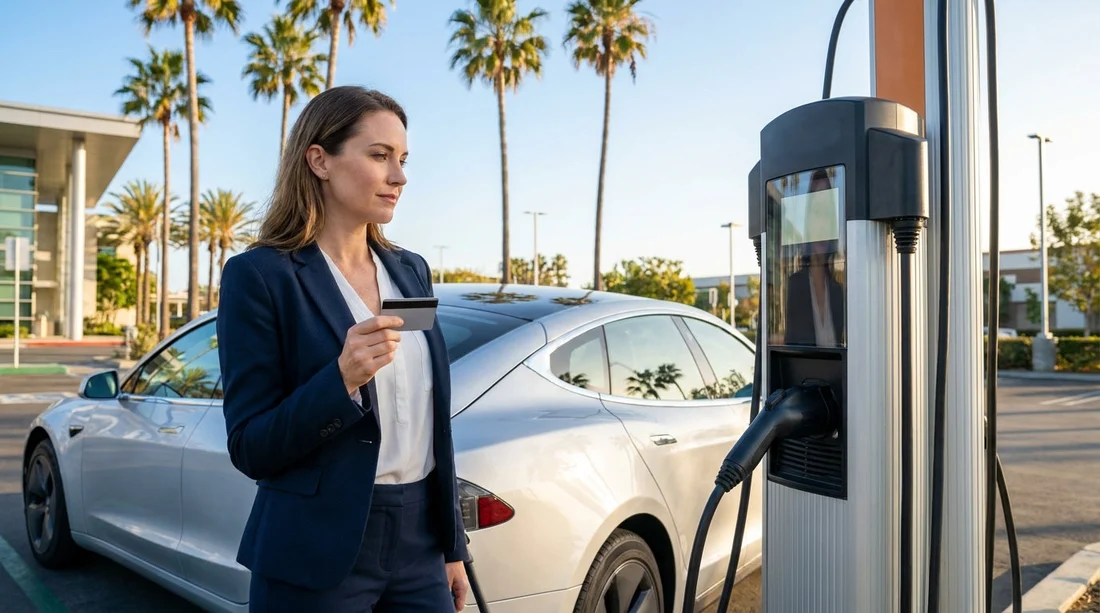
Yes, many EV chargers in California can place a temporary credit-card pre-authorisation, and it is worth budgeting for it before car hire. The key detail is that the hold is not the final cost of charging. It is a temporary amount set aside by your card issuer to confirm funds are available, then replaced by the actual session cost later. Depending on the network, location, and payment method, that hold can be noticeably higher than a typical top-up, and it can overlap with your rental deposit hold.
When you hire a car, especially when paying by credit card, your rental company may also place a deposit hold for security. If your available credit is tight, two overlapping holds can make your card look maxed out even though your real spending is modest. Planning for both types of holds is one of the easiest ways to reduce stress, avoid declined transactions at chargers, and keep flexibility for tolls, parking, and incidental travel costs.
What an EV charging “hold” really is
A pre-authorisation is a temporary reservation of funds. You will often see it as “pending” on your statement. The charger is effectively asking your bank, “Is this card valid and is there enough available credit?” The bank earmarks the amount, reducing your available credit until the transaction settles or the hold drops off.
The final charge that posts can be lower than the hold. For example, a network might place a higher temporary amount to cover a long session or potential idle fees, then later bill only what you used. This behaviour is common in other travel categories too, such as petrol stations and hotels, so it helps to treat it as normal rather than as an extra fee.
Why holds can feel bigger in California
California has dense EV infrastructure, with a mix of fast chargers on major corridors and slower destination chargers in cities. Fast charging is often priced per kWh, sometimes with time-based or idle-fee components. Because the total cost of a session can vary, some charging networks prefer to ring-fence a larger amount upfront, particularly for ad-hoc tap-to-pay sessions.
Also, the combination of travel patterns and urban pricing can produce multiple small transactions in a day, such as a short top-up near a hotel, another near a theme park, and a fast charge before a long drive. If each one triggers a separate hold, your available credit can shrink quickly until settlement catches up.
How EV charging holds interact with a car hire deposit
With car hire, a deposit hold is typically placed when you pick up the vehicle and removed after return, subject to the rental agreement and inspection. That hold reduces available credit, just like a charging hold. The problem is timing. If you pick up a car and start charging the same day, your card can be carrying multiple pending amounts at once.
If you are flying in, it is particularly easy to run into this. You collect your car near the airport, drive to your accommodation, then charge overnight. If your rental deposit is still pending and your charger also places a pre-authorisation, your remaining available credit can be lower than you expect.
If you are arranging car hire around major airports, it helps to understand your likely charging pattern from the start. For San Francisco arrivals, see car rental at San Francisco Airport (SFO). For Southern California itineraries, car rental at Los Angeles Airport (LAX) can suit trips where you might fast-charge before tackling longer drives.
How long do charging holds last?
There is no single standard. Some holds clear quickly once the session ends and the network submits the final amount. Others can linger as pending for a few days, depending on how the merchant submits transactions and how your bank processes them. Weekends and bank holidays can slow settlement. Importantly, your bank controls when the pending hold is released if the merchant does not finalise it promptly.
In practical terms, plan for the possibility that a charging hold can remain in place for several days, especially if you are using ad-hoc tap-to-pay rather than an app account that invoices more predictably.
Which payment methods tend to trigger holds?
Tap-to-pay with a credit card is convenient, but it can be more likely to produce a larger pre-authorisation because the network knows less about you as a customer. Using a charging network account, where you add a card in the app, can sometimes lead to smaller authorisations or more predictable billing. The trade-off is setup time and remembering logins.
Some drivers also use a separate card or a dedicated wallet for travel incidentals. This can be useful if you want your primary credit line reserved for the rental deposit and accommodation. If your trip starts in Silicon Valley, planning ahead is straightforward when you know your pickup point, such as car rental in San Jose (SJC).
A simple budgeting method before you travel
To avoid surprises, treat available credit as a travel resource. Before you fly, check the credit limit and current balance on the card you will use. Then allocate headroom for the rental deposit hold, EV charging holds, and day-to-day spending.
A practical approach is to keep a buffer that is comfortably above what you think you will spend. Charging is usually not the biggest line item, but the holds can be. If you expect to fast-charge frequently, or if multiple drivers will tap the card at different chargers, increase the buffer so your card is not squeezed by pending transactions.
If you plan to drive longer distances across the state, you may also want to consider vehicle type and comfort. Larger vehicles can be relevant for passenger load and luggage, and your charging pattern may change too. For travellers arriving in the capital region, SUV hire in Sacramento (SMF) can align with itineraries that mix city driving with day trips.
Ways to reduce the chance of declined charging payments
Use two cards where possible. Put the car hire deposit on one credit card, and use another for charging and day-to-day expenses. Even if both cards are from the same bank, separate available credit limits can prevent one stream of holds blocking the other.
Prefer in-app activation for regular networks. If you know you will rely on a particular network, setting up the app can make billing more consistent than ad-hoc tap-to-pay, depending on the operator.
Avoid repeated tiny top-ups. If your route allows, fewer, longer sessions can reduce the number of separate authorisations that appear as pending.
Keep receipts and session IDs. If a hold looks unusually high or does not clear, having the session reference helps support teams trace the transaction.
Check your available credit, not just your balance. Pending holds reduce available credit. What matters at the charger is whether your card has enough headroom at that moment.
How this affects planning with Hola Car Rentals
The main planning takeaway is that EV charging holds are separate from your rental deposit hold, but both draw from the same available credit if they are on the same card. If your rental requires a credit-card-only deposit hold, you should leave extra headroom for charging, parking, and any other travel authorisations that may appear during your trip.
If you want fewer moving parts, keep one card dedicated to the rental deposit and a second card for charging. If you only have one credit card, consider reducing other pre-authorisation heavy spending during the first couple of days, until you see how quickly your bank releases charging holds.
If your plans include San Diego pickup, National car hire in San Diego (SAN) is a useful reference point for organising your timeline.
FAQ
Do all EV chargers in California place a credit-card hold? No. Many do, especially for tap-to-pay sessions, but policies vary by network, site host, and payment method.
Is the pre-authorisation hold an extra fee on top of charging? Usually not. It is a temporary amount reserved by your bank, then replaced by the final session total once processed.
How much available credit should I keep aside for EV charging holds? Enough to cover your expected charging plus a buffer for larger temporary authorisations, particularly if you will use multiple fast chargers.
Can I avoid holds by paying with a debit card? Debit cards can also have authorisations, and holds may affect available bank funds. Using a charging app account can sometimes reduce unpredictability.
What should I do if a charging hold has not cleared after several days? First confirm whether the final charge posted. If the hold remains pending, contact your card issuer and provide the session details if requested.




























































































