


Quick Summary:
- ‘Or similar’ refers to a class, not a specific model.
- Book a class labelled automatic, and verify it on your voucher.
- Pick-up allocation depends on live fleet, timing, and returns.
- Arrive early and confirm transmission at the counter before signing.
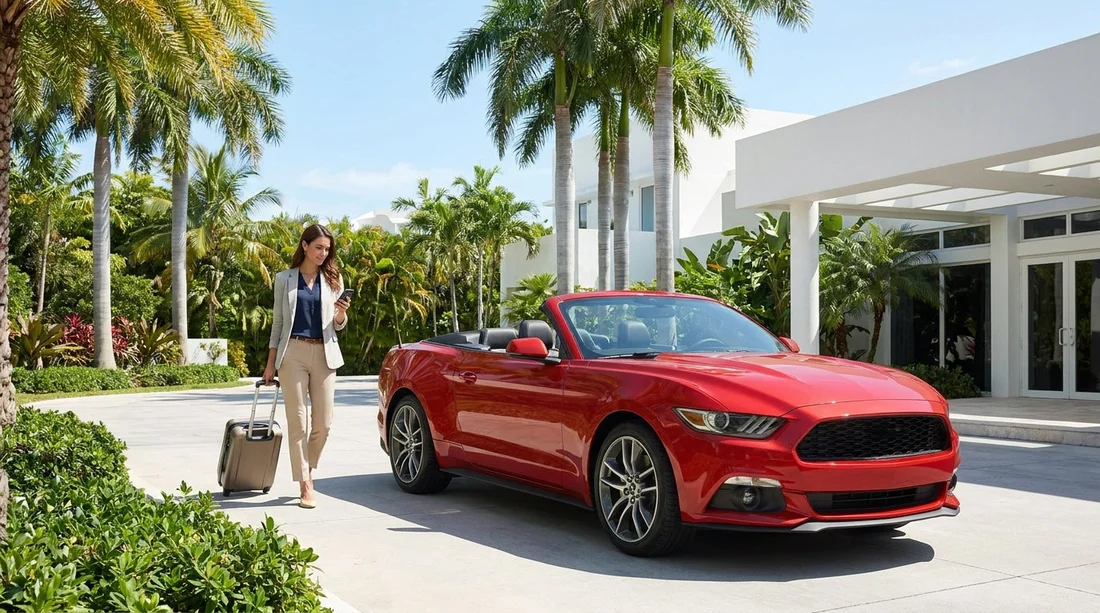
When browsing car hire in Miami, you will often see a picture of a specific vehicle followed by the words ‘or similar’. It is a common source of confusion, especially for travellers who need an automatic transmission and worry they might be given a manual. The key point is that rentals are usually sold by vehicle class rather than by a specific make, model, trim, or colour. That is what ‘or similar’ is signalling.
This article explains how vehicle classes work, what ‘or similar’ means in practice, and the most reliable ways to request an automatic without expecting a particular model. The goal is clarity, not overpromising. Even in a market where automatics are very common, the only thing you can sensibly aim to secure is the right category with the right transmission type.
What ‘or similar’ really means in Miami car hire
‘Or similar’ means the supplier intends to provide a car from the same general category as the one shown, with broadly comparable size, seating, doors, luggage space, and features. The image is an illustration, not a promise. You are buying the category description, for example “Economy automatic” or “Intermediate SUV”, not “a particular Toyota” or “a particular Nissan”.
In Miami, this matters because airport and city fleets turn over quickly. Cars are returned late, cleaned on different schedules, moved between branches, or held back for maintenance. Because of that, staff typically allocate vehicles from what is physically available at the time you arrive, as long as it matches the class you reserved, or a close equivalent. That is why listings lean on ‘or similar’ language.
How vehicle classes work, and why two ‘similar’ cars can feel different
Vehicle classes are groupings used across the industry, but they are not always identical between brands. Two suppliers can label categories slightly differently, and even within one supplier, the cars inside a class can vary. This is why you can receive a vehicle that is still within the class but feels larger, smaller, newer, or differently equipped than the one you pictured.
Classes often consider:
Size and space: economy, compact, intermediate, full-size.
Body style: saloon, hatchback, SUV, people carrier.
Doors and seats: two-door vs four-door, five seats vs seven.
Luggage capacity: how many medium suitcases fit with seats up.
Transmission type: automatic vs manual.
In the US, automatics dominate, but you should still treat transmission as a specific attribute to confirm. If your confirmation says “automatic” (or “AT”), that is what you are aiming to receive, regardless of the illustrated model. If your confirmation does not specify transmission, do not assume.
If you are comparing options, it can help to start from the right Miami landing page and then narrow by category and transmission. For example, car hire in Miami listings typically show the class name and the key icons that matter, including transmission.
Can an automatic be guaranteed when ‘or similar’ appears?
You generally cannot guarantee a specific model when ‘or similar’ is shown. What you can do is reserve a class that is explicitly described as automatic, and keep evidence of that on your voucher or confirmation. In practice, that is the closest thing to a guarantee the industry can offer, because allocation happens at pick-up and depends on the live fleet.
Most Miami suppliers stock overwhelmingly automatic fleets, but edge cases still happen. An automatic may be temporarily unavailable in a particular class due to peak arrival waves, late returns, cleaning or maintenance holds, imbalanced one-way flows, or substitutions staff use to manage shortages.
The practical approach is to treat “automatic” as a required spec, and “model shown” as illustrative only. If you need an automatic for accessibility, confidence, or licence limitations, you should select only categories that state automatic clearly, and you should double-check that wording on the final confirmation.
How to request an automatic without expecting a specific model
When arranging car hire in Miami, you can reduce surprises by focusing on verifiable details.
1) Filter by transmission, then read the class label
Look for an explicit transmission indicator, such as “Automatic”, “AT”, or an automatic icon. Avoid leaving it to assumption. If you are using Miami car rental search results, the class line is where transmission is typically stated.
2) Check the voucher wording, not the thumbnail photo
The photo can stay the same while the class label changes. Your voucher is what matters at the counter. If it states “automatic”, keep a copy accessible offline.
3) Use notes as a request, not a guarantee
You can ask for preferences like “automatic only” or “no electric” as a note. A note helps staff understand your needs, but it does not override fleet reality. Think of it as guidance, not a promise.
4) Choose a class with more automatic depth
Some categories have deeper availability than others. In Miami, standard saloons and mainstream SUVs often have larger fleets. If space suits your trip, booking an SUV category can sometimes reduce the chance of shortage within a single narrow class. See SUV rental in Miami for examples of broader SUV groupings.
5) Arrive earlier in your pick-up window
Arriving earlier gives staff more options before the day’s inventory becomes constrained. If your flight lands late, consider whether a later pick-up time increases risk during busy periods.
6) Ask the counter to confirm transmission before you sign
Before accepting the keys, confirm the transmission type and ensure the paperwork reflects it. This avoids misunderstandings when a class name is unfamiliar.
What to do if the car offered is not automatic
If you reserved an automatic class and are offered a manual, treat it as a mismatch and raise it immediately. Calmly ask staff to check their inventory again, including other classes that are still automatic. If there is no automatic available at that moment, the location may propose a wait, an alternative branch, or a different category.
If your plans include collecting outside Miami, inventory can differ. For example, Fort Lauderdale Airport has its own fleet and demand patterns, which can affect what is available on the day. If your itinerary changes, it helps to compare options such as car rental at Fort Lauderdale Airport (FLL) and select the class and transmission carefully.
Why suppliers avoid guaranteeing specific models
Even if a supplier lists several example vehicles, guaranteeing one exact model would be difficult because a car can be extended, returned damaged, returned to a different branch, substituted as fleets change, or temporarily removed for cleaning, servicing, or recalls.
That is why the industry standard is class-based renting with “or similar” language. It protects customers from being denied a car because the pictured model is missing, and it protects the operator from promising what it cannot control. Your best protection is to make sure your reserved class matches your real requirements, especially transmission.
FAQ
Is ‘or similar’ the same as being upgraded or downgraded?
Not exactly. ‘Or similar’ means any vehicle within the reserved class. An upgrade or downgrade is a move outside that class, usually due to availability or an operational decision at pick-up.
If I book an automatic class, can I still be given a manual?
It should be avoided, but it can happen if inventory is constrained. The practical safeguard is ensuring your confirmation states automatic, then confirming transmission at the counter before accepting the vehicle.
Does choosing a bigger category make getting an automatic more likely?
Sometimes. Categories with deeper fleet numbers can be easier to allocate. The important point is that the category must still be labelled automatic on the booking details.
Will I get the exact car shown in the picture?
Usually not. The image is a representative example. You will receive a vehicle that matches the class description and key specifications, such as automatic transmission where stated.
What is the single best step to avoid confusion about automatic transmission?
Read the class line on your voucher or confirmation and ensure it explicitly says automatic. If it does not, ask for clarification before travel.




























































































