


Quick Summary:
- Expect guidance from staff, but you will usually fit the seat.
- Allow extra time at pick-up to test fit and tighten properly.
- Inspect labels, expiry date, parts, and damage before accepting any seat.
- Finish with safety checks on belt path, buckle, recline, and movement.
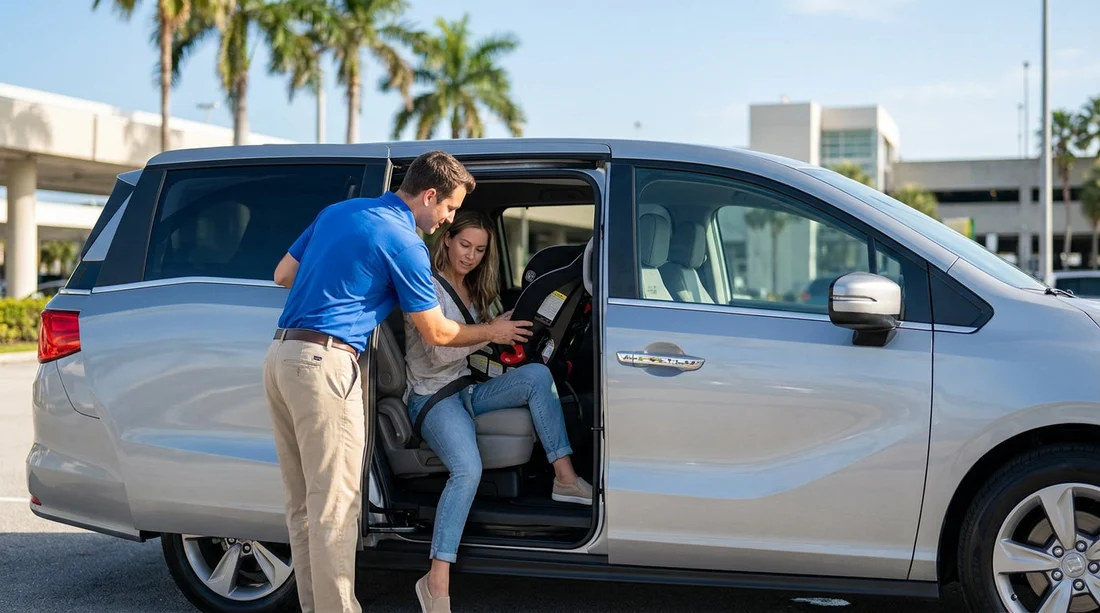
When you collect a car hire in Florida with a child seat added, it is sensible to expect some assistance, but not a full, hands-on installation service every time. Policies vary by rental brand, location, and even the individual desk agent or lot attendant on duty. Some teams will talk you through the basics, show you where to route the belt, or point out the top tether anchor location. Others may be restricted to providing the seat and a manual, leaving you to do the fitting and checks yourself.
The key is to plan for self-sufficiency. If you arrive assuming staff will install the seat for you, you can end up rushed, under pressure in the pick-up area, and tempted to drive away with a loose or misrouted installation. Instead, build a short “collection routine” so you can confirm the seat is appropriate, complete, and correctly fitted before your first mile.
If you are collecting at a busy airport, you may appreciate having your collection point clear in advance. For example, if you are flying into Orlando, details for car hire at Orlando Airport (MCO) can help you anticipate how much time to allow between landing and driving away. The same applies if your arrival is in South Florida, such as car rental at Miami Airport (MIA), where queues and shuttle transfers can affect your window for a calm fitting.
What help can you realistically expect at pick-up?
In Florida, rental staff may be willing to help in a limited way, but their role is usually not the same as a trained child passenger safety technician. Common types of support you might see include:
General guidance: pointing to the correct seating position, discussing whether LATCH or seat belt installation is possible in that vehicle, and reminding you about the top tether for forward-facing seats.
Seat handover checks: confirming you have the right seat type you requested, and providing any included straps, inserts, or manuals.
Practical tips: showing where the tether anchors are, how to adjust the recline, or where the locking mechanism is for the seat belt.
What is less reliable is a member of staff physically installing the seat, tightening it, and signing off that it is safe. Some locations avoid hands-on fitting due to liability concerns, time pressure, or staffing levels. So the most accurate expectation is: you may get helpful pointers, but you should be prepared to do the installation and final checks yourself.
Build time into your Florida car hire collection
Child seat fitting takes longer than most people expect, especially when you are tired after a flight or have children eager to move. Give yourself at least 15 to 25 minutes at the vehicle for seat inspection and installation. If you are picking up from an airport, factor in the extra steps of counter paperwork and walking to the car, or taking a shuttle to an off-airport lot.
For city collections, you may have a more controlled environment, which can make fitting easier. If you are staying centrally, it may be useful to compare a downtown location such as car rental in Downtown Miami versus an airport pick-up, depending on your itinerary and how quickly you want to leave with children safely strapped in.
Whatever the location, aim to do the fitting in good light, away from traffic, with doors fully open. Do not let a queue behind you make you rush.
What to inspect on the child seat before accepting it
Before you fit anything, inspect the seat itself. A quick visual and label check can catch issues that are awkward to solve once you have already installed it.
1) Correct seat type for your child
Confirm whether the seat is rear-facing, forward-facing, or a booster, and whether it matches your child’s height and weight. If you have a toddler who should still ride rear-facing, ensure you are not handed a forward-facing only model. If you have an older child, confirm whether you are getting a high-back booster or backless booster, and whether your child can sit correctly with the vehicle’s shoulder belt.
2) Expiry and compliance labels
Look for the manufacturing date and expiry information on the shell or label. In the US, child restraints have expiry guidelines, and you want a seat that is within date and has readable labels. If the labels are missing or illegible, ask for another seat.
3) Condition and completeness
Check for cracks in the plastic shell, frayed harness webbing, missing chest clip, sticky buckles, and damaged adjusters. Make sure any required inserts, padding, or belt guides are present. If the seat uses a top tether, confirm the tether strap and hook are present.
4) Cleanliness and odour
Rental seats see heavy use. If the cover is heavily soiled or smells strongly, it can be unpleasant for children, and excessive grime can hide damage. It is reasonable to request a different unit if the condition is poor.
Fitting basics: what you should do at the car
Even if a staff member gives guidance, the last check is yours. Use this simple sequence so you do not miss something important.
Get the belt path right
Thread the seat belt or LATCH strap through the correct belt path for rear-facing or forward-facing mode. Misrouting is a common error when you are rushed. Take a moment to check the labels on the seat that show the routing.
Use the top tether when forward-facing
For forward-facing seats, attach and tighten the top tether to the designated anchor point. This helps reduce head movement in a crash. Ask staff to point out the anchor location if you cannot find it quickly.
Perform the “inch test”
When installed, grasp the seat at the belt path and try to move it side-to-side and front-to-back. It should not move more than about one inch. Do not test movement at the top of the seat, where motion is normal.
Harness and booster checks before you leave the lot
Installing the seat is only half the job. Do a quick child fit check before you drive away.
Rear-facing harness fit: straps at or below shoulders, harness snug with no slack, chest clip at armpit level.
Forward-facing harness fit: straps at or above shoulders, harness snug, chest clip at armpit level, tether attached and tightened.
Booster fit: lap belt low on hips, not across the belly. Shoulder belt crosses the centre of the shoulder, not the neck or arm. Child can sit back with knees bending at the seat edge without slouching.
These are quick checks, but they prevent the most common issues that lead to poor restraint performance.
Choosing the right vehicle can make fitting easier
Some vehicles are simply easier for child seat fitting and everyday family travel. More rear legroom can help with rear-facing seats, and larger door openings can reduce strain when lifting a child in and out. If you are travelling with more than one child seat, three-across can be challenging in narrower cars, and you may prefer a larger vehicle category.
If your trip involves beaches, buggies, or multiple passengers, a people carrier can be practical. It can be useful to review options such as minivan rental in Doral or van rental in Miami Beach, depending on where you are staying and collecting.
FAQ
Will Florida car hire staff install the child seat for me?
Sometimes they may offer basic help, but many locations will not do a full installation. Plan to fit it yourself and use staff for guidance on anchors and belt locking.
How long should I allow at pick-up to fit a child seat?
Allow 15 to 25 minutes at the car, longer if you have multiple seats. This gives time to inspect the seat, install it tightly, and check harness fit.
What is the most important check before I drive away?
Do the inch test at the belt path. If the seat moves more than about one inch, re-tighten or re-install before leaving.
Can I switch to a different seat if it looks worn or incomplete?
Yes. If labels are missing, parts are incomplete, harnesses are frayed, or the shell looks damaged, ask for a different unit before you accept the rental.
Is a larger vehicle better for child seat fitting in Florida?
It can be. Minivans and larger cars often provide easier access and more rear space, which helps when installing rear-facing seats or using two or more restraints.





























































































