


Quick Summary:
- Do not drive off, return to the counter, and report it immediately.
- Photograph the warning light, odometer, and the car’s exterior condition clearly.
- Request a like-for-like replacement car, and confirm availability before leaving.
- Get written notes on your contract, including time, agent, and instructions.
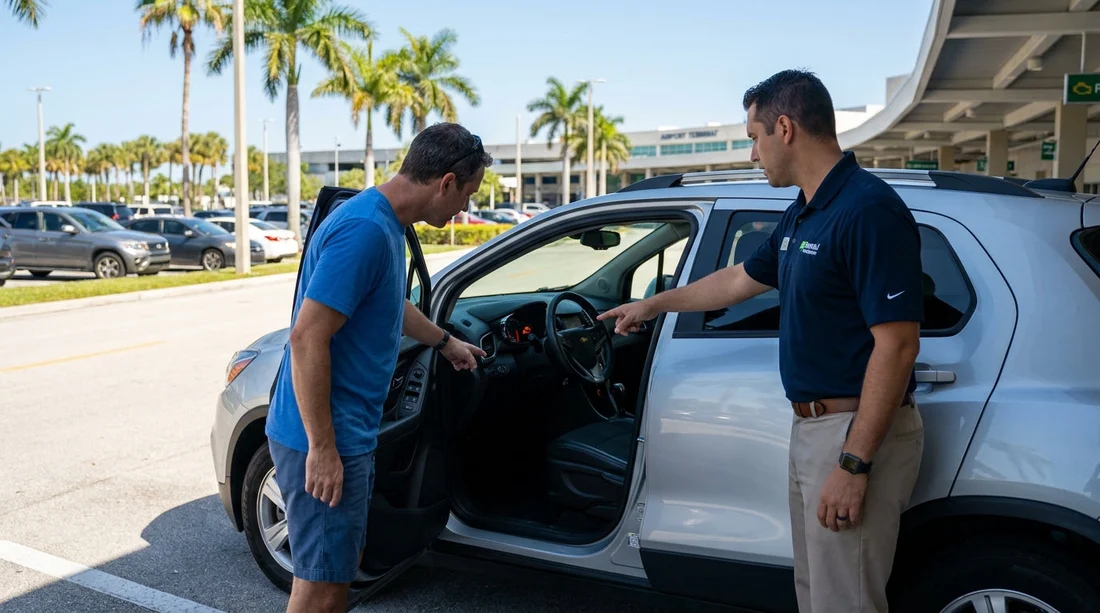
Seeing a check engine light at rental car pick-up can be unsettling, especially when you have just landed in Florida and want to get on the road. The safest approach is to treat it as a stop and clarify moment. Some warnings are minor, but you cannot reliably know that from the driver’s seat, and you should not assume the rental company already has it on record.
This guide covers the practical, counter-side steps to take before driving off. The aim is to protect your safety first, then avoid being held responsible for an existing fault, delayed travel, or unexpected charges later.
Why the check engine light matters at pick-up
The check engine light, sometimes labelled “MIL” (malfunction indicator lamp), can indicate anything from a loose fuel cap to an engine misfire. A warning light that is steady might allow limited driving in some situations, but a light that is flashing can indicate a more serious problem that could damage the engine. At pick-up, you do not have the vehicle history, so the safest option is to pause and resolve it with staff before you leave the facility.
Florida conditions can also magnify problems. Long highway stretches, heavy traffic around major cities, and high heat can stress cooling systems and engines. Starting a trip with a warning light adds unnecessary risk and can lead to a breakdown far from the rental location.
Step-by-step: the safest counter-side actions
1) Do not leave the rental facility car park. If you have already pulled away from the bay, circle back and park in a safe, permitted area. The key is keeping the location and time clear, the warning was present before you began your journey.
2) Photograph and video the evidence. Use your phone to capture the illuminated check engine light, the full dashboard, and the odometer reading. If possible, take a short video showing the engine running and the light staying on. Then take exterior photos of each side of the car, plus any pre-existing scratches, dents, wheel scuffs, and the fuel gauge. This documentation is useful if there is a dispute later about when the issue began.
3) Check for obvious, low-risk causes without “fixing” anything. You can look for a loose fuel cap if it is accessible and you have not driven away, but avoid attempting any mechanical troubleshooting beyond that. Do not disconnect the battery, do not clear codes with a scanner, and do not keep restarting the engine repeatedly. Your goal is to record the condition and hand it back to the company to resolve.
4) Return to the counter and report the warning clearly. Use plain language: “The check engine light is on at start-up, before I have left the facility.” Ask them to note the issue immediately. If you collected the car at a busy airport location, queueing can be frustrating, but it is still better than driving away with an unresolved warning.
5) Request a replacement vehicle, ideally like-for-like. The simplest, safest outcome is a swap to another car in the same category. You can ask what alternatives are available and whether a comparable model is ready now. If you are picking up near major hubs, such as car rental at Tampa Airport (TPA) or car rental at Fort Lauderdale Airport (FLL), there is often more fleet turnover, which can make an immediate swap easier.
6) If they cannot swap immediately, ask for written options. Sometimes staff may suggest you drive “a little while” to see if the light goes out. If you are considering that, ask for a written note stating that you reported the warning before departure, you were advised to proceed, and what to do if symptoms appear. Clarify whether roadside assistance will tow at no cost if the vehicle becomes undriveable.
7) Get the agreement updated in writing. Ask for a printed or emailed note attached to your reservation that includes the date and time, the agent’s name or ID, and the specific instruction given. If they perform a swap, confirm the new vehicle registration, mileage, and fuel level are correctly updated, and that your original vehicle is checked back in against your contract.
What to ask the agent, to avoid confusion later
Counter conversations can move quickly. These questions keep things specific and help you avoid being blamed for pre-existing issues:
Is the light steady or flashing, and have you verified it? A flashing light is more urgent. If it is flashing, request a different car and do not accept advice to continue driving.
Will you attach a note to my contract that the light was on at pick-up? Verbal assurances are not enough. You want it on the record.
If I proceed, what is the process for exchanging the vehicle later? Confirm where to go, what number to call, and whether you must return to the original location or can swap elsewhere. If your itinerary includes Miami, it may help to know you can access locations such as National Car Rental Downtown Miami depending on your provider and agreement.
Will any diagnostic fees or towing costs be charged to me? Clarify that a warning present at pick-up should not become your expense, provided you reported it immediately.
Can you confirm my deposit and pre-authorisation remain unchanged after the swap? Swaps can sometimes trigger a second hold if processed incorrectly. Asking reduces the chance of duplicate charges.
If you must leave before a swap is available
Occasionally, travellers feel pressured by timing. If you are collecting during a rush period or late at night, the desk may claim no alternatives are available. If you still choose to drive, reduce risk and protect yourself:
Limit distance and speed until you confirm the situation. Stay near the facility for a short loop, avoiding high-speed roads, and monitor for unusual noises, vibrations, loss of power, overheating, or burning smells. If any appear, return immediately and insist on a swap.
Keep the fuel cap check simple. If the fuel door is accessible, ensure the cap is properly tightened. If you do tighten it, record a quick video of the light still on, plus the time, before restarting. This helps show you did not ignore the issue.
Know where you can exchange. If you are based around Miami Beach, having a local reference point can reduce stress. For example, car rental in Miami Beach can be useful to locate services and alternative pick-up points that may be closer than the airport.
How this affects insurance, liability, and your car hire agreement
From a car hire perspective, the main risk is being held responsible for mechanical damage that you did not cause. Reporting the warning before leaving, documenting it, and getting written confirmation shifts the timeline clearly to “pre-existing.” That matters if the vehicle later needs recovery or repairs.
Also remember that warning lights can coincide with reduced engine performance modes. If a vehicle goes into limp mode on a busy Florida highway, the immediate safety hazard is significant. This is why requesting a swap is usually the best option, even if it takes extra time at the counter.
FAQ
Can I drive a rental car if the check engine light is on? It is safer not to drive off at pick-up. Report it immediately, request a swap, and only proceed if you have written instructions and the light is not flashing.
What if the desk says the warning is “normal” or “just a sensor”? Ask them to record that statement on your contract and offer a replacement vehicle. If they will not document it, treat it as unresolved and insist on a swap.
Should I take photos even if the agent says they have noted it? Yes. Photos of the dashboard, odometer, fuel, and exterior condition create a clear timeline and help prevent disputes about responsibility later.
Will I be charged for diagnostics or a tow if the light was on at pick-up? Policies vary, but you reduce your risk by reporting before departure and getting written notes. Ask explicitly about towing, roadside assistance, and fees before you leave.
What if the check engine light comes on later during my Florida trip? Pull over safely, check for overheating or obvious issues, and contact the rental provider’s roadside number. Document the dashboard and location, then follow their instructions for repair or exchange.





























































































