


Quick Summary:
- Collect the car with a full tank and return it full.
- Confirm the gauge reading matches the contract before driving away.
- Refuel close to drop-off, keep the receipt, and note time.
- Avoid refuelling fees by returning clearly full, not nearly full.
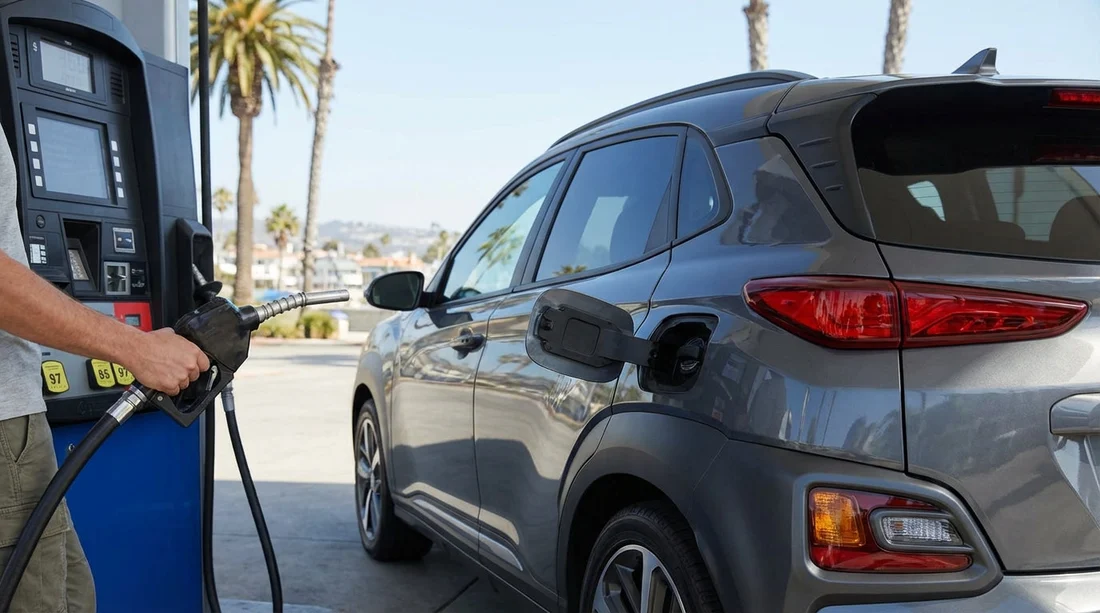
A full-to-full fuel policy on a rental car booking in California means you collect the vehicle with a full tank and you return it with a full tank. In practice, it is designed to be the most transparent option for car hire because you pay for the fuel you use at regular pump prices, rather than paying the rental company for unused fuel or expensive refuelling services.
That said, “full” can be more specific than it sounds. Fuel level is usually measured by the dashboard gauge, sometimes backed up by a printed check-out form or a digital vehicle inspection. If the gauge is not at full when you pick up the car, the agreement should record the starting level, and you should return it at that same level, not necessarily at “F”. Understanding these details helps you avoid charges that catch out many first-time renters.
How fuel is measured at pick-up in California
At pick-up, the agent or a self-service kiosk typically issues a contract showing the fuel policy and an indicated fuel level. Under full-to-full, the intended starting point is a full tank, but measurement relies on the car’s own gauge. Some cars show a traditional needle, others show digital bars, and some show “range remaining” in miles as well as a gauge.
Before driving away, take 30 seconds to check three things: the gauge reading, the contract’s stated fuel level, and whether any warning lights are on. If the gauge is slightly under full, ask for it to be corrected on the paperwork or in the inspection record. This matters because return fuel is compared to the recorded starting point, and even a small mismatch can lead to confusion at drop-off.
If you are collecting at a busy airport location, processes can vary. For example, travellers arriving into Los Angeles often pick up car hire at facilities serving Los Angeles LAX, where queues and quick handovers make it especially important to verify the fuel reading before leaving. The same principle applies if your trip starts in the Bay Area with San Francisco SFO car hire, where vehicles can be turned around quickly and gauges may not be perfectly stable immediately after refuelling.
What counts as “full” when you return the car
“Full” usually means the gauge is at the full mark, not merely close. With many modern vehicles, the needle can sit a fraction below full even after you top up, especially if you drive a short distance after refuelling and the gauge recalibrates. Because returns are often processed quickly, the inspection team may only glance at the gauge, and if it is not clearly full they can apply a refuelling charge.
To reduce the risk, refuel as close to the return time as practical, ideally within a few miles of the drop-off location. Keep the fuel receipt in case there is a dispute, and make sure the receipt shows the time and location. If you are returning at an airport, fuel stations immediately nearby can be busy, so allow extra time in your schedule. This is particularly relevant for returns around major hubs, including services for San Diego SAN.
If the car was supplied with a starting level that was not exactly full, such as 7/8, then “full-to-full” functionally becomes “same-to-same”. Return it at the same recorded level. In those situations, your receipt still helps, but the contract’s starting point is what the inspector will use.
Why full-to-full is often best value for car hire
Full-to-full is widely considered the fairest fuel policy because you control the fuel spend. You pay pump prices and only for what you use, rather than paying for a full tank at the rental counter at a higher per-gallon rate. It also avoids paying for fuel you do not use if you return the car with more in the tank than expected.
It is also simpler to plan. If you are taking a longer drive, perhaps starting with a pick-up near Sacramento SMF and heading toward the mountains or coastline, you can refuel on your route like any local driver, and you are not forced into a prepaid fuel purchase that may not match your itinerary.
Fees to watch for with a full-to-full policy
Even with full-to-full, fees can apply if the car is returned with less fuel than required. The most common is a refuelling charge, which usually combines two elements: the cost of the missing fuel and a service fee for the refuelling process. The fuel price used is often higher than local pump prices, and the service fee can be significant even if only a small amount is missing.
Other possible charges include an administrative fee related to processing the refuel, or a charge linked to how the fuel level is rounded. Some companies treat the gauge in segments, for example charging you for an eighth of a tank if the needle sits just below full. This is why aiming for clearly full, and refuelling close to return, matters.
Practical steps to avoid fuel disputes
Start with documentation. At pick-up, photograph the fuel gauge and the odometer as part of your normal walkaround. If the contract states “full” but the gauge is not, go back to the desk immediately or flag it with staff at the exit booth so it can be recorded. A 2-minute check can prevent a lengthy follow-up later.
Plan your final refuel. Identify a fuel station close to the return location in advance, and aim to fill up within 5 to 10 miles of drop-off. If you are returning during peak traffic, build in time so you are not tempted to skip refuelling. Once you fill up, keep the receipt, and if possible take a quick photo of the gauge at the station showing it is full.
If you are on a group trip or carrying lots of luggage, you might be using a larger vehicle. With bigger tanks, the cost difference between “nearly full” and “full” can be meaningful, and the refuelling fee risk is the same. In those cases, being precise with refuelling matters even more, including for van rental at San Jose SJC.
FAQ
Is full-to-full always exactly a full tank at pick-up? It should be, but the practical measure is the recorded starting level. If the gauge is under full, have it noted on the agreement or inspection record.
What happens if I return the car slightly under full? The rental company can charge for the missing fuel and add a refuelling service fee. The per-gallon price used may be higher than local pump prices.
Should I keep my fuel receipt in California? Yes. A receipt showing time and location is useful evidence if you are billed incorrectly, especially for airport returns where inspections are fast.
Can I prepay fuel and still call it full-to-full? Prepaid fuel is a different product. If you accept it, you may pay for fuel you do not use, so confirm which option is on your contract.
How close to the return location should I refuel? Ideally within a few miles, or about 10 minutes’ driving. This reduces the chance the gauge drops and helps match the required “full” reading.





























































































