


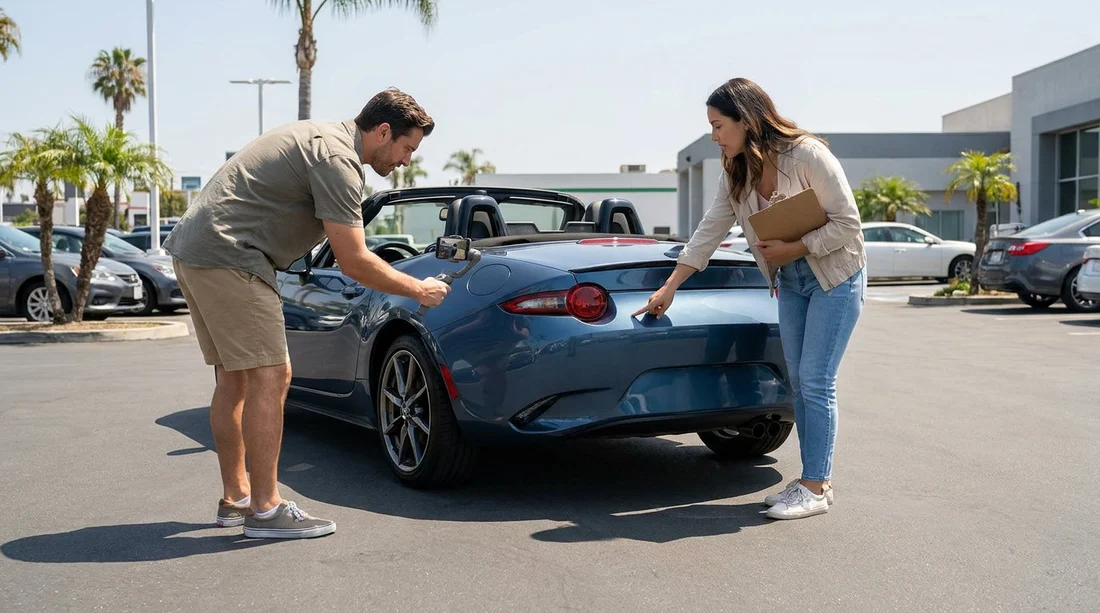
Quick Summary:
- Film a full walkaround before moving the car, including the roof.
- Photograph every scratch with a wide shot and close-up detail.
- Ensure all existing damage is written on the car hire form.
- Get staff confirmation or timestamped evidence before leaving the Los Angeles lot.
Yes, you should film a walkaround and note damage on the car hire form in Los Angeles. It is one of the simplest ways to make sure the rental contract reflects the vehicle’s condition at pick-up, not your condition at drop-off. Los Angeles is busy, lots are fast-paced, and vehicles often turn around quickly between drivers. A short, methodical routine protects you if a scratch, scuff, crack, or missing accessory is later questioned.
This matters because many damage discussions are not about major incidents, they are about small marks that are easy to miss at first glance. Your goal is not to create conflict with staff, it is to create clarity. A clear record helps everyone agree what was already there, and what was not.
If you are collecting at LAX, allow an extra 10 to 15 minutes for documentation, especially if you arrive at peak times. You can compare provider options and pick-up flows through pages such as car hire Los Angeles LAX and car rental Los Angeles LAX, but the checklist below works at any Los Angeles location.
Why filming and notes on the form work together
A video walkaround is great evidence, but on its own it may not change what your paperwork says. The car hire form or vehicle condition report is the document most teams refer to first. The strongest approach is to do both: capture the condition on camera, then ensure the same items are marked on the form before you leave the bay.
Think of it as two layers. The form is the official record. Your photos and video are supporting proof if the official record is incomplete, hard to read, or missing detail. When they match, disputes usually dissolve quickly.
A practical Los Angeles pick-up checklist
1) Start recording before you unlock or move the car
Begin with a slow 360-degree video showing the whole vehicle and the parking space. Include the number plate, the car’s model badge, and the fuel or battery gauge if visible through the window. If the car is in shade, move around until reflections are reduced. In Los Angeles sun, glare can hide dents, so change angles rather than rushing.
2) Capture the odometer, fuel level, and warning lights
Once inside, take a short clip of the dashboard with ignition on. Record the odometer, fuel level or EV charge, and any warning lights. If a tyre pressure or service warning is already present, get it on video and raise it immediately. This protects you from being blamed for a pre-existing issue and helps you avoid driving away with a car that needs attention.
3) Photograph damage in a consistent way
For every mark you see, take two photos: one wider shot that shows where it is on the car, then one close-up where the damage is clear. Do not rely on zoom alone, step closer so the photo stays sharp. Include context such as a wheel arch, door handle, or light cluster. This makes it harder for anyone to argue the damage was “somewhere else”.
4) Check the high-miss areas people forget
In Los Angeles, quick handovers mean common missed spots. Specifically check:
Lower bumper edges and the front lip for scrapes. Alloy wheels and hubcaps for curb rash. Windscreen and side windows for chips or cracks. Mirrors for scuffs. Door edges for paint chips. The boot lid and rear bumper for loading scuffs. The roof, especially on SUVs, for scratches from luggage or low branches.
5) Inspect tyres and glass carefully
Take photos of each wheel and tyre. Look for sidewall bulges, severe scuffing, or very low tread. For glass, use a slow pan across the windscreen, then still photos of any chips. A small chip can be hard to prove later without a close-up, and it can spread with heat changes.
6) Confirm accessories and safety items
Open the boot and check for items you might be charged for if missing: parcel shelf, floor mats, charging cable (for EVs), spare wheel or inflator kit, warning triangle if supplied, and any child seat parts if you have one. If something is missing, record it and have it noted. If you are hiring a larger vehicle, the same approach applies, particularly with cargo-area scuffs. For Los Angeles airport options, you can review vehicle categories on van hire California LAX.
7) Match the condition report to what you found
Now compare your observations to the marked diagram or checklist on the condition report. Many reports only show a few ticked boxes or tiny arrows. If the form uses codes, ask what each code means. If you found damage not shown, ask for it to be added. Be specific, for example “front passenger wheel scuffed” or “rear bumper scratch, lower left”. Vague notes can be unhelpful later.
8) Get confirmation in a way you can keep
Ideally, the agent updates the form and gives you a copy, digital or paper. If the location uses an app, ensure the updates appear in your confirmation. If the queue is long and staff cannot rewrite everything, ask for a brief written acknowledgement that you reported additional marks, then keep your video as backup. The key is a timestamped trail that links to your rental agreement.
How to film a walkaround that is actually useful
A useful walkaround is steady, slow, and complete. Keep the clip under two minutes if possible, but do not rush. Hold your phone horizontally and walk one panel at a time: front bumper, bonnet, driver side, rear, passenger side. Pause on each wheel and on the windscreen. End with a view of the fuel gauge and odometer. If you spot damage mid-walkaround, say it out loud while filming, then take still photos afterwards.
Also record the environment: the date and time on your phone screen, the bay number, and any poor lighting. If you are collecting at night, use your torch and sweep it across panels. Reflections reveal dents better than a static light.
Common Los Angeles scenarios that cause disputes
Airport rush handovers can mean you are waved through with minimal checks. That is exactly when you should slow down and document.
Tight parking and kerb contact can create fresh wheel rash quickly. Photos of all four wheels at pick-up are a smart baseline.
Previous renter quick repairs may leave paint transfer, touch-up marks, or misaligned trim. These are easy to miss unless you look along the car’s surface at a shallow angle.
Sand and dust masking scratches can hide marks until the car is washed. A video that shows dusty panels helps explain why something was hard to see at pick-up.
What to do if you spot damage after leaving the lot
If you notice something within the first few minutes, pull over somewhere safe and record it immediately, including a wide shot showing you are close to the pick-up location. Then contact the rental provider through the method in your paperwork and ask for the condition report to be updated. The sooner you do this, the more credible it looks.
If you are comparing providers at LAX, Hola Car Rentals pages for major brands can help you understand typical processes, such as Alamo car hire California LAX and Hertz car hire Los Angeles LAX. Procedures vary, but your personal documentation routine stays the same.
Return day: use the same discipline
On return, repeat a quick walkaround video in the drop-off lane before handing over the keys, again capturing wheels, bumpers, and fuel or charge. Keep your return receipt or check-in confirmation. If a staff member checks the car with you, stay present and ask them to confirm no new damage is recorded. If you are doing an after-hours drop, your own time-stamped return video is even more important.
FAQ
Is filming a walkaround allowed at car hire pick-up in Los Angeles? In most public pick-up areas it is fine, but avoid filming staff closely without consent. Focus on the vehicle, the number plate, and the condition details.
What damage should always be written on the car hire form? Anything beyond tiny, normal wear: dents, scratches, scuffed wheels, cracked lights, windscreen chips, missing trims, interior stains, and warning lights on the dash.
How long should my walkaround video be? Aim for 60 to 120 seconds, slow and steady. A shorter but complete video is better than a long clip that misses key panels or wheels.
What if the agent says the mark is “too small” to note? Ask politely for it to be added anyway, especially on wheels, bumpers, and glass. If they refuse, get a clear close-up photo and keep your time-stamped video.
Do photos really help if there is a dispute later? Yes, especially when they show the damage location clearly, include the number plate, and are backed up by the condition report matching what you documented.





























































































