


Quick Summary:
- Look for LATCH symbols, then feel for two fixed metal bars.
- Confirm the seating position is approved using the manual or labels.
- Find a marked top tether anchor and ensure it is accessible.
- Install, tighten, then check movement at the belt path.
When you collect a car hire in California and need to fit a child seat, checking for LATCH points (Lower Anchors and Tethers for CHildren) is one of the quickest ways to avoid an incorrect install. Most modern US vehicles have LATCH, but not every rear seating position is equipped, and some anchors are hard to spot at first glance. The goal is simple, confirm you have the right anchors in the right place for your child seat, and confirm they are intact and accessible before you drive away.
This guide shows where to look in common US car types, how to verify you have found true LATCH anchors rather than lookalike hardware, and what to do if a seating position does not support LATCH. If you are picking up at a major airport location, build in five minutes to check the back seat before leaving, the lighting and space are usually better in the collection area than once you reach your hotel car park.
If you are arriving into Los Angeles, you can see general collection info for car rental California LAX. For Northern California collections, you may also be comparing options like van rental San Francisco SFO or car hire airport San Jose SJC, all of which may involve different rear seat layouts.
What counts as LATCH, and why it matters before departure
LATCH has two parts. First, lower anchors, which are a pair of fixed metal bars set into the vehicle seat bight, the crack between the seat back and seat cushion. Second, a top tether anchor, used with forward facing child seats to reduce head movement in a crash. Your child seat may use either the vehicle seat belt or the lower anchors for the primary installation, depending on weight limits and the seat’s design, but the top tether is commonly required for forward facing use.
Before you leave, you are verifying three things, that the seating position you plan to use actually has a pair of lower anchors, that you can route and attach the connectors without twisting, and that there is an appropriate top tether anchor for forward facing seats. You are also checking the condition, no bent bars, broken plastic guides, missing tether loops, or obstructing seat covers.
Step-by-step: how to check a rental car has LATCH points
1) Start with the easiest visual cues. Open the rear doors and look at the seat bight. Many cars have small fabric tags or embossed symbols showing a child seat icon or the word LATCH. Some vehicles use tiny buttons on the seat back or plastic guides that frame where the bars sit.
2) Use your hand to confirm the metal bars. Visual markers are helpful, but the reliable check is tactile. Slide your fingers into the seat bight where the label indicates and feel for a rigid, horizontal metal bar on each side. True lower anchors feel solid and fixed. If you can wiggle it like a loose wire loop, it is not the lower anchor.
3) Confirm you are in an approved seating position. Many US cars have lower anchors only in the two outboard rear seats. The centre position may have a seat belt only, or it may have lower anchors with restrictions. Check the vehicle manual in the glovebox for a LATCH section or a diagram on the rear seat label. If you cannot access a manual easily, assume the centre does not have lower anchors unless clearly marked with two separate anchor locations.
4) Locate and inspect the top tether anchor. If you will use a forward facing seat, find the tether anchor before you install. It is commonly on the rear shelf in sedans, on the back of the seat or cargo side wall in SUVs, and on the seat back or floor in some vans. Look for the tether symbol, a small anchor icon. Make sure the anchor is not hidden behind a trim flap you might miss.
5) Attach, tighten, and do a tightness test. After you clip the connectors to the bars, tighten according to your seat instructions. The correct quick check is movement at the belt path, not the top of the seat. Grab near where the lower anchors connect and tug side-to-side and front-to-back. If it moves more than about 2.5 cm, tighten again or reassess the route.
Where LATCH anchors are found in common US vehicle types
Compact and midsize sedans. Lower anchors are usually in the two outboard rear seats. You may need to push down into the seat bight to find them, especially if the upholstery is tight. Top tether anchors are commonly on the rear parcel shelf behind the headrests. If the rear headrests block access, raise them or fold them if adjustable.
SUVs and crossovers. The second row outboard positions almost always have lower anchors. Some three-row SUVs also have anchors in the third row, but not always, and sometimes only on one side. Top tether anchors may be on the back of the second row seat, on the cargo floor area behind it, or on the side panel. Check that the tether strap route does not cross sharp cargo hooks.
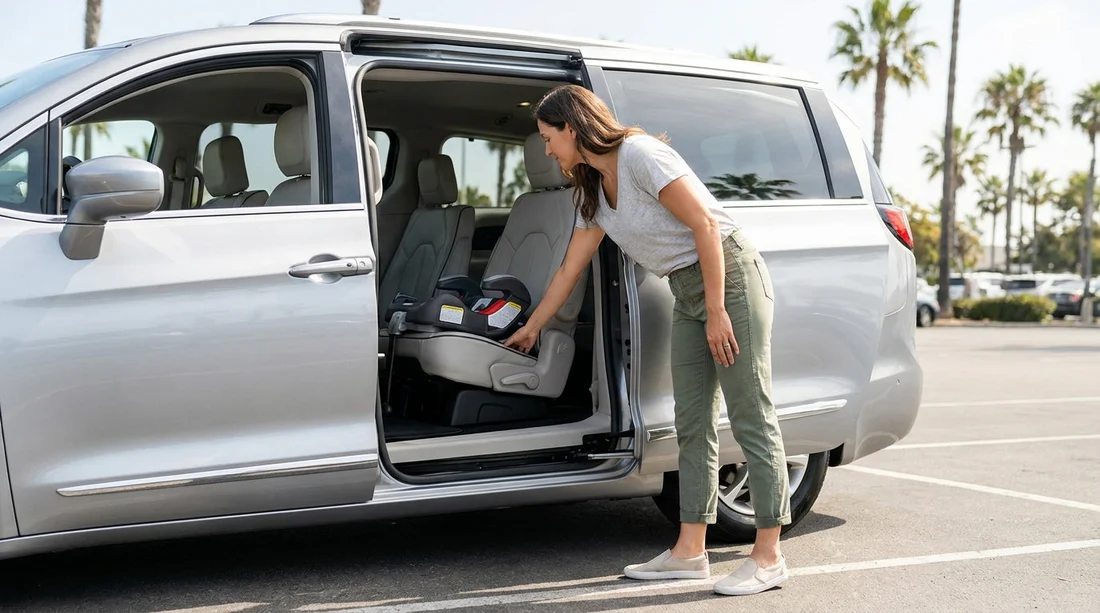
Minivans and people carriers. These often have the most family-friendly layouts. You may find lower anchors in more positions, including some second row captain’s chairs. Top tether anchors can be on the back of the seat or sometimes on the floor behind. Vans also tend to have deep seat bights, so you might need to use the plastic guide if provided to avoid digging into upholstery while clipping on.
If you are collecting a larger vehicle for family travel, it helps to know that different suppliers stock different configurations. You can browse broader pickup points such as Alamo car rental San Francisco SFO or compare airport availability like car hire Sacramento SMF when planning what size vehicle is likely to fit your child seat setup.
How to avoid common mistakes when verifying LATCH
Mistaking cargo hooks for tether anchors. In SUVs, metal loops in the boot are often cargo tie-downs, not tether anchors. Tether anchors are usually marked with the anchor icon and located in a specific, symmetrical position for each seat.
Assuming the centre seat has lower anchors. Even when there are two sets of anchors close together, you cannot borrow one anchor from each side unless the vehicle manufacturer explicitly allows it. Most do not. Treat each seating position as needing its own pair.
Forgetting the seat’s weight limits for LATCH. Many child seats allow lower anchor use only up to a combined child and seat weight limit. Above that, you typically switch to installing with the vehicle seat belt, and still use the top tether for forward facing. If you are near the limit, check your seat label for guidance.
Pre-departure checklist in the rental car park
Before you pull away, run through a quick repeatable check. Confirm you used the correct seating position. Confirm both lower connectors are clipped to fixed bars, with no twists. Confirm the seat moves less than about 2.5 cm at the belt path. If forward facing, confirm the top tether is attached to a marked tether anchor and tightened. Confirm no airbags are present where your seat is installed, rear seats are fine, and you never place a rear-facing seat in front of an active front airbag.
Doing this in the collection area means you can still swap vehicles if something is missing or damaged. It also reduces stress later, particularly if you are travelling after a flight and fitting the seat in poor light.
FAQ
Q: Are LATCH anchors required on all rental cars in California?
A: Most passenger vehicles sold in the US for many years include LATCH, but not every seating position has it. Always confirm the exact rear seat position has anchors before installing.
Q: How can I tell I have found a real lower anchor bar?
A: A lower anchor is a solid, fixed horizontal metal bar in the seat bight. If the metal piece flexes, swivels, or looks like a loose loop, it is likely not a lower anchor.
Q: Where are top tether anchors typically located?
A: Sedans often place them on the rear parcel shelf. SUVs and vans commonly have them on the seat back, cargo floor area behind the seat, or a marked point on the side panel.
Q: Can I use the inner anchors from two outboard seats for a centre install?
A: Usually no. Unless the vehicle manual explicitly allows centre borrowing, each seating position needs its own dedicated pair of anchors.
Q: If I cannot use LATCH, is a seat belt install acceptable?
A: Yes, seat belt installation is safe when done correctly and is required in some cases. Ensure the belt is locked or tightened properly and confirm minimal movement at the belt path.





























































































