


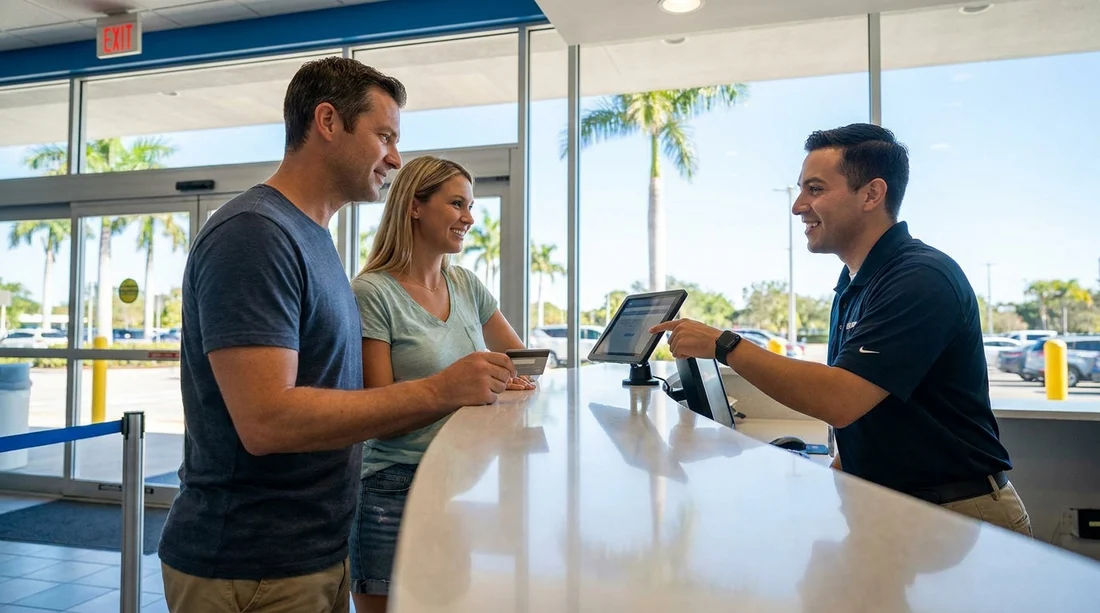
Quick Summary:
- Pay-now often locks in online-selected cover, reducing counter-only insurance upsells.
- Pay-at-counter can limit pre-selected options, leaving extras to pick-up time.
- Check what is included, excluded, and the excess before confirming payment type.
- Bring licence, card, and proof of cover to decline duplicate counter add-ons.
When arranging car hire in Florida, “pay-now” and “pay-at-counter” can look like a simple timing choice. In practice, it can change what insurance and protection products you can select online, how clearly they are itemised, and how the rental desk presents optional add-ons at pick-up. The key is not that one option is always better, but that each one affects the paperwork trail and what the supplier expects to sell at the counter.
This guide explains how payment timing typically influences insurance selection for Florida rentals, what to check in the booking summary, and how to avoid paying twice for the same protection.
What “pay-now” and “pay-at-counter” usually mean
Pay-now generally means you pay the rental cost (and any chosen add-ons offered online) during the online checkout. You receive a voucher or confirmation showing what was prepaid. The rental desk still takes a deposit and confirms eligibility, but the core charges are already settled.
Pay-at-counter typically means you secure the reservation online, then pay the rental charges at the rental desk when you collect the vehicle. You may still see estimated totals online, but final pricing and the add-ons chosen can be handled at pick-up.
How payment timing can change which insurance you can add online
Different suppliers and rate types use different rules, but these patterns are common in Florida car hire bookings.
1) Pay-now often gives a clearer, itemised “prepaid package”. Many pay-now rates present protection options during checkout, allowing you to add (or decline) products while you have time to read what they cover. If you add a protection product online, it is more likely to appear on the voucher as prepaid or included, which can reduce confusion at the desk.
2) Pay-at-counter may show fewer online add-ons, pushing choices to pick-up. With pay-at-counter, the online checkout may focus on vehicle and base rate, while the supplier’s counter process handles insurance selection. That does not mean you cannot be covered, but it can mean you have fewer chances to pre-confirm what you want and what it costs.
3) Some covers are inherently “counter products”. Certain items, such as roadside assistance programmes, windscreen and tyre protection, or supplier-specific damage waivers, may be offered mainly at pick-up, regardless of payment timing. The difference is that pay-now bookings may already have the main protections you wanted, so counter-only extras are easier to evaluate one-by-one.
4) Prepay can reduce price variability, not remove counter decisions. Even when you pay now, the counter still verifies your identity, deposit, and eligibility. If something changes (for example, you do not have the required card, or you cannot meet licence rules), the desk may need to switch the rate type, which can also change what insurance options are available.
If you are comparing locations like Orlando International Airport, it helps to review the booking details carefully before choosing a payment method. For example, the pages for car hire Orlando MCO and Hertz car hire Orlando MCO can be useful starting points to compare typical rate structures and what is presented upfront.
What to check online before you choose pay-now or pay-at-counter
To avoid surprise add-ons at pick-up, focus on the details that determine whether the counter will treat you as “fully arranged” or “still deciding”.
Check 1, what is included as standard. Look for clear wording about included protections, and whether they are included in the rate or merely available. If a protection is only “available”, you may be deciding later at the desk.
Check 2, excess amount and what it applies to. Two rates can both mention a damage waiver, yet the excess can differ sharply. Also check whether glass, tyres, underbody, and roof are excluded or limited. If they are excluded, the counter may offer an extra product that targets exactly those gaps.
Check 3, credit card requirements and deposit size. Many counter issues are not about insurance itself, but about deposit rules. If the supplier requires a credit card in the main driver’s name, and you arrive with a different arrangement, you may be moved onto a different package that changes your insurance options.
Check 4, the wording for “voucher” or “prepaid”. With pay-now, your documents should state what is prepaid and what remains payable locally. Print or save the confirmation so you can refer to it calmly at the desk.
If you are planning a Florida trip around major hubs, it can help to compare how offers are presented across airport and city locations. For instance, car hire Airport Disney Orlando MCO may show a different mix of packages than a Miami-area page such as budget car rental Miami Beach, even when the vehicle category is similar.
Does pay-now reduce counter pressure in Florida?
Often, yes, but it is not guaranteed. Pay-now can reduce counter pressure because the main financial decisions were already made online and documented. It can also reduce the chance that you agree to something quickly while tired after a flight. However, the desk may still offer optional protections, and you may still need to meet deposit and card requirements.
Pay-at-counter can be fine if you prefer flexibility or want to decide in person, but it puts more responsibility on you to read the counter contract before signing. If you pick pay-at-counter, plan to spend a few extra minutes reviewing the breakdown and declining anything you do not want.
Common scenarios, and what they mean for your insurance choices
Scenario A, you pay now and add protection online. You should arrive with a voucher showing what is included. At the counter, confirm those items are on the rental agreement, then consider only genuinely optional extras.
Scenario B, you pay now but add no protection online. The counter will likely offer protection products. This is not automatically a problem, but it means your insurance decision is happening at pick-up.
Scenario C, you pay at counter and see “estimated” totals online. Treat the online price as provisional and expect to decide insurance at the desk unless your confirmation explicitly states protections are included.
Scenario D, your card or licence situation does not match requirements. Regardless of pay-now or pay-at-counter, mismatched requirements can force a rate change, and that can change what insurance can be added and at what price.
FAQ
Does paying now guarantee I will not be offered insurance at the counter in Florida? No. You can still be offered optional products, but pay-now usually gives clearer proof of what you already selected or included.
If I pay at the counter, can I still get the same cover I saw online? Sometimes, but not always. Some online options are tied to prepaid rates, while counter products can be priced and packaged differently.
What documents help me avoid duplicate insurance charges at pick-up? Bring your booking confirmation or voucher, your driving licence, and the payment card used. Use the voucher line items to confirm what is already included.
Are damage waiver and liability cover the same thing? No. Damage waiver relates to the rental vehicle, while liability cover relates to claims by third parties. You may need one, both, or neither depending on your situation.
What is the quickest way to spot a surprise add-on before I sign? Ask for the full per-day and total cost of each add-on, then compare it to your voucher’s included items before agreeing.





























































































