


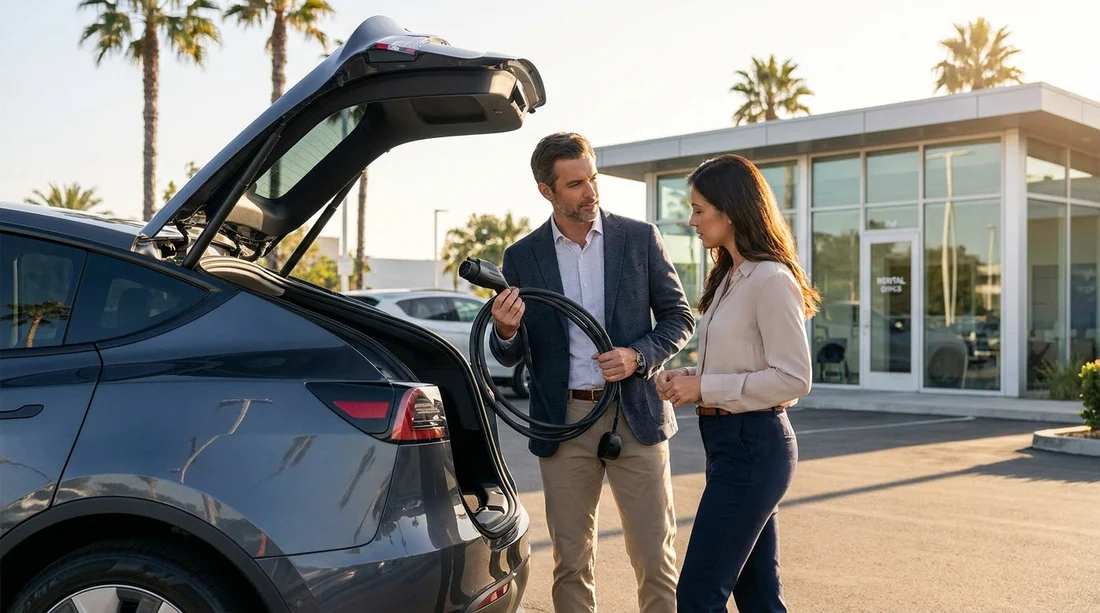
Quick Summary:
- Most California EV rentals include a Level 1 cable, confirm at pick-up.
- Check the boot for the cable bag, plugs, and adapter labels.
- Ask how DC fast charging works, and whether any apps are required.
- Photograph missing items before departure to avoid return fee disputes later.
Electric car hire in California is straightforward once you know what charging kit is usually supplied, and what is often not. Many renters assume an EV will always come with a charging cable, but policies vary by supplier, vehicle model, and even by branch. The key is to treat charging equipment like any other piece of rental inventory, check it before leaving the car park, confirm what you have been given, and make sure it matches how you plan to charge during your trip.
This matters in California because charging options range from slow overnight charging at a holiday let, to fast DC charging on interstates. The equipment you get at pick-up mainly affects AC charging, such as at a wall socket or some hotel and destination chargers. DC rapid charging (often called Level 3) generally uses a tethered cable attached to the charger, so you usually do not need to bring your own cable for that.
If you are collecting at a major airport branch, expectations can differ too. For example, pick-ups linked to car hire at Los Angeles LAX often see high EV turnover, which can mean staff are familiar with the kit, but it can also mean accessories get separated between vehicles if checks are rushed.
What charging equipment is usually supplied with EV car hire?
In California, the most commonly supplied item is a basic portable charging cable intended for a standard household socket. In North America this is often referred to as a Level 1 charging cable, or an “EVSE” (electric vehicle supply equipment). It typically plugs into a regular wall outlet and charges slowly, which is useful if you have guaranteed overnight parking and you just need to top up.
Some EV rentals may also include a Level 2 portable cable, or an interchangeable plug set for different outlet types, but that is less consistent. Many rental companies prefer to rely on public Level 2 stations that have their own tethered cable, or on DC fast chargers where the cable is attached to the unit.
What you should check for in the boot before you leave
Before driving away, open the boot and do a quick inventory. Rental EV charging gear is frequently stored in a soft bag, sometimes branded, sometimes plain black. It may be tucked in the side well, under the boot floor, or strapped near the tyre repair kit. If you are picking up an EV via car hire in California arrangements that start at LAX, do this check while you are still close to the staff so any missing items can be noted immediately.
1) The correct connector for the car. Most EVs in the US use a J1772 inlet for Level 1 and Level 2 AC charging, even if they use a different port for DC fast charging. If the car is a Tesla, it may have a Tesla-specific connector, or it may come with an adapter for J1772. Check what the vehicle actually accepts by looking at the charge port and the cable end.
2) The wall plug type. A Level 1 cable will have a standard household plug. Make sure it is intact, not cracked, and not taped. If the cable includes interchangeable wall plugs, confirm the set is complete and clearly labelled.
3) Any adapters that were mentioned at the desk. If staff tell you the vehicle includes an adapter, ask them to point it out. Adapters are easy to misplace and are commonly chargeable if missing at return.
4) Condition and cleanliness. Look for fraying, exposed wires, bent pins, or a damaged latch at the vehicle connector end. A cable that looks unsafe is not worth taking, request a replacement before leaving.
Finally, take photos. Photograph the boot area, the cable bag, and any adapters present. If something is missing, photograph the empty storage spot and tell the agent straight away, so the rental record can be updated.
Questions to ask at the car hire desk before driving off
Because “included charging equipment” is not a universal standard, ask direct questions. You are trying to confirm what you have, what you might need, and what you could be charged for later.
“Does this EV come with a charging cable, and which type?” Specifically confirm Level 1 only, or any Level 2 capability. If you are planning to charge overnight at a rental home, this answer affects whether you can rely on a wall socket.
“Is there a J1772 adapter or any other adapter, and is it required?” This is especially relevant for Tesla models. If an adapter is required for many destination chargers, confirm it is provided and note it on the agreement if possible.
“What items are chargeable if missing at return?” Ask for the list, then keep the kit together during your trip. Charging accessories are small and easy to forget in a hotel drawer or garage.
“How does payment work at public chargers?” Some cars have in-car navigation that routes you to chargers, but you still pay through a charger app or card. Clarify if there is any billing arrangement, and whether you will need to set up an account on your phone.
“Which connector does the car use for fast charging?” Many vehicles use CCS for DC fast charging, while some use NACS. Knowing this helps you choose compatible rapid chargers on the road.
If you are picking up in Northern California, these questions are just as relevant. Branches connected to car rental at San Francisco SFO often serve travellers heading straight for coastal drives or wine regions, where overnight charging can be more convenient than relying only on rapid chargers.
What to expect at California charging stations, and why the cable matters
Most public AC charge points (Level 2) in California have a tethered cable attached, so you park, plug in, and start the session. In those cases, the rental cable in your boot is irrelevant. Where your own cable becomes valuable is at private sockets, basic accommodation parking, or any location that offers an outlet but not a dedicated EV charge point.
DC fast charging stations almost always have attached cables, and you will not need your own. What you do need is the correct vehicle inlet, an understanding of how to activate and pay, and enough battery to reach the station. If you are new to EVs, it is worth asking staff for a quick overview of how to open the charge port and start a charge session in the vehicle’s interface.
Also consider the practical reality of travel. Policies can differ between providers like those represented on pages such as Alamo car rental in California at LAX or other brands, so do not assume your last EV rental experience will match the next one.
Common pitfalls that lead to fees or frustration
Assuming the cable is included without checking. If you only discover it is missing later that evening, you may waste time returning to the branch or changing your charging plan.
Mixing up AC and DC charging expectations. People sometimes look for a cable to use at a rapid charger. You typically do not need one. Instead, you need the right port type and a payment method.
Not confirming adapters. A missing adapter can turn a convenient destination charger into a non-option, and replacement charges can be significant.
Forgetting to return the cable. If you take the cable out to charge at accommodation, put it back in the boot immediately after. Treat it like the fuel cap on a petrol car, it is part of the vehicle inventory.
Not documenting the kit at pick-up. Photos can help resolve disputes about whether a cable or adapter was supplied.
FAQ
Do EV rental cars in California always come with a charging cable? Not always. Many do include a basic Level 1 cable, but it varies by supplier, branch, and model, so confirm before leaving.
Where should I look for the charging cable in the car? Check the boot first, including side compartments and under-floor storage. Look for a soft cable bag near the tyre repair kit area.
Will I need my own cable to use rapid chargers in California? Usually no. DC fast chargers typically have fixed cables attached, so you just plug in and pay or activate the session.
What if the cable or adapter is missing at pick-up? Tell the desk immediately and ask for it to be provided or noted on your agreement. Take photos of the boot area as evidence.
Can I be charged if I forget to return the charging cable? Yes. Charging cables and adapters are commonly treated as chargeable accessories, so keep them together and return them with the car.





























































































