


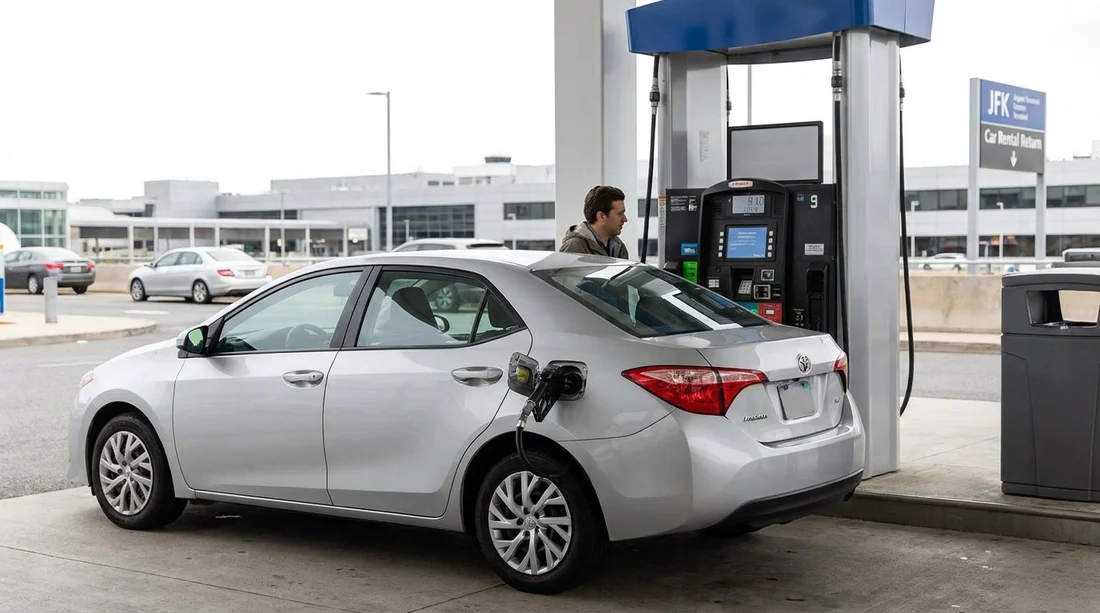
Quick Summary:
- Choose full-to-full and return with a full tank to avoid fees.
- Photograph the fuel gauge and keep receipts from pick-up and return.
- Decline prepaid fuel unless you plan to return with almost no fuel.
- Confirm the contract fuel option matches your booking before you sign.
Refuelling charges are one of the most common surprises on car hire, especially after a long flight into New York. At JFK, most suppliers offer a small set of fuel policies, but the wording can differ between the booking page, the counter agreement, and your final invoice. The goal is simple, make sure you only pay for the fuel you actually use, and avoid any supplier refuelling service fees.
This guide compares the common fuel options you will see for car hire at JFK, and explains exactly what to confirm at the counter so the agreement matches your booking and budget. If you are reviewing options for the airport itself, the practical details for pick-up and return are covered on car rental at New York JFK Airport.
Why refuelling charges happen at JFK
Refuelling charges usually happen for one of three reasons. First, the car is not returned at the agreed fuel level. Second, the supplier applies a higher per-gallon price than local stations, plus a refuelling service fee. Third, the counter agreement is set to a different fuel policy than your booking, often because the agent offers an “easier” option at pick-up.
At JFK, the practical challenge is timing. You may be trying to find a station close to the airport, you are working around traffic, and you may be returning the vehicle early or late. A good fuel policy is the one that fits your route and return plan, not the one that sounds simplest at the desk.
The fuel policies you will see, and what they really mean
1) Full-to-full (also called “return full”)
This is generally the best policy to avoid refuelling charges, because it is transparent. You receive the car with a full tank (or near full), and you return it full. If you return it short, the supplier will add fuel at their rate and may add a service fee.
Why it works at JFK, you control where you refuel and what price you pay. Why it fails, you do not leave enough time to top up, or you rely on the gauge without keeping a receipt.
2) Same-to-same (return at the same level)
With this policy, you pick up the car at whatever level it has and return it at the same level. It sounds fair, but it can be harder to execute precisely. Gauges are not perfectly accurate, and “three quarters” is not a measurement. If you return slightly under, you can still be charged supplier rates.
This can work for short trips or if the tank is clearly full at pick-up, but it becomes risky when the tank starts at an odd level such as seven eighths.
3) Prepaid fuel (often “full-to-empty”)
With prepaid fuel, you pay upfront for a full tank and can return the car as empty as you like. This can avoid refuelling charges, but only if you genuinely plan to return with very little fuel left. Otherwise you are paying for unused fuel.
4) Supplier refuel on return (sometimes bundled as “return empty”)
This is the option most likely to create high charges. The supplier allows you to return with any fuel level, then bills you for the missing fuel at their price, usually plus a service fee. If you have a long drive back and cannot guarantee a stop, this may feel simpler. In practice, it is often the most expensive way to buy fuel.
So which policy best avoids refuelling charges?
For most travellers, full-to-full is the safest way to avoid refuelling charges on car hire at JFK in New York. It keeps the supplier out of the fuel transaction, as long as you return it full and can show evidence if there is a dispute.
If you are comparing different supplier deals and inclusions at the airport, it helps to review the fuel policy line closely on a JFK-specific page such as budget car hire New York JFK, where you can focus on the airport terms rather than generic city conditions.
What to confirm at the counter so the agreement matches your booking
The counter agreement is what you sign, and it is what the supplier uses to bill you. Before you accept the keys, confirm these items verbally and on the printed or digital contract.
Confirm the fuel policy wording. Ask the agent to point to the fuel section and read it. You are looking for “full-to-full” or equivalent wording, not “prepaid” or “supplier refuel”. If it differs from your booking, request that it is corrected before signing.
Check the pick-up fuel level on the vehicle. Do not rely only on the paperwork. Take a photo of the gauge with the car running, plus a photo of the odometer. If the tank is not full but your contract says it is, return to the desk immediately.
Get clarity on what “local station” means for receipts. Some suppliers accept any receipt, others prefer one within a certain distance or time window. Ask what they require, then plan accordingly.
Supplier terms can vary even within the same brand depending on location. If you are researching a specific provider at JFK, details on locations and typical conditions are often easiest to compare on a dedicated page such as Dollar car rental New York JFK.
Practical tips to return the car fuelled without stress
Plan your final refuel stop before the trip ends. In New York traffic, leaving refuelling to the last few miles can backfire. Aim to refuel within the last 10 to 15 miles of JFK, then drive directly to the return area.
Keep the receipt and photograph it. Receipts fade or get lost. A quick photo, plus a photo of the fuel gauge at return, is usually enough to resolve most disputes.
Allow time for the return process. If the return lanes are busy, you may be sitting with the engine running. That can move the needle slightly. Build buffer time so you can refuel again if needed.
Common booking-to-counter mismatches to watch for
“Recommended” fuel upgrade. An agent may offer prepaid fuel as a convenience. If your booking is full-to-full, treat this as an optional change that can increase cost unless it fits your plan.
Different policy for different vehicle classes. Occasionally, certain categories have different fuel rules. If you switch cars at the desk, confirm the fuel policy again.
If your trip involves picking up or dropping off outside JFK, note that nearby airport operations can have different practices. For example, a New Jersey airport location may have different counter routines than New York. If you are cross-checking policies for the region, see car rental New Jersey EWR for a point of comparison.
FAQ
Which fuel policy is best to avoid refuelling charges at JFK? Full-to-full is usually best. You refuel yourself at pump prices and avoid supplier refuelling service fees, as long as you return the car full.
Is prepaid fuel ever good value on car hire in New York? It can be, but only when you expect to return the car almost empty and you value skipping the last refuel stop. Otherwise you often pay for unused fuel.
What proof should I keep in case I am charged for fuel? Keep the final fuel receipt and take photos of the fuel gauge at pick-up and at return. If available, keep the return slip showing the recorded fuel level.
What should I do if the contract fuel policy differs from my booking? Do not sign until it is corrected or you understand the cost impact. Ask the agent to update the agreement so the fuel policy line matches what you intended.
Can I dispute a refuelling charge after I leave JFK? Yes, but it is easier with evidence. Provide your receipt and time-stamped photos, and reference the fuel policy shown on the signed agreement.

























































































