


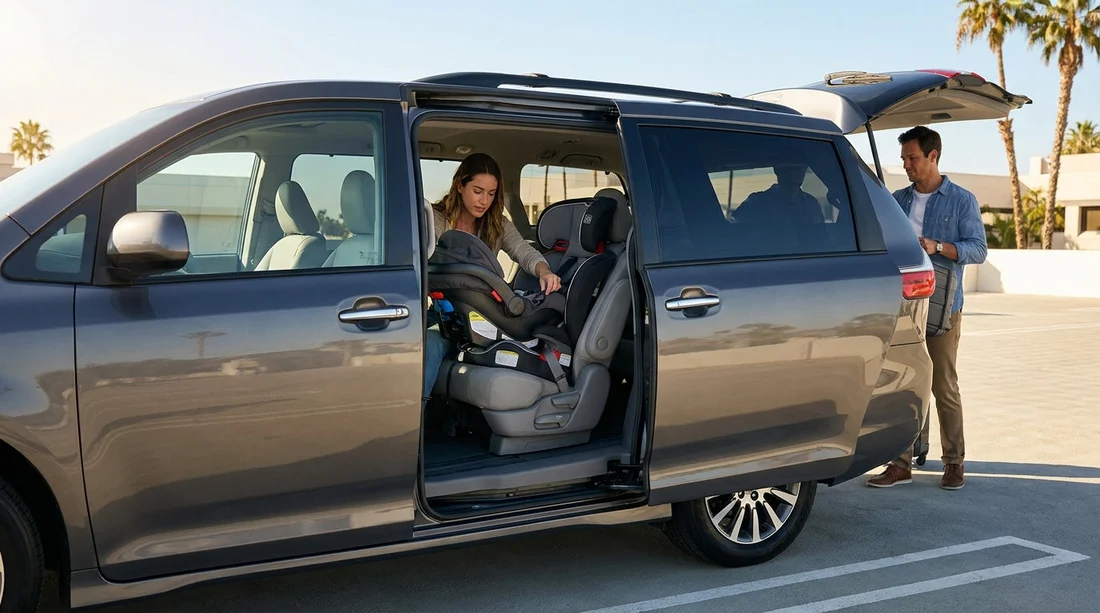
Quick Summary:
- Texas requires under-8s to use a suitable child safety seat.
- Rear-facing infant seats suit babies until they exceed seat limits.
- Convertible seats cover rear-facing toddlers, then forward-facing with a harness.
- Use a booster until the adult belt fits hips and shoulder.
When you arrange car hire in Texas with children aboard, picking the right child seat matters for both safety and legal compliance. Texas law requires children younger than 8 to be secured in a child safety seat system, unless they are at least 4ft 9in (57 inches) tall. That means your decision is usually driven by height and how the seat belt fits, not just age.
This guide maps the most common child-seat types offered with car hire, infant seats, convertible seats, and booster seats, to typical age and height needs. It also explains what to check at pick-up, so you can match the seat to your child and to the vehicle you are collecting.
If you are collecting at a major airport, it can help to check your route and vehicle plan alongside local pages such as Austin Airport car rental or Houston IAH car rental, because seat availability and vehicle types can vary by location.
Texas child seat rules in plain English
Texas Transportation Code requires a child passenger safety seat for any child under 8 years old, unless the child is taller than 4ft 9in. For families, the simplest way to stay on the right side of the rule is to think in three checkpoints.
Checkpoint 1, age: under 8 usually means a child seat is required. Over 8 can still need a booster if the belt does not fit, because safety best practice often goes beyond the minimum legal threshold.
Checkpoint 2, height: once a child reaches 57 inches, the legal requirement for a child seat generally ends. Many children reach this height between about 10 and 12 years old, but it varies.
Checkpoint 3, belt fit: even if your child is older than 8, the adult belt should sit low on the hips, shoulder belt across the chest and collarbone, and the child should sit back with knees bending naturally at the seat edge. If not, a booster is still the safer choice.
How child-seat types offered with car hire map to your child
Rental counters usually describe seats in broad categories. The best match comes from your child’s current measurements and the kind of trip you are taking.
Infant seat, rear-facing for babies
An infant seat is designed to be used rear-facing. It supports the head, neck, and spine of babies, and the harness holds the child in the safest position in a crash.
Typical fit: from birth up to around 12 to 18 months, but the real limit is the seat’s maximum height and weight rating. Many babies outgrow an infant carrier by height before weight.
When to choose it: pick an infant seat if your child is still within rear-facing infant limits, especially for younger babies who need the recline angle and newborn insert support.
Convertible seat, rear-facing then forward-facing
A convertible seat can be used rear-facing for longer, then switched to forward-facing with a harness. This is often the most versatile choice for families with toddlers.
Typical fit: roughly 6 months through about 4 years, depending on the seat’s limits and how quickly your child grows. Many safety experts recommend keeping children rear-facing as long as the convertible seat allows, because rear-facing reduces stress on the neck and spine.
When to choose it: choose a convertible seat if your child has outgrown an infant carrier, or if you have a young toddler who still fits rear-facing. If your toddler has reached the rear-facing limit, a forward-facing harnessed setup is the next step.
Key checks at pick-up: ask which mode you will be using, rear-facing or forward-facing. Make sure you can tighten the harness so it passes the pinch test, and confirm you can secure the seat tightly with the vehicle belt or LATCH where allowed. If you are collecting a larger vehicle for luggage and family comfort, pages like van rental in El Paso can be useful for planning space for a convertible seat’s footprint.
Booster seat, belt-positioning for older children
A booster seat positions your child so the adult lap and shoulder belt fit correctly. It is not restrained by an internal harness, the vehicle’s seat belt restrains the child, and the booster improves the belt path.
Typical fit: commonly from about age 4 up to 10 to 12, but the best indicator is belt fit and the booster’s height and weight range.
When to choose it: choose a booster when your child has outgrown a forward-facing harnessed seat. If your child is under 8 and not yet 57 inches tall, a booster is often the legally sensible choice if they have moved beyond harnessed limits.
The five-step belt fit test for older children
If you are deciding between a booster and the adult belt, run this quick test in the vehicle you have hired. A child can usually ride without a booster only when all five are true.
One, they can sit all the way back against the seat. Two, their knees bend naturally at the seat edge without slouching. Three, the lap belt stays low on the hips, touching the thighs. Four, the shoulder belt crosses the centre of the chest and shoulder, not the neck or face. Five, they can stay seated like this for the whole trip, including when asleep.
If any step fails, a booster is the safer and often more practical option, even when the law may not strictly require it.
Pick-up tips that prevent common child-seat problems
Bring measurements: arrive with your child’s current height and weight, plus their age. If you cannot bring the child to the counter, keep these details on your phone.
Inspect the seat condition: check the harness, buckle, and shell for obvious damage, and confirm the seat is not missing parts. If anything seems wrong, request a different unit.
Plan for installation time: fitting a seat correctly can take longer than expected. Allow time in the car park so you are not rushing.
Choose a suitable vehicle: compact cars can be tight for rear-facing seats, while larger cars and vans make it easier to keep front seats comfortable. If you are comparing providers and vehicle sizes for city driving, Budget car rental at Fort Worth DFW is a helpful reference point for planning around airport fleets and family luggage.
How Hola Car Rentals travellers can plan ahead
The biggest reason families end up with the wrong seat is assuming the categories match a precise size. With car hire, the label “infant”, “child”, or “booster” can be broad. Your best approach is to match your child to the seat type using height, weight, and belt fit, then confirm the category aligns with your needs at pick-up.
If you are flying into Texas through a major hub, it may help to compare collection options and timings, for example car hire Texas IAH, so you can build in time for seat fitting before a long drive out of the airport.
Finally, remember that legal minimums and best practice are not always identical. Staying rear-facing longer, using a harness until it is outgrown, and keeping a child in a booster until the adult belt fits properly will typically give you the safest outcome on Texas roads.
FAQ
Do Texas laws specify infant, convertible, or booster seats by name? Texas law focuses on using an appropriate child safety seat for children under 8, unless they are at least 4ft 9in. It does not require specific product names, so you choose the seat type that fits your child’s size and belt fit.
My child is 7 but very tall, can they use the adult belt? If your child is at least 57 inches tall, they may meet the height exception. Even then, check lap and shoulder belt fit in the hired vehicle, and use a booster if the belt sits on the stomach or touches the neck.
Is a rear-facing seat required in Texas? Texas law requires an appropriate child safety seat, but rear-facing recommendations come mainly from safety guidance rather than the statute. Rear-facing is generally best for babies and young toddlers until they reach the seat’s rear-facing limit.
What if the rental seat does not fit securely in the car? A seat should not move more than about an inch at the belt path when tightened. If you cannot achieve a tight installation, ask for a different seat model or a different vehicle with more compatible seating and belt geometry.
Can my child sit in the front seat with a booster? It is usually safer for children to ride in the back seat, particularly if they are using any child seat or booster. If the front is the only option, avoid placing a rear-facing seat in front of an active airbag and follow the vehicle’s safety guidance.

























































































