


Quick Summary:
- For two adults and two kids, choose midsize SUV or minivan.
- Keep one rear seat free for access, avoid tight three-across.
- Measure pushchair folded size, check boot height and depth.
- Ask for LATCH positions, tether points, and third-row usability.
Choosing the right car hire size in Orlando is less about the number of passengers and more about what else travels with you. A couple of suitcases, a pushchair, and one or two child seats can overwhelm a compact boot, and cramped rear seats make daily park runs tiring. Orlando also tends to mean longer drives, big supermarket shops, and days where you carry extra kit, so it is worth sizing up if you are unsure.
This guide compares common vehicle classes you will see at Orlando Airport and nearby rental locations, focusing on boot space, rear-seat layout, and the practical questions to ask so you actually receive something that works for your family.
If you are collecting at the airport, start by checking the location details for Orlando MCO airport car hire, then use the class guidance below to match your luggage and seating needs.
Start with your real packing list, not the passenger count
Families often underestimate volume because “we only have four people” sounds like a small group. In reality, four people plus child equipment is closer to six adults’ worth of space. Before choosing a class, list what must fit in the boot with the rear seats in use:
Typical family load in Orlando includes two large suitcases, one cabin suitcase, a folded pushchair, a nappy bag, a cooler bag, and occasional shopping. If you are visiting for 10 to 14 nights, swap “two large” for “three large”, and the boot requirement jumps quickly.
Also decide what cannot be compressed. A rigid travel system or double pushchair is the biggest wildcard. Suitcases can sometimes be stacked or moved, but a pushchair shape can force you into a larger vehicle even if you travel light otherwise.
What boot space really means for suitcases and a pushchair
Rental listings often show photos, but not the dimension that matters: usable boot depth and height with the parcel shelf in place. For families, the key issue is whether the pushchair can lie flat while leaving a stable base for suitcases. If you have to stand suitcases upright to fit, you may block the rear window, lose visibility, and create an unstable stack that shifts when you brake.
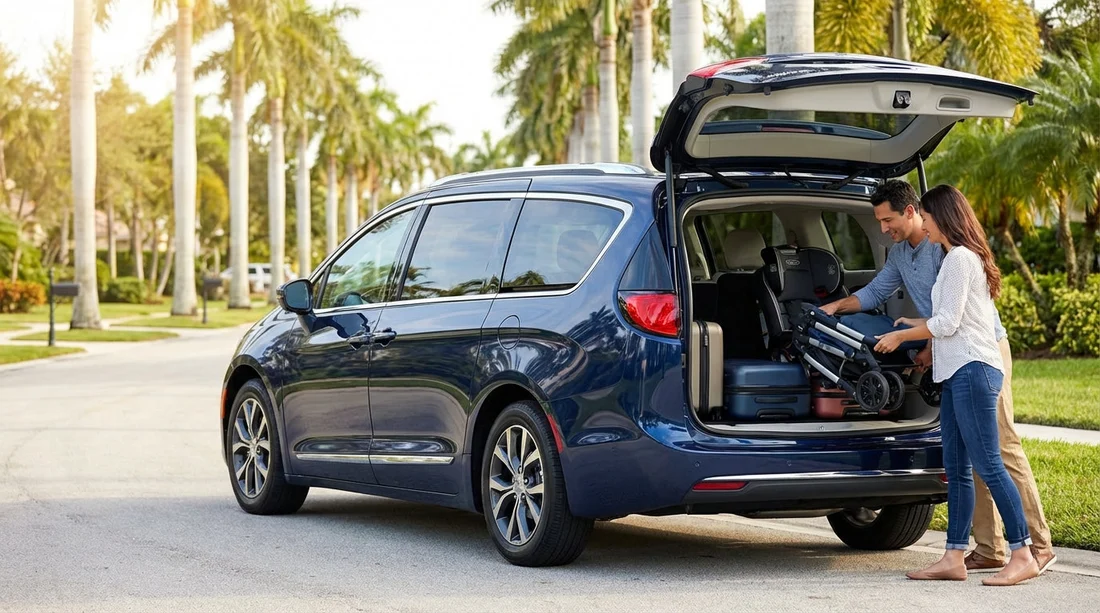
Quick rule of thumb: if your pushchair takes the full boot width when folded, avoid compact cars and most standard saloons. You will usually need a midsize SUV, a full-size SUV, or a minivan to keep luggage and pushchair together without forcing a rear seat to fold down.
Rear-seat layout: the hidden deciding factor
Boot space gets most of the attention, but rear-seat layout can be the reason a “big” vehicle still fails your needs. Child seats and boosters are wide, and ISOFIX style fittings, called LATCH in the US, can sit only on certain positions. If you need to fit two seats and still keep a comfortable spot for an adult in the back, you should plan around width, buckle access, and tether points.
Two child seats are usually straightforward in most SUVs and larger saloons, but three across can be difficult even in vehicles marketed as “full size”. If you have three children in seats or boosters, a minivan is typically the least stressful option because it offers true three-row access and more flexible anchoring points.
For families collecting at MCO, check which desk and shuttle arrangements apply for your supplier via car hire Orlando MCO, then use the seating questions later in this article to confirm the configuration you need.
Vehicle class comparison for Orlando family trips
Because fleet composition changes, think of classes as a range rather than a single model. The goal is to choose the class that reliably delivers enough boot volume and usable rear seating, even if you are given a different vehicle than expected.
Compact and economy: usually too small for pushchair plus luggage
These cars can work for two adults and one small child if you have minimal luggage and a compact umbrella stroller. The issue is boot opening height and depth. Many compact boots fit either a pushchair or a large suitcase, not both together. Rear-seat space also makes it harder to install a rear-facing seat without pushing the front passenger uncomfortably forward.
Choose this class only if your pushchair is very small when folded, you have one medium suitcase, and you are comfortable placing some soft bags at passengers’ feet. For most Orlando park trips, it is the least forgiving choice.
Midsize or standard saloon: workable for light families, limited for bulky pushchairs
A midsize saloon gives a longer boot than a compact, and can take two large suitcases more reliably. However, boot openings can still be narrow, and the pushchair frame can be awkward to angle in. Rear seats often fit two child seats well, but three-across is rarely pleasant.
This class can be a good value if you have one child seat and a slim pushchair, and you do not mind stacking luggage carefully. If you need the flexibility to throw things in quickly after a long day, an SUV tends to be easier.
Intermediate or midsize SUV: the sweet spot for many families
For two adults, one to two children, two to three suitcases, and a standard pushchair, a midsize SUV is often the best balance. You get a taller boot opening, a squarer cargo area, and rear doors that make installing child seats less awkward. Ground clearance also helps with kerbs and the occasional uneven car park surface around hotels.
There is still variation. Some midsize SUVs have a sloping rear window line that cuts boot height. Others have a higher load floor that reduces depth. If your pushchair is bulky, confirm you can fit it without folding a rear seat. If you want to focus on this type of vehicle, look at SUV rental near Disney Orlando MCO to compare options.
Full-size SUV: better boot, but check third-row impact
Full-size SUVs can be excellent for families with more luggage or taller passengers, but be careful with models that include a third row. If the third row is present and you plan to use it, boot space can shrink dramatically. If you need the third row folded all the time, the boot becomes large again, but you must be confident you can keep it folded and still access luggage easily.
Also note that some third rows fold in a way that creates a slope, making suitcase stacking less stable. A minivan can provide a flatter, more usable cargo floor when fully loaded with people.
Minivan (7 to 8 seats): best for three children or bulky gear
When the priority is stress-free loading, a minivan is hard to beat. Sliding doors make child seat installation easier in tight spaces, and the rear cargo area is typically designed for family gear. Even with two rows in use, you often have a deep luggage well behind the third row, which helps keep pushchair and suitcases separate and secure.
Minivans are also the most practical answer if you need an adult to sit in the back row next to a child seat, or if you want to keep a walkway to the third row rather than folding seats every time.
How many suitcases fit, by class, in real family terms
Instead of quoting litres, it helps to picture a typical holiday set. Use these as planning ranges, assuming the rear seats are all in use:
Compact: one large suitcase plus a small folded stroller, usually tight.
Midsize saloon: two large suitcases plus a small pushchair, often needs careful packing.
Midsize SUV: two to three large suitcases plus a standard pushchair, generally comfortable.
Full-size SUV: three to four large suitcases plus pushchair if third row stays folded.
Minivan: three to four large suitcases, pushchair, and extra day bags with fewer compromises.
If you are travelling with a travel cot, consider moving up one class from what you think you need. The travel cot shape is similar to a pushchair in how it steals boot depth.
Child seats in Orlando: what to ask for when booking
In the US, most modern vehicles support LATCH, but not all seating positions do. For forward-facing seats, top tether anchors matter, and they are not always available in the third row. When planning your car hire, ask questions that focus on what matters, rather than hoping the counter staff can improvise.
Ask these questions before you arrive:
Which rear seats have LATCH, and are there top tether anchors for forward-facing seats?
Can you confirm whether the vehicle has three separate rear headrests, useful for high-back boosters?
If it is a 7-seater, does the third row have tether anchors, and can you still store luggage?
Is there enough rear legroom for a rear-facing seat behind an average-height driver?
Do rear seats have accessible buckle stalks, or do child seats cover them?
Even if you plan to bring your own seats, these questions still matter because seat geometry varies widely. A seat that fits well in your car at home may need a different angle or belt routing in another model.
Supplier fleets differ, so it can help to compare desks and typical vehicles through pages such as Avis car rental Orlando MCO and Enterprise car hire Orlando MCO when you are weighing up which class to choose.
Pushchair tips: avoid surprises at the boot
The simplest way to avoid a mismatch is to know your folded pushchair measurements. Note the folded length, width, and height, and whether the wheels come off quickly. Also note if it folds into one rigid block or a flatter shape. A long rigid fold is often harder to fit than a slightly wider but flatter stroller.
Practical packing approach: load the pushchair first, then build around it with suitcases. If the pushchair must go in last, you risk discovering there is no remaining shape that accommodates it.
Comfort and safety on Orlando roads
Orlando driving is generally straightforward, but you will likely do a lot of short hops, plenty of parking, and occasional motorway runs on I-4 or toll roads. The right size vehicle helps in three ways:
Less fatigue, because you are not constantly repacking the boot.
Better visibility, because you are not stacking luggage to the roofline.
Faster loading, which matters when children are tired and you are leaving a park at closing time.
If you are debating between a bigger SUV and a minivan, choose based on how often you will access the third row and how bulky the pushchair is. A minivan is often easier day to day, while an SUV can feel more familiar if you prefer a higher driving position without sliding doors.
FAQ
What size hire car is best for two adults, two children, two suitcases and a pushchair in Orlando?
Most families find a midsize SUV the safest choice, as it usually fits the pushchair and luggage without folding a seat, and rear doors make child seats easier to manage.
Can a compact car handle a pushchair and child seats?
Sometimes, but only with a small umbrella stroller and light luggage. With a standard pushchair and at least one large suitcase, compact boots and rear legroom often become limiting.
Is a 7-seater SUV always better than a 5-seater for luggage?
No. If you use the third row, boot space can drop sharply. If you need both extra seats and luggage space, a minivan usually offers a more usable cargo area.
What should I ask about child seat fittings on my Orlando car hire?
Ask which seats have LATCH, whether top tether anchors are available where you need them, and if the third row supports child seats if you are considering a 7 or 8 seat vehicle.
Should we bring our own child seats or rent them?
Bringing your own can help with familiarity and fit, but you still need a vehicle with the right anchoring points and space. If renting seats, confirm the seat type required and check installation support policies at collection.

























































































