


Quick Summary:
- Find the cleaning clause, confirm triggers, fees, and proof required.
- Confirm smoking rules include vaping, and note fixed fees plus downtime.
- Check pet rules, carrier requirements, and whether extra cleaning applies.
- Photograph the interior at pickup and return, and keep signed notes.
Penalty fees on car hire in Florida can feel frustrating because they are often written as short clauses inside longer sections like “Vehicle Condition”, “Prohibited Uses”, or “Return Requirements”. The good news is that the charges for cleaning, smoking, and pets usually follow predictable patterns. If you know where to look in the rental agreement and what wording signals a fee, you can make a more informed decision before you sign.
If you are arranging airport pickup, the same principles apply whether you are collecting via car hire at Miami Airport (MIA), car hire at Orlando Airport (MCO), or car hire at Fort Lauderdale (FLL). The fee wording is typically supplier specific, not location specific, but the busy airport environment makes it easier to miss details.
1) Cleaning fees: where they hide and what “clean” actually means
Cleaning fees are rarely listed on the headline price screen. In the rental agreement, they commonly appear under headings such as “Cleaning”, “Vehicle Condition”, “Return Condition”, “Special Cleaning”, or “Detailing”. Sometimes they are bundled into a broader “Fees” schedule near the end of the contract.
What to check before signing: confirm whether the contract differentiates between normal wear and excessive dirt. Normal sand on mats after a beach day is treated differently from stains, spills, strong odours, or excessive pet hair. Look for phrases like “excessive cleaning”, “biohazard”, “stain removal”, “odour treatment”, or “detailing required”. Those are triggers for added charges.
Check whether the fee is fixed or “up to” a maximum. “Up to” wording can mean the supplier decides the amount after inspection. Ask whether the fee is a flat rate per incident or based on time and materials. Also check if taxes are added on top, as fees can be quoted before tax.
Look for the proof standard. Some agreements say charges apply “at the company’s sole discretion”. Others specify “if evidence of soiling is present” or “if professional cleaning is required”. If the contract is vague, your best protection is documentation. Photos at pickup and return can help show the baseline condition and the state you returned it in.
2) Smoking and vaping: the fee is often more than a single charge
Smoking policies are usually found under “Prohibited Use”, “No Smoking Vehicle”, “User Responsibilities”, or “Cleaning and Damage”. Do not assume it only refers to cigarettes. Many suppliers explicitly include vaping, e-cigarettes, and marijuana smoke. In Florida, that clause matters because the fee is often justified as an odour remediation and “loss of use” issue, not just a quick wipe down.
What to check before signing: confirm the definition of smoking. If it says “smoking of any substance” or “including vapour”, treat it as a broad ban. Next, check the amount and what it includes. Some contracts list a fixed smoking fee, but others pair it with additional charges such as “ozone treatment”, “deep cleaning”, or “downtime” while the car is unavailable.
Look for language about evidence. Common wording includes “if we detect smoke odour” or “if there is evidence of smoking”. Because odour can be subjective, you should protect yourself by checking the vehicle’s interior smell at pickup, before you leave the car park. If there is any lingering odour, ask for it to be noted on the checkout report, or request another vehicle if available.
3) Pet fees: “allowed” does not always mean “free”
Pet clauses are commonly placed under “Vehicle Use Restrictions”, “Cleaning”, “Additional Fees”, or a separate “Pets” subsection. The key detail is that many agreements allow pets but still charge for hair or odour removal, and some restrict pets unless they are in a carrier.
What to check before signing: identify whether pets are permitted at all, and whether the clause covers only certain categories. Some policies say “pets allowed in carriers only”, or “no pets on seats”. If the wording is strict, a simple blanket or towel may not be enough to comply if the clause requires a carrier.
Check whether there is a stated pet fee, a cleaning fee that is likely to be applied if pet hair is present, or both. Watch for phrasing like “additional cleaning may be charged if evidence of pets is found” or “special detailing”. Even if there is no dedicated pet fee, a general cleaning clause can become a pet related charge in practice.
4) Where exactly to look in the agreement at the counter
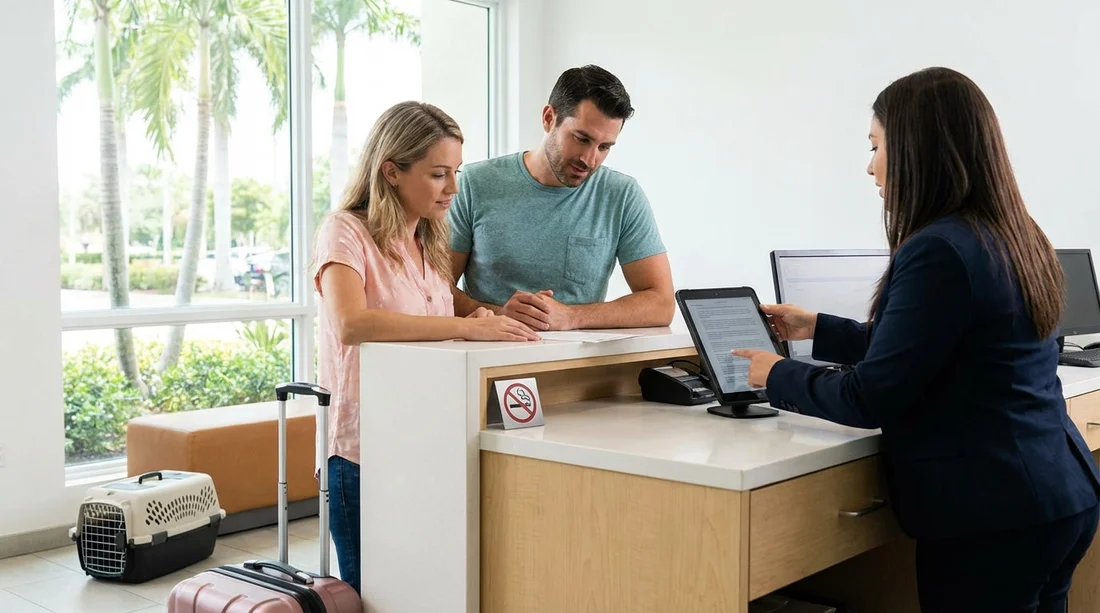
At signing time, you are usually shown a condensed agreement on a screen, with longer terms referenced elsewhere. First, locate the “Fees” or “Charges” table, sometimes presented as a list of “Additional Charges” or “Optional and Mandatory Charges”. Then look for cross references, for example “see Cleaning policy”, “see Prohibited Uses”, or “see Return Conditions”. These cross references are where cleaning, smoking, and pet fees are typically defined.
Next, check the “Vehicle Condition Report” or “Check-Out” section. This is where you want any existing odour, stains, or heavy sand to be noted. If the pickup process is rushed, take your own timestamped photos of seats, mats, boot area, and door pockets.
If you are hiring a larger vehicle for family travel, similar rules apply for people carriers. If you are comparing options, you might review terms while considering van hire in Orlando (MCO) or van rental in Miami Beach, since more seats can increase cleaning risk if snacks and sand are involved.
5) A practical pre-sign checklist you can do in five minutes
Before you sign: ask the agent to show you where cleaning fees, smoking fees, and pet terms are written, not just described verbally. Then confirm whether fees are fixed, “from”, or “up to”, and whether taxes apply. Clarify whether vaping is treated as smoking. Confirm pet rules, especially whether a carrier is required.
Before you drive away: do a fast interior sniff test, check for visible stains, ash, hair, and sand in hard to see areas like seat creases. Photograph any existing issues and make sure they are acknowledged on the condition report where possible.
Before you return: remove rubbish, wipe obvious spills promptly, shake out mats, and check the boot and under seats. If you carried a pet, remove hair as best you can. Return with enough time to do a quick walkthrough and request a receipt or return confirmation showing time and location.
FAQ
Q: Are cleaning fees always charged if the car is dusty or sandy in Florida?
A: Not always. Many contracts allow normal use, but charge for “excessive cleaning” such as heavy sand, stains, spills, or strong odours. The trigger words in the agreement matter more than the presence of a little dust.
Q: Does a smoking fee usually include vaping?
A: Often, yes. Many Florida car hire agreements define smoking to include vaping and e-cigarettes. Check the “Prohibited Use” or “No Smoking” clause for the exact definition before signing.
Q: If pets are allowed, can I still be charged a pet cleaning fee?
A: Yes. “Allowed” typically means you may transport a pet, but it does not guarantee there is no fee. Agreements often reserve the right to charge for hair, stains, or odour removal under a general cleaning clause.
Q: Where do smoking and cleaning charges appear in the rental agreement?
A: Common locations include “Fees”, “Vehicle Condition”, “Return Condition”, and “Prohibited Use”. Sometimes the short agreement references longer terms, so look for cross references to cleaning or prohibited conduct policies.
Q: What evidence should I keep to dispute a cleaning or smoking charge?
A: Keep timestamped interior photos from pickup and return, the signed condition report, and your return receipt or confirmation. If charged later, request the supplier’s inspection notes and any supporting images.

























































































