


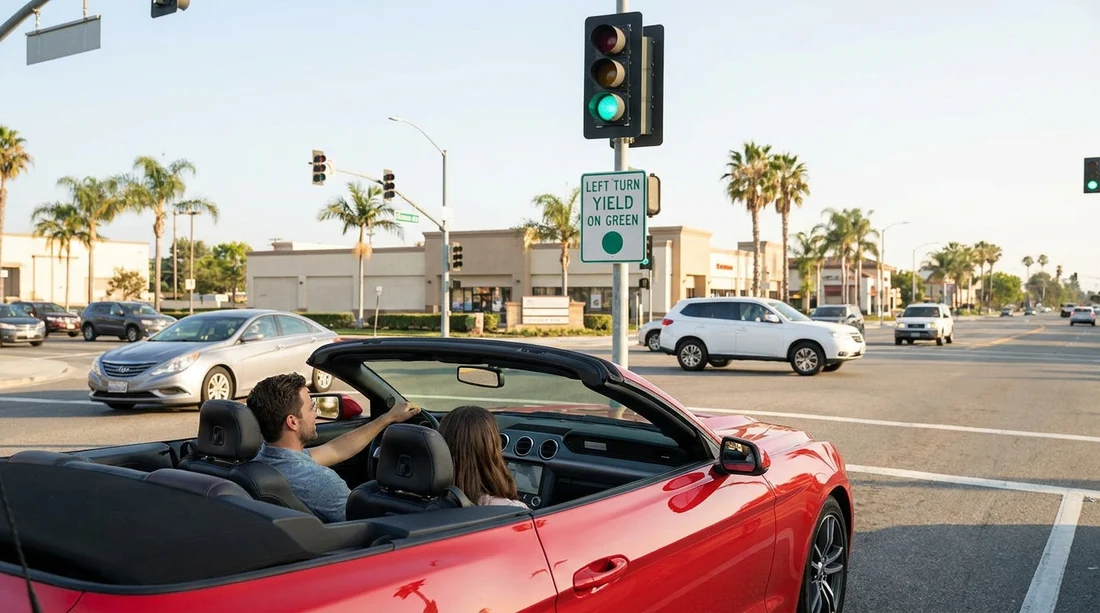
Quick Summary:
- On a green light, turn left only after yielding to others.
- Yield to oncoming traffic, cyclists, and pedestrians crossing with priority.
- Wait for a clear gap, never assume others will slow down.
- Scan, signal, then commit smoothly to reduce hesitation and risk.
When you collect a car hire in California, the first few junctions can feel fast and unfamiliar, especially around airports and city arterials. One sign that regularly catches visitors out is “Left turn yield on green”. It sounds like permission, but it is really a warning about priority. Understanding it before you leave the car hire lot helps you avoid risky assumptions and keeps traffic flowing smoothly.
In simple terms, the sign means this: if you have a steady green light (a circular green) and you want to turn left, you must give way to any traffic coming towards you that is going straight or turning right, and you must also yield to pedestrians and cyclists who are crossing the road you want to enter. You may complete the left turn only when it is safe and legal to do so.
This is different from a protected left turn, where you get a green arrow pointing left and opposing traffic has a red signal. With a protected left, your turn is prioritised. With “left turn yield on green”, your turn is permissive, you are being allowed to turn only if you can do it without forcing others to brake or swerve.
Where you will see this sign in California
You will commonly see “Left turn yield on green” on wide multi lane roads, near freeway ramps, and at junctions with heavy crosswalk use. It often appears where there is no dedicated left turn arrow, or where the arrow appears only at some times of day. In busy areas, the junction may have a left turn lane, but the signal facing you might still be a circular green rather than a green arrow.
If you are picking up a vehicle near a major airport, you are likely to meet this setup quickly. For example, the first few exits around Santa Ana airport car rental routes can put you onto large signalised intersections with quick cycles and multiple lanes to read at once. Similarly, urban approaches around San Francisco airport car rental often combine heavy pedestrian flow with short gaps in opposing traffic.
Who has priority when you are turning left on green
Think of priority in layers. If any road user is in a higher priority layer, you wait.
1) Pedestrians in the crosswalk. If pedestrians are crossing the road you want to turn into, they have priority when they have a walk signal or are already in the crosswalk. Even if the light is green for you, you must wait until the crosswalk is clear. Be alert for people stepping off the kerb late, and for groups that move at different speeds.
2) Cyclists and scooters. Cyclists may be in a bike lane to your left, in a shared lane, or coming from the opposite direction. When you turn left, you must not cut across a cyclist’s path. Also watch for e bikes moving faster than expected.
3) Oncoming vehicles going straight. Any oncoming car proceeding straight through the junction has priority. Your left turn should not cause them to brake. California traffic can move briskly at the start of a green, so assume they will accelerate.
4) Oncoming vehicles turning right. If they are turning right on a green, they also have priority over your left turn, because they are not crossing opposing traffic, you are. Be especially cautious if their right turn is into multiple lanes, as they may choose a different lane than you expect.
5) Your left turn. You go only when the above are clear and you can complete the turn smoothly.
This hierarchy matters when you are in an unfamiliar car hire vehicle. Different mirrors, different blind spots, and unfamiliar indicator stalks can slow your decision making. Build a predictable routine so you are never “half committed” in the intersection.
Protected arrow vs permissive green, how to tell quickly
The fastest rule is: a green arrow means protected movement in the arrow direction. A circular green means proceed, but turning traffic must yield. Some junctions use a “flashing yellow arrow” for left turns, meaning you may turn left but you must yield, similar to the sign’s message. If you see the sign and a circular green, treat your turn as yielding. If the signal changes to a green arrow, you can complete the turn, still checking for pedestrians.
Do not rely on what the car next to you does. Locals may take smaller gaps than you find comfortable. With a car hire, prioritise a gap that lets you accelerate through the turn without harsh braking by anyone else.
Safe decision steps before you leave the car hire lot
Before you even reach the first major junction, set yourself up to handle “yield on green” turns.
Step 1, adjust for visibility. Set seat height, mirrors, and steering wheel so you can see the signal heads and the crosswalk edges. Make sure the windscreen is clear and demisted. If you are driving an SUV or van, the bonnet line may hide a smaller pedestrian near the kerb.
Step 2, know your indicators and wipers. In an unfamiliar car hire, accidental wiper activation can distract you at the exact moment you need to scan. Confirm indicator operation and cancel behaviour before you reach traffic.
Step 3, choose the correct lane early. If there is a dedicated left turn lane, enter it in good time and match speed with the flow. Sudden lane changes near the junction increase conflict with cyclists and drivers accelerating on green.
If you are driving away from a busy rental area such as Los Angeles van rental at LAX, allow extra space and time. Larger vehicles take longer to clear the intersection, so your safe gap needs to be bigger than it would be in a compact car.
How to execute the left turn safely at a busy California junction
1) Signal early and reduce speed smoothly. Signal well before the junction and slow down in a controlled way. Avoid abrupt braking that invites a rear end conflict.
2) Stop at the limit line if required. If the light is red, stop behind the limit line. If it is green and you are already in the left turn lane, you may enter the intersection to prepare for a permissive left, but only when it is safe and legal, and only if there is space to complete the turn without blocking the junction.
3) Position your vehicle for maximum sight. Keep your wheels straight while waiting. If you are hit from behind, turned wheels can push you into oncoming traffic. Hold a position that lets you see around any opposing left turners without edging into their path.
4) Yield, then commit. Wait until oncoming lanes are clearly stopping or there is a clean gap. Then accelerate through the turn decisively. Hesitation is dangerous because it increases the time you are exposed in the intersection.
In downtown areas near San Diego airport car rental corridors, watch for right turning vehicles that swing wide and for pedestrians who start crossing on a late countdown. Treat every green phase as a mixed environment, not just a vehicle only movement.
FAQ
What exactly does “Left turn yield on green” mean? It means a green light allows you to proceed, but if you are turning left you must give way to oncoming traffic, cyclists, and pedestrians before completing the turn.
Do I always have to stop when I see this sign? No. You stop only if the signal is red or if you cannot turn safely. On a green light, you may proceed to turn left only after yielding and confirming the path is clear.
Who goes first, me turning left or an oncoming car turning right? The oncoming car turning right generally has priority because your left turn crosses opposing traffic. You should wait unless you have a protected green arrow or the way is clearly clear.
Can I enter the intersection and wait to turn left on green? In many situations drivers do pull forward to wait, but you must not block the junction and you must yield to pedestrians and oncoming traffic. Only do this if there is space and you can complete the turn safely when a gap appears.
What if drivers behind me honk when I wait? Stay focused on safety and right of way. You are responsible for yielding on a permissive green, and you should only turn when you can do so without forcing others to brake or swerve.

























































































