


Quick Summary:
- Check lane signs for required occupants, operating hours, and access rules.
- Assume HOV 2+ unless signage clearly shows a different requirement.
- Confirm express lane toll payment, transponder needs, and any admin fees.
- Avoid Clean Air Vehicle exceptions unless the hired car officially qualifies.
If you are planning a California road trip, HOV lanes can look like an easy win for saving time. For car hire drivers, the key is understanding that California uses several similar-looking lane types, each with different rules, enforcement, and tolling. The signs are the final authority, but knowing the common patterns before you pick up the keys helps you avoid citations and unexpected charges.
HOV usually means “High Occupancy Vehicle”. You will also see “carpool lane”, “diamond lane”, “express lane”, “HOT lane”, and “FasTrak” used on signs and maps. Some are free for carpools, some are tolled for solo drivers, and some are restricted to carpools only during certain hours. Your route into and around Los Angeles can look very different from a drive near Sacramento or San Diego, so it pays to check what applies where you are going.
If you are collecting from a major airport, it is sensible to get oriented before you pull out of the car park. For example, drivers leaving Los Angeles LAX often hit managed lanes quickly, and the same applies when heading out from San Diego Airport. Your car hire agreement may also describe toll programmes and admin fees, which can matter as much as the road rules.
What counts as an HOV lane in California?
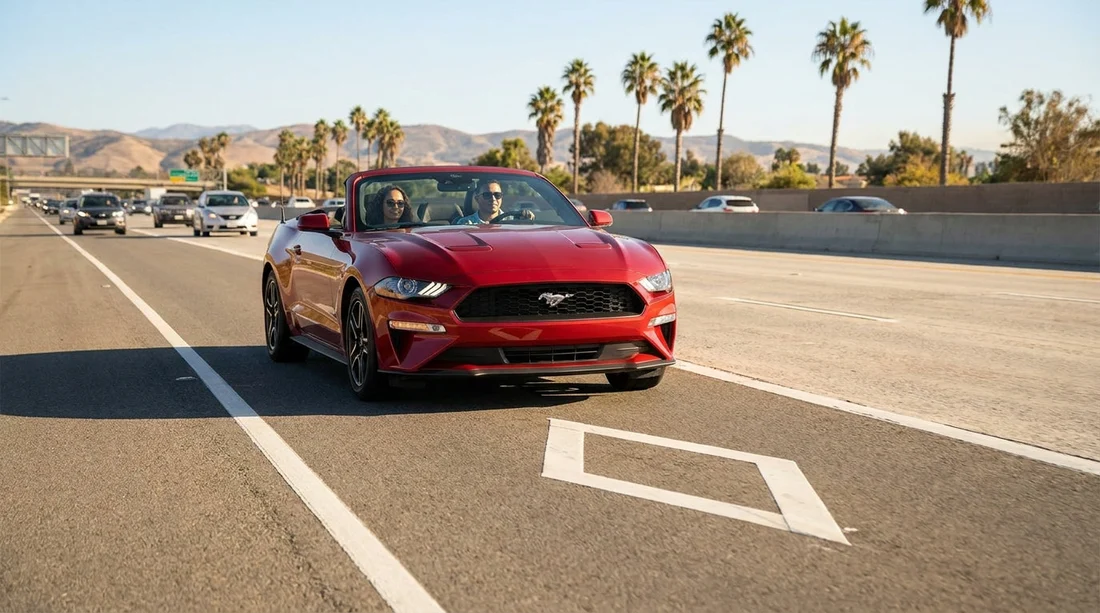
In California, HOV facilities are typically marked with a diamond symbol on the roadway and signs that say “Carpool Lane” or “HOV 2+” (or “HOV 3+”). Traditional HOV lanes are generally free if you meet the occupancy requirement and are open only to eligible vehicles. Managed lanes, often called express lanes, may allow carpoolers to ride free or discounted, but can also charge solo drivers a toll.
Because the term “HOV” gets used loosely, do not assume every diamond-marked lane is free. Some corridors are “FasTrak only” lanes, meaning you may need a transponder or a registered account to use the lane, even if you have enough passengers. Always read the posted sign at the entry point and any overhead gantry signs that follow.
Who can use HOV lanes, and how occupancy works
Occupancy rules are simple in principle but strict in enforcement. “2+” means at least two people in the vehicle, including the driver. “3+” means at least three. Children count as occupants, including infants, but pets do not. If you have two adults and a baby in a child seat, that qualifies for 3+ if the sign requires it.
Timing matters. Many HOV lanes have limited hours, such as weekday peak periods, and may be open to all traffic outside those times. When the sign lists hours, the lane rules apply only during the posted times. If no hours are shown, assume the HOV restriction applies at all times.
Motorcycles are commonly allowed in HOV lanes regardless of passenger count, but you should still read the local sign because managed lanes can have additional requirements. If you are hiring a larger vehicle for family travel, note that passenger counting is the same whether you are in a compact or a people carrier. If your plans involve a bigger vehicle from San Jose SJC, the same HOV occupancy thresholds apply, but your lane changes and merging gaps may need more care in heavy traffic.
Express lanes, HOT lanes, and “FasTrak only” signs
California has an expanding network of express lanes. These may be called HOT lanes, meaning high occupancy or toll. The lane can serve carpools, buses, and other eligible vehicles, while also selling spare capacity to solo drivers via variable tolls. Tolls can change based on congestion, so the price shown on the electronic sign is the price at that moment for that lane segment.
For car hire drivers, the practical questions are: can your hired vehicle use the lane, how will tolls be paid, and will there be admin fees? Some rental fleets include or offer access to toll services, while others may require you to opt in. Some corridors use number-plate billing tied to an account, while others strongly prefer or require a FasTrak transponder. If your lane is posted “FasTrak only”, do not assume you can just drive through and pay later like a standard toll road.
Before you leave the counter, confirm whether the car has a transponder and whether it is active. If the car has a switchable transponder, ask how to set it for the correct occupancy where permitted. If you are picking up with a specific provider, it can help to review location details such as Payless at San Jose SJC so you know what questions to raise about toll handling and charges.
Clean Air Vehicle decals and why they matter in a hire car
You may see “Clean Air Vehicle” references associated with HOV access. California has historically allowed some qualifying low-emission vehicles to use certain HOV lanes with fewer occupants if they display the correct state-issued decal. The rules can vary by programme and can change over time.
In a car hire, the important point is that you cannot assume a hybrid or EV automatically qualifies, and you cannot add decals yourself. If the vehicle does not already have the appropriate, valid decals and documentation, treat it like any other car for HOV purposes. Entering an HOV lane under a decal exception when your vehicle does not qualify can be treated like any other HOV violation.
Common mistakes rental car drivers make with California HOV lanes
Assuming all diamond lanes are free. Some are toll lanes that still require an account or transponder. Read every entry sign.
Misreading the hours. A lane might be HOV-only only during certain periods. Outside those hours it may be open to all traffic, but the reverse is also possible.
Forgetting that “2+” includes the driver. Two people total qualifies, not two passengers.
Crossing double solid lines. Many express lanes use double white lines to indicate no crossing except at designated openings. Crossing can lead to a separate citation, even if you have enough occupants.
What to check before you drive off in your car hire
1) Your planned routes. If you will be commuting at peak times, search whether your corridors have express lanes and whether they are FasTrak-only. This matters on urban motorways near Los Angeles, the Bay Area, San Diego, and parts of Sacramento.
2) Toll equipment. Confirm whether the vehicle has a transponder, whether it is removable or fixed, and whether it can be set for occupancy. If not, ask what alternatives exist for toll payment.
3) The rental company toll policy. Ask how tolls are billed, when charges post, and what daily caps or admin fees apply. Keep your contract details and any toll programme paperwork.
4) Who will be in the vehicle. If you will sometimes be driving solo, plan to avoid HOV-only lanes during restricted hours. If you will consistently have two or three people, identify where that saves time and where express lanes still require a device.
FAQ
Can I use California HOV lanes in a car hire? Yes, if you meet the occupancy requirement and follow any posted restrictions. The fact it is a hire car does not change the basic eligibility.
Do children count toward HOV occupancy in California? Yes. Any person in the vehicle counts, including infants and children in car seats. Animals do not count.
Are express lanes the same as HOV lanes? Not always. Some express lanes are HOV-friendly but still require FasTrak or charge tolls for solo drivers. Always follow the specific lane signage.
What happens if I use an express lane without the right toll setup? You may receive a toll violation or later billing via the rental company, often with added admin fees. Check transponder and toll policy before driving.
Can I cross double white lines to enter or leave an express lane? No. Double solid white lines usually mean you must not cross. Use only the designated entry and exit openings.

























































































