


Quick Summary:
- Use frontage roads to access businesses and set up correct exits.
- Take signed U-turn lanes only from the marked cut-through points.
- On slip roads, choose your lane early, then follow exit-only arrows.
- Watch for one-way service roads, yield signs, and right-on-red rules.
Driving in Texas with a car hire can feel unfamiliar because the road network is designed to keep highway traffic moving fast while still providing access to shops, hotels and neighbourhood streets. That is where frontage roads, slip roads and those distinctive signed U-turn cut-through lanes come in. Learn the logic behind them and you will stop second-guessing exits, reduce last-second lane changes, and avoid manoeuvres that are legal elsewhere but risky here.
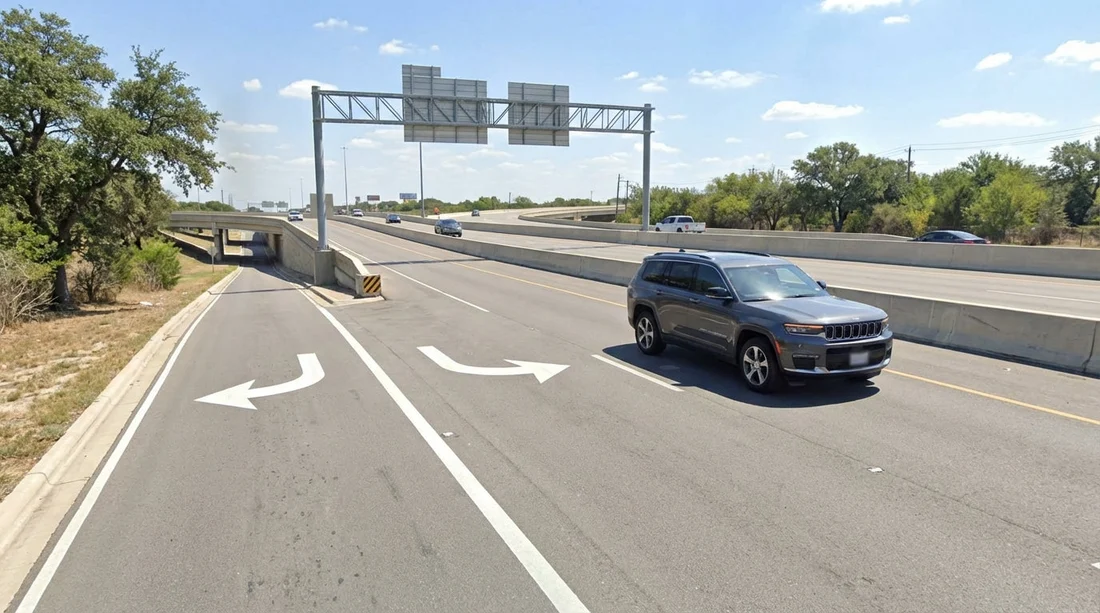
Texas uses frontage roads (also called service roads) alongside many major highways. Instead of turning directly off the highway into a business driveway, you often exit onto a parallel road, travel a short distance, then turn into your destination. This setup also makes it common to miss a turn on the first try, then recover using the frontage road rather than attempting an unsafe swerve across lanes.
If you are collecting a vehicle around Dallas or Fort Worth, these patterns appear immediately on routes near the airport and along major corridors. For location-specific pickup details and local driving conditions, you can compare options on Dallas DFW car rental and Fort Worth DFW airport car rental.
Frontage roads in Texas, what they are and why they exist
A frontage road runs parallel to a highway, separated by a barrier or a strip of land. In Texas they are often one-way, carrying traffic in the same direction as the highway. Their purpose is to provide access to local streets and businesses without stopping or slowing highway traffic. If you need to reach a petrol station, hotel or retail park next to the highway, you will likely exit onto the frontage road first.
There are two key ideas to remember. First, you normally exit the highway earlier than you expect, because the exit is not directly onto the cross street. Second, the frontage road is part of the route, not just an optional side lane. Your navigation may say “take Exit 235, then turn right,” but that right turn usually happens after you are already on the frontage road.
Common frontage-road features you will see include frequent right turns into parking areas, short slip roads that connect back to the highway, and signalised intersections under overpasses. Expect heavier weaving, because drivers are entering and leaving the frontage road more often than on a standard urban street.
How to exit correctly without overshooting
On a Texas motorway, watch for the “EXIT ONLY” lane markings and overhead signs well before the junction. When the sign shows an exit number and a destination street, the actual ramp normally leads to the frontage road first. If your goal is to cross over the highway to the other side, you still begin by exiting, then using the intersection under or over the highway to continue across.
A reliable method is to plan in three steps: (1) get into the correct lane early, (2) take the exit ramp to the frontage road, then (3) look for the next sign that directs you to the cross street or U-turn. This is particularly helpful around high-traffic areas where lanes split quickly.
If you are driving a larger hire vehicle, allow more space for merges and turns. Wider vehicles can be easier to manage when you take exits smoothly and avoid quick lane changes. If you are travelling as a family group, it can help to review vehicle sizing information via minivan rental at Dallas DFW, as larger vehicles change how comfortably you can navigate tight frontage-road turns and parking entrances.
Slip roads, entrance ramps and the merge culture
In UK terms, slip roads in Texas cover both exit ramps and entrance ramps. Exit ramps often reduce speed quickly, sometimes with a tight curve. Entrance ramps can be short or long, depending on the area, and you are expected to accelerate to match highway speed before merging. On busy corridors, drivers tend to merge assertively, so it helps to signal early and keep a steady pace.
When joining a highway from a frontage road, you may encounter a stop or yield sign at the end of the ramp, especially on older interchanges. If there is a yield sign, you must give way to highway traffic. If there is a merge lane, use it fully to accelerate and find a gap, rather than stopping unless traffic forces you to.
Two practical tips reduce stress. First, check mirrors early and identify whether you are merging into a dedicated lane that continues, or into a lane that ends quickly. Second, avoid matching speed with a vehicle beside you, either ease off slightly or accelerate, so you create a usable gap.
Signed U-turn cut-through lanes, how they work
Texas U-turn lanes are designed to let you reverse direction efficiently without going through a full set of traffic signals. You will usually find them at major intersections and at highway overpasses. They are clearly signed with U-turn arrows and often say “U TURN ONLY.” You enter the cut-through lane, curve under the bridge, and emerge onto the frontage road travelling the opposite direction.
These are legal and normal when signed, but you must use the correct entry point. Do not attempt a U-turn from a through lane unless signage and lane markings explicitly allow it. Many intersections prohibit U-turns from certain approaches, even if they allow left turns.
Also note that some U-turn lanes are controlled by traffic lights, while others are yield-controlled. If you see a yield sign, treat it like joining a road. Yield to traffic already moving along the frontage road you are entering, and watch for pedestrians where the U-turn lane meets a crosswalk.
Using frontage roads and U-turns to recover from a missed turn
One of the most useful things to know for Texas driving is that missing an exit is rarely a disaster. Because frontage roads run parallel, you can often continue to the next intersection, use a U-turn cut-through, and come back along the opposite frontage road to reattempt the exit or reach the business entrance from the other direction.
Here is the safe recovery pattern. Stay in your lane, take the next exit onto the frontage road, continue until you find a signed U-turn or a signalised intersection, reverse direction legally, then follow signs to rejoin the highway or reach your destination. Avoid stopping on the shoulder to “fix” navigation, and do not reverse on an exit ramp. Those actions are dangerous and typically illegal.
Lane rules, signals and common legal pitfalls
Frontage roads can be one-way or two-way, but one-way is common near major highways. Look for “ONE WAY” signs and the direction of parked cars and lane arrows. If you accidentally turn the wrong way onto a one-way frontage road, do not continue. Pull into a safe driveway or parking area and reorient.
Right turn on red is generally allowed in Texas after a complete stop unless a sign says otherwise. However, at busy frontage-road intersections, there can be a dedicated right-turn lane with its own signal. If the lane has a red arrow, you must wait, even if cross traffic is clear.
Another frequent confusion is the frontage-road left turn. You might think you can turn left across several lanes to reach a shop on the far side. Usually you cannot. You are expected to proceed to an intersection, use a U-turn lane, then approach the entrance from the correct side.
If you are driving around Austin, expect the same frontage-road logic on major routes, plus more complex lane guidance near downtown. Local pickup and driving notes can be found on Austin AUS car rental and, if you are comparing suppliers, Avis car hire in Austin AUS.
Reading the signs that matter most
Texas interchanges rely on a few sign types that are worth recognising quickly. “EXIT ONLY” means the lane must leave the highway. If you stay in it, you will be forced off, which is often fine because you can loop back using frontage roads, but it may add time. “FRONTAGE RD” or “SERVICE RD” confirms you are leaving to the parallel road. “U TURN” signs usually include an arrow showing where the cut-through begins.
Pay close attention to lane arrows painted on the road. They often show whether a lane is turn-only or can continue straight. On frontage roads near signals, a lane might be marked “RIGHT TURN ONLY” to feed an on-ramp, which can unintentionally send you back onto the highway if you are not watching.
If you rely on sat nav, use it as confirmation rather than authority. In multilane areas, the best approach is to match the exit number and the street name on the overhead signs, then let the navigation recalculate as needed. Texas roads are designed with redundancy, so rerouting is typically easy and safe.
Practical driving approach for visitors using car hire
Set yourself up with a simple routine each time you approach an interchange. First, decide whether you need to stay on the highway or move to the frontage road. Second, get into the correct lane early, ideally a mile or more ahead on busy roads. Third, once on the frontage road, slow down and look for business entrances, cross-street signs, and the next ramp back to the highway.
Give yourself extra time for manoeuvres at peak hours. Texas drivers are used to these patterns and may assume you will keep moving. If you are unsure, do not block a lane. Continue forward to the next safe turn or driveway and reset.
Finally, remember that frontage roads can contain sudden queues near traffic lights, especially where an on-ramp begins. Leave a larger following distance than you would on a normal high street, because braking can be abrupt.
FAQ
Are frontage roads the same as service roads in Texas? Yes. In Texas the terms frontage road and service road are used interchangeably for the parallel road running alongside a highway.
Can I make a U-turn anywhere at a junction in Texas? No. Only make a U-turn where signs and lane markings permit it, and use the dedicated U-turn cut-through lanes when provided.
What should I do if I accidentally take an exit onto the frontage road? Stay calm, continue along the frontage road, and use the next signed ramp or U-turn point to rejoin the highway or correct direction.
Do I have to stop on an entrance ramp when merging? Not usually. Use the ramp to accelerate and merge, but obey any stop or yield signs that control the ramp end.
Why does my sat nav say “keep right” so often on Texas highways? Many interchanges split into exit-only lanes and through lanes. “Keep right” guidance helps you avoid being forced onto a frontage road or wrong ramp.

























































































