


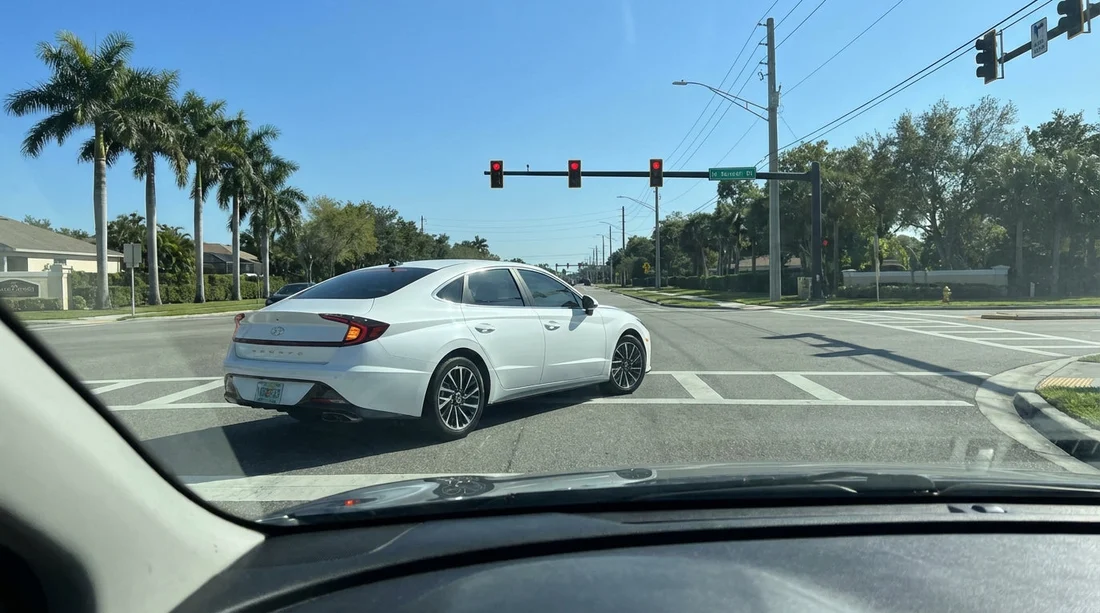
Quick Summary:
- Left on red is allowed only from a one-way to one-way street.
- Stop first, then turn only when the way is clear.
- Any “No Turn on Red” sign overrides the general Florida rule.
- Never turn on red if crossing pedestrians, cyclists, or a school crossing.
If you are picking up car hire in Orlando, the “left on red” rule is one of the easiest ways to get caught out. Many visitors know that Florida generally allows a right turn on red after stopping, but fewer realise there is also a limited situation where a left turn on red can be legal. The catch is that it is legal only in a very specific layout, and in tourist-heavy areas around Downtown Orlando, International Drive, and near major attractions, there is often signage that removes that permission.
This guide explains the exact scenarios where Florida permits a left turn on red, what you must do before turning, and when it becomes illegal, even if the junction looks like it should be allowed.
What Florida law actually allows for a left turn on red
In Florida, you may make a left turn on red only when you are turning from a one-way street into a one-way street. You still must come to a complete stop first, and you must yield to pedestrians and other traffic that has the right of way. Think of it as the mirror image of a right-on-red, but it works only in that one-way-to-one-way arrangement.
For Orlando visitors with car hire, this often shows up in downtown grids and in areas with service roads, garages, and hotel access lanes that are posted as one-way. It is far less common on the big multi-lane roads around theme parks, because those roads are usually two-way.
If you are collecting a vehicle from the airport area, it helps to settle in on local road rules early. Hola Car Rentals provides airport options across the main pickup points, including Orlando Airport car hire and other MCO-focused pages where you can compare providers and vehicle types.
The only legal “left on red” setup, explained clearly
To be legal in Florida, a left turn on red must meet all of the following conditions at the same time:
1) You are on a one-way street. There should be clear “One Way” signs, directional arrows on signs, and often lane arrows painted on the road.
2) You are turning into a one-way street. The street you are entering must also be one-way, flowing in the direction you will travel after the turn.
3) You come to a complete stop at the stop line or before the crosswalk. This matters in Orlando, where pedestrian crossings are frequent in busy areas.
4) You yield to everyone with priority. That includes pedestrians stepping off the kerb on a walk signal, cyclists, and vehicles approaching with a green signal.
If any of those elements are missing, you cannot turn left on red. The most common mistake is attempting to turn left on red from a one-way street into a two-way street, which is not permitted.
How to identify one-way streets quickly in Orlando
Visitors often miss one-way signs because they are looking for the traffic signal head. Use a quick scan routine at every red light where you are considering a turn:
Look for “One Way” signs on both streets. On the street you are on, there is often a “One Way” sign behind or to the right of the signal. For the street you want to enter, there may be a “One Way” sign on the far corner or mounted on a pole that faces oncoming traffic.
Check the lane arrows. Painted arrows pointing only one direction can confirm the flow, but do not rely on paint alone, as markings can be faded.
Look at parked cars. On one-way streets, parked vehicles usually face the same direction. It is a helpful clue, not a legal confirmation.
Watch cross traffic. If traffic on the street you want to enter appears to be moving both ways, treat it as two-way and do not make a left on red.
Downtown Orlando has several one-way stretches, and these checks become especially important at night or in heavy rain when signs are harder to read.
The stop requirement, where to stop, and why it matters
Even if a left on red is allowed, Florida requires you to stop first. In practice, police often assess this the same way they do for right on red: your wheels must fully stop before you proceed.
Stop at the stop line if there is one. If not, stop before the crosswalk. If there is no crosswalk, stop before entering the intersection. Rolling through and then stopping while already blocking the crossing can still lead to a citation, especially in pedestrian-heavy areas near venues and hotels.
This is also where visitors with car hire get surprised by local driving culture. Some local drivers may creep forward quickly. Do not copy them. Your priority is legality and safety, particularly with pedestrians who may enter late on a flashing signal.
The signage that overrides left on red every time
The general rule allowing left on red from one-way to one-way is cancelled by signs or signal controls that prohibit it. You should treat the following as absolute “do not turn” instructions unless the signal changes to green for your movement:
“No Turn on Red”. This is the most common override. It can apply to both right and left turns, depending on where it is placed. If it is posted next to your lane or near your signal face, assume it applies to your turn.
“Left Turn Signal”. If the intersection uses a dedicated left arrow and signs indicate you must follow the arrow, do not turn on red. Many junctions manage pedestrian phases and conflicting traffic this way.
Lane-use control signs and arrows. If your lane is marked for left turn only and controlled by a red left arrow, that red arrow means stop, and no turn is allowed unless signage explicitly permits a turn on red. In Florida, a red arrow is treated as a red signal for that movement.
“Do Not Enter” or wrong-way signage. Occasionally, visitors misread a one-way setup and nearly enter against traffic. If you see “Do Not Enter”, stop and re-evaluate immediately.
When you are navigating from airport pickup routes into the city, you may prefer to keep things simple by choosing straightforward routes and avoiding tight downtown one-way grids until you are comfortable. If you are arranging car hire through Hola Car Rentals, you can review location-specific pickup options such as car rental at Orlando MCO before arriving, which helps reduce first-drive stress.
When a left on red is illegal, even if it feels logical
Here are the common Orlando scenarios where visitors assume a left on red should be fine, but it is illegal:
One-way to two-way. This is the big one. You may be on a one-way exit road from a garage, turning onto a main road that carries traffic both directions. That left on red is not allowed.
Two-way to one-way. Turning left on red from a normal two-way road into a one-way is not allowed either. The “from” street must be one-way.
Any posted prohibition. A “No Turn on Red” sign ends the debate, even in a one-way to one-way situation.
Red left arrow controlling your lane. Unless you have a green arrow, treat it as a hard stop for the left movement.
Blocked sightlines. Even if technically permitted, if you cannot see oncoming traffic clearly because of parked vans, delivery trucks, or landscaping, the safe choice is to wait for green. Failing to yield can still produce a ticket or a collision fault.
Pedestrians in or entering the crosswalk. Florida requires you to yield. In busy tourist areas, pedestrians may step out late. If you turn and force them to stop, you can be cited.
One-way junctions near tourist areas: why citations happen
Orlando’s visitor zones concentrate unfamiliar drivers, heavy foot traffic, and complex access roads around hotels, outlets, and entertainment districts. Police know that illegal turns frequently happen at:
Garage exits and hotel one-way loops. Drivers see a red light and assume any turn is fine after stopping.
Multi-lane intersections with separate arrows. Visitors watch the main green and miss that their lane is still controlled by a red arrow.
Downtown one-way pairs. The streets run in parallel one-way patterns, so it looks like “everyone is turning”, but the exact turn may be prohibited by signage.
If you are driving a larger vehicle such as an SUV, your sightlines can be better, but your turning radius and blind spots are different. If you are comparing vehicle options for family trips, you might look at pages like SUV hire near Disney Orlando MCO to match the vehicle to your route comfort level.
A simple decision checklist for drivers using car hire in Orlando
Use this quick checklist at any red light where you are thinking about turning left:
Step 1: Am I on a one-way street? If no, do not turn left on red.
Step 2: Am I turning into a one-way street? If no, do not turn left on red.
Step 3: Do I see any “No Turn on Red” sign? If yes, do not turn.
Step 4: Is my movement controlled by a red left arrow? If yes, do not turn.
Step 5: Can I stop fully behind the line and see clearly? If no, wait for green.
Step 6: Are pedestrians or cyclists present or approaching? If yes, yield fully, and wait if needed.
This approach keeps you legal, and it avoids the pressure of following local drivers who might be taking risks.
What about right on red, and does it affect left on red?
Right on red is more common, but the same principles apply: you must stop, you must yield, and signs can prohibit the turn. The reason this matters for left on red is that drivers sometimes treat “turn on red” as a general permission. In Florida it is not. Left on red is the exception, and only in the one-way to one-way case.
If you are planning a longer stay with multiple day trips from Orlando, selecting the right provider and pickup option can help reduce the need for stressful downtown driving. Hola Car Rentals lists a range of suppliers, including pages such as Enterprise car hire Orlando MCO, so you can compare what fits your plans without changing the road rules you need to follow.
If you make a mistake: safe ways to recover
If you realise you are in the wrong lane or about to make an illegal left on red, do not force the turn. The safest recovery options are:
Stay put and continue straight when green. You can reroute using the next safe turn.
Do not reverse. Reversing at a light or into an intersection is dangerous and can be illegal.
Follow one-way rules strictly. If you miss a turn in a one-way grid, accept the loop and re-navigate. It often adds only a minute or two.
These habits are particularly useful around event traffic, where cones and temporary signage can make junctions feel unfamiliar even to confident drivers.
FAQ
Can I turn left on red in Florida when driving in Orlando? Yes, but only when turning from a one-way street onto a one-way street, after a complete stop and yielding to others.
Is a left turn on red allowed from a one-way street onto a two-way road? No. If the street you are entering carries traffic in both directions, the left on red is illegal.
What sign makes a left on red illegal even at a one-way junction? A “No Turn on Red” sign overrides the general rule and prohibits the turn until green.
Does a red left arrow allow a left turn after stopping? No. A red arrow means you must stop and remain stopped for that direction, unless signage specifically permits a turn.
If I am unsure at a junction, what is the safest legal choice? Wait for the green signal or green arrow. Being cautious avoids citations and reduces risk to pedestrians.

























































































