


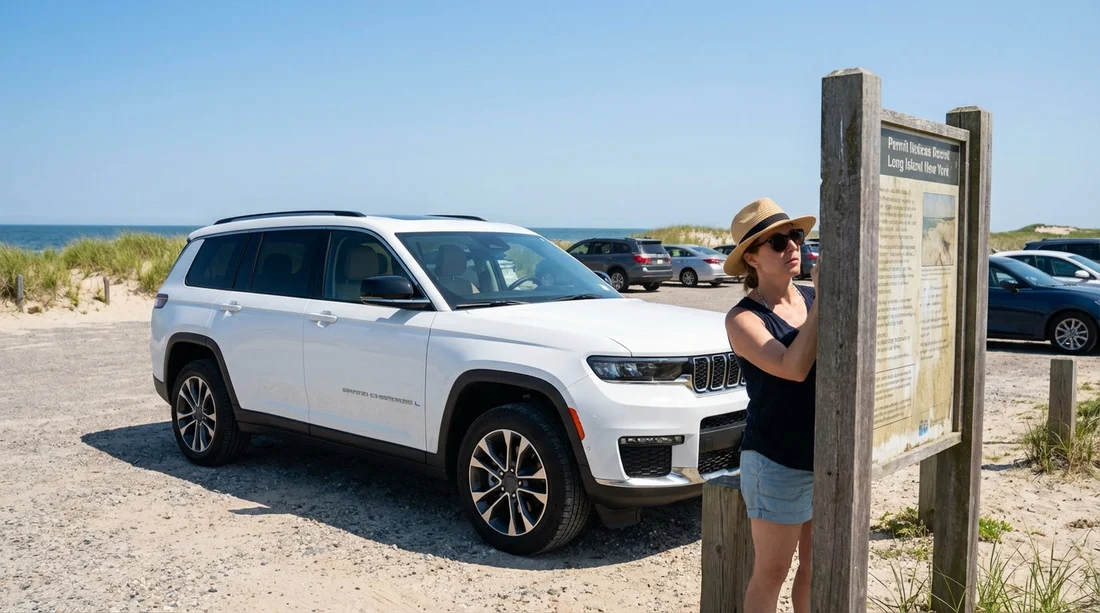
Quick Summary:
- Read every sign at the entrance and pay station before parking.
- Assume oceanfront lots are resident-permit restricted on peak summer days.
- Use town-operated pay lots, garages, or metered streets near village centres.
- Arrive early, keep proof of payment visible, and note enforcement hours.
Long Island beach days are a classic add-on to a New York trip, but parking rules can feel like a trap if you are unfamiliar with how towns and villages manage shoreline access. Many beachfront lots exist primarily to protect local access, meaning non-residents can be limited to certain hours, certain sections, or excluded entirely unless you have a resident permit. With a car hire in New York, the key is learning how to spot resident-only beach lots quickly, how to interpret “permit required” wording, and how to choose alternatives that are designed for visitors.
This guide focuses on practical steps you can use on the day. It is not legal advice, and rules can change by season and by municipality, but the patterns are consistent across Nassau and Suffolk. If you understand the patterns, you can avoid the common ticket scenarios: parking in a resident field by mistake, paying a fee but still needing a permit, or missing a time restriction that flips from “public” to “permit only” in the afternoon.
Why permit-only beach parking is so common on Long Island
Long Island’s most popular ocean beaches sit in towns with limited roads, limited lots, and heavy summer demand. Residents often fund beach maintenance through local taxes or permit programmes, so municipalities reserve prime lots for residents, especially on weekends and holidays. Visitor access is still possible, but it is frequently channelled to specific pay lots, state park facilities, village metered streets, or seasonal shuttles.
From a driver’s perspective, the biggest takeaway is this: “Public beach” does not automatically mean “public parking.” You can be allowed on the sand and still be restricted from parking in the closest lot.
How to spot resident-only lots before you turn in
Most ticket problems start at the entrance. A lot may have multiple signs, and you need to read them in order of importance. Use this quick checklist before you commit:
1) Look for the lot name and operator. If the entrance says “Town of…,” “Village of…,” or “Residents Only Field,” that is your first clue it is restricted. State parks and large regional facilities typically have clearer visitor pricing rather than permit-only language.
2) Scan for permit language at the very top. The strictest restrictions are usually in larger text: “Resident Permit Required,” “Town Permit Parking Only,” “No Non-Resident Parking,” or “Permit Required At All Times.” If you see “at all times,” do not assume paying a machine will make you compliant.
3) Check for time windows that change. A common setup is “Non-residents allowed before 9am” or “Permit required 8am to 5pm.” If you arrive at 10am, the rule that mattered at 7am no longer helps you. Also check for different weekday and weekend rules.
4) Watch for zone or section wording. Some lots have a small visitor section marked by colour, a lettered row, or “Daily Fee Parking” signage. If you park in the wrong section, you can be ticketed even if the lot is not entirely permit-only.
5) Confirm signage at the pay station, not just the gate. A frequent trap is paying a daily fee, then later discovering a smaller sign saying a resident permit is still required in that lot. Payment can be necessary and still not sufficient.
6) Do a 30-second walk around. If you see permit stickers in most windscreens, or enforcement vehicles circling, treat that as a warning to double-check rules.
What “permit required” signs really mean
Permit signage is not standardised across every municipality, so similar phrases can have different implications. Here is how to interpret the most common wording as a visitor using a car hire:
“Permit required at all times.” The strictest form. It usually means only holders of that town or village permit may park there, regardless of payment. If you do not have that specific permit, use another lot.
“Resident permit parking” or “Resident parking only.” Typically the same as above, unless the sign also states a visitor section exists. If you cannot find a clearly marked visitor area, assume you are not allowed.
“Permit required 8am to 6pm” (or similar hours). Visitors may be able to park outside those hours. Be careful, though, because beach lots can close gates or restrict overnight parking. Also, if you park before the permit window begins, you can still be ticketed once the window starts.
“Permit or pay” (or “Permit holders free, daily fee for others”). This is the visitor-friendly version. It means non-residents can pay, but you must follow instructions exactly. Keep proof of payment visible and verify you are in the correct section.
“Beach access permit required.” Sometimes this refers to parking, sometimes to entry or amenities. Read the smaller text. If it mentions “parking” or “vehicle,” treat it as a parking rule.
“No parking without permit” plus a local code reference. That usually indicates active enforcement. If you are unsure, do not gamble, especially in peak season.
The most common ways visitors get ticketed
Paying a machine in a permit-only lot. Some lots have pay stations that apply only to a small visitor area or to different days. Payment does not override a permit requirement.
Parking in a resident section of a mixed lot. Mixed lots can be confusing when the boundary is a small sign on a post. If you cannot clearly identify the visitor section, move.
Missing seasonal dates. Many restrictions only apply from late spring to early autumn, but the exact dates can start earlier than you expect on warm weekends.
Arriving after the non-resident window closes. A beach lot that is fine at 7am can become permit-only mid-morning.
Not displaying proof properly. If you pay, ensure the receipt is placed as instructed, typically face-up on the dashboard. If you use a phone-based system, keep the confirmation and verify the correct plate number.
Visitor-friendly parking alternatives that reduce risk
If your first-choice oceanfront lot looks permit-heavy, you have options. The best alternative depends on whether you prioritise proximity, certainty, or cost.
1) State parks with large public lots. Large state-managed beaches and parks usually provide clearer daily fees and capacity, making them predictable for visitors. Arrive early on peak days because even public lots can fill, and once full, access may be limited until spaces open.
2) Village centres near beaches with metered streets. In some seaside villages, metered streets and municipal lots near the main shopping area can be visitor-friendly, even when the closest beach field is permit-only. The walk may be longer, but the rules are often clearer.
3) Municipal pay lots away from the sand. Some towns operate pay lots slightly inland with marked visitor terms. These can be more forgiving than beachfront fields.
4) Rail station lots plus local shuttle or taxi. On very busy weekends, parking near a rail station or a commercial area and finishing the last stretch by local transport can be less stressful than circling beach lots.
5) Off-peak timing. Early morning and late afternoon often have different rules and lower enforcement pressure. If you can time your visit outside the strictest permit windows, you reduce risk, but only if the signs explicitly allow it.
Practical day-of checklist for your New York car hire
Before you leave New York: save the beach address and a backup parking location in your map app. Build in extra time for traffic and for one failed lot attempt. If your group includes kids or lots of gear, consider a vehicle size that makes loading quick and keeps items out of sight.
On arrival: slow down at the entrance and read every sign, even if cars behind you are impatient. If you are unsure, do not pull into a space “just for a minute,” enforcement can be fast in summer.
When you park: photograph the closest signs, the pay station instructions, and your receipt placement. This is not a guarantee against a ticket, but it helps if you later need to challenge an error.
When you leave the car: remove valuables and beach passes from view. Break-ins are not the norm, but beach lots can be opportunistic environments.
Know your plate number: if payment is app-based, entering a single wrong character can invalidate payment.
Planning your pickup points and driving routes
Many visitors start their beach drive from an airport pickup, then head east via major parkways and local roads. If you are comparing pickup locations, Hola Car Rentals provides information for arrivals at car hire at New York JFK as well as options around Newark, including car hire at Newark Airport EWR and car hire in Newark EWR. For groups carrying chairs, coolers, and umbrellas, a larger vehicle can make day trips calmer, and you can compare space-focused options such as minivan rental at New York JFK.
Whichever pickup point you use, remember that Long Island beach traffic is highly directional, heavy toward the ocean in the morning and heavy back toward New York late afternoon. If you plan around that pattern, you will have more time to deal with parking signage carefully, rather than rushing.
What to do if you still get a ticket
First, do not ignore it. Long Island municipalities typically provide instructions on the ticket for payment or contesting. Keep your photos of signage and payment proof. If you believe the ticket was issued in error, follow the dispute process listed, and be factual. If you parked in a permit-only area by mistake, paying quickly may reduce additional fees, but always read the ticket’s timelines and requirements.
FAQ
Q: If a beach lot has a pay machine, can non-residents always park there?
A: Not always. Some pay machines apply only to a designated visitor section, or they collect fees even for permit holders. Always confirm the sign language, especially “permit required at all times.”
Q: What does “permit required 8am to 5pm” mean if I arrive at 7am?
A: It usually means you may park before 8am, but you can still be ticketed once the permit window begins. Unless the sign explicitly allows all-day parking if you arrived earlier, assume you must move before 8am.
Q: Are there visitor-friendly alternatives when oceanfront lots are resident-only?
A: Yes. Look for state park beaches with large public lots, village metered streets near town centres, or municipal pay lots a bit inland. Arriving early increases your choices.
Q: How can I reduce the chance of a ticket when using a car hire?
A: Photograph signs and payment instructions, double-check the plate number for app payments, and only park where the visitor terms are clearly stated. If anything is ambiguous, choose a different lot.
Q: Do permit rules change by season on Long Island?
A: Very often. Many restrictions tighten during the summer season, on weekends, and on holidays. Treat warm-weather weekends as peak rules unless signage clearly states otherwise.

























































































