


Quick Summary:
- Load bags at your destination, not curbside, then lock immediately.
- Park in staffed garages, avoid quiet side streets, and remove all valuables.
- If theft occurs, photograph damage, location, and contents list with timestamps.
- Report to NYPD and your rental provider quickly, keeping every reference number.
In New York, luggage theft from parked cars is usually fast, opportunistic, and avoidable with good habits. Visitors are most exposed at airports, hotel kerbs, popular attractions, and any spot where someone can watch you load a boot and then wait for you to walk away. With car hire in New York City, the goal is simple, prevent a thief from guessing there is anything worth taking, and if the worst happens, gather enough evidence, quickly, to support a police report and your rental claim.
If you are picking up from the airport area, it helps to know your pickup point and parking plan before you arrive. Many travellers collect at hubs such as car rental New York JFK, or fly into Newark and drive into Manhattan after collecting from car rental airport New Jersey EWR. Airport transitions are exactly when bags are most visible and routines are rushed, so treat the first hour as your highest risk window.
How luggage theft happens in NYC, and why parked cars get targeted
Most “smash-and-grab” thefts in NYC are about speed. Thieves look for easy signals, suitcases visible through glass, shopping bags on the back seat, a sat-nav left on a windscreen mount, or even a boot that was loaded in full view. They also target rental cars because they assume travellers have passports, electronics, and cash. A hire car sticker, barcode on a window, or the simple look of an unfamiliar model can be enough to attract attention.
Another common pattern is “follow theft”. Someone sees you load luggage at an airport, then follows you to a hotel or tourist spot. You park, walk away, and they strike within minutes. If you only remember one principle, it is this, never show the car contains luggage unless you are actively moving it.
Safer loading and unloading in New York: practical, NYC-specific steps
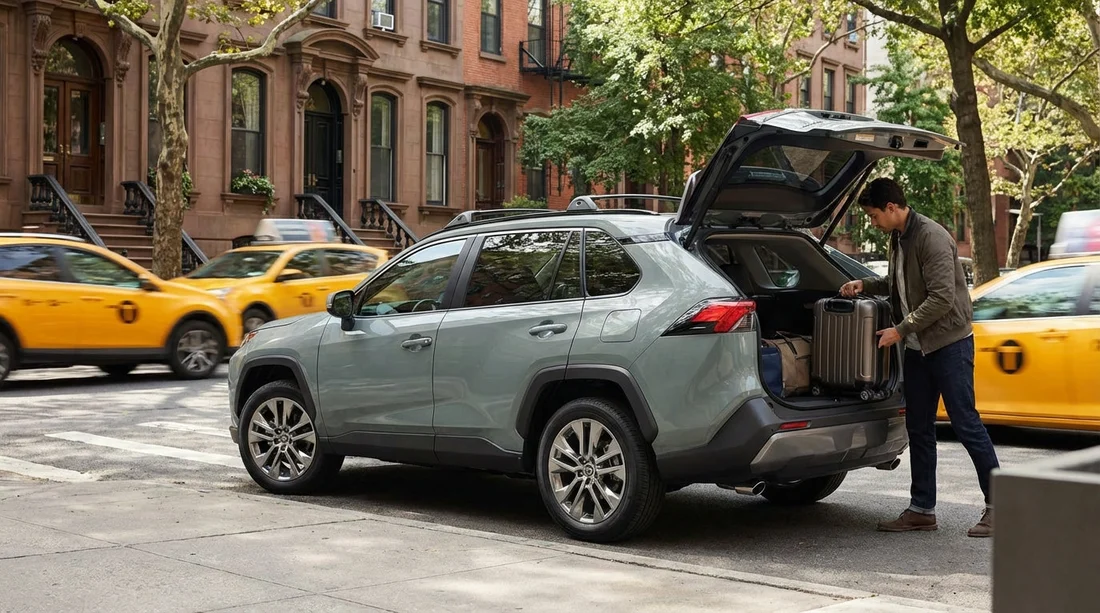
Load at the destination, not at the departure point. If you are leaving a hotel, try to pack the boot in an underground or private garage area rather than on the street. If you must load at the kerb, do it in one quick sequence. Keep doors closed as much as possible, and lock immediately before you do anything else.
Use “two-person security” if you can. One person stays with the car while the other checks in, asks the concierge about safe parking, or collects directions. At busy hotel kerbs in Midtown, a car can be unattended for seconds but that is enough for a thief to grab something from an unlocked door.
Do not reorganise luggage with doors open. Sorting bags, moving items between seats, and repacking on the pavement signals you have valuables. If you need to rearrange, drive to a garage, a staffed lot, or a quieter well-lit area, then do it fast.
Be wary of distractions. If someone “helps” with luggage unexpectedly, or you are approached with a question while the boot is open, pause and close up. Distraction is a known technique in high-footfall areas.
What not to leave visible, and what to remove entirely
With car hire, it is tempting to treat the vehicle like a mobile locker. In NYC you should assume anything left inside will eventually be seen.
Never leave in view: phones, tablets, cameras, headphones, passport wallets, handbags, backpacks, shopping bags, duty-free bags, gym bags, hotel room key packets, or any charging cables. Even a cable can signal a device is nearby.
Remove completely, not just hide: passports, IDs, cash, cards, prescription medicines, car rental paperwork, and anything with personal data. If a thief gets your documents, the impact goes beyond property loss and can complicate travel home.
Avoid “false security” hiding places. Under-seat storage, the glovebox, and the centre console are the first places thieves check. If you must leave something, put it in the boot before you arrive and do not open the boot again in public.
Keep the cabin empty. A truly empty interior is one of the strongest deterrents. It shortens the “reward” calculation that drives opportunistic theft.
Parking choices in NYC that reduce risk
Prefer staffed garages and lots. In Manhattan especially, a paid garage with an attendant reduces casual scanning and gives you a potential witness or CCTV trail. It also reduces the time you spend parallel parking with luggage visible and doors open.
Check lighting, foot traffic, and sight lines. A well-lit block with steady pedestrian flow is usually safer than a quiet side street where someone can work undisturbed. Avoid parking next to scaffolding, large vans, or corners that shield a thief from view.
Minimise time parked with luggage. If you are doing attractions, drop luggage at your accommodation first. If that is impossible, consider storing bags with your hotel or a luggage storage service rather than leaving them in a car for hours.
At airports, treat car parks as high risk. Terminals and long-stay areas are busy and full of travellers with suitcases. Whether you have collected near Newark using car hire Newark EWR or you are passing through JFK, aim to load out of sight, then drive directly away. Do not stop for food with luggage in the car right after pickup.
Simple security habits that help with a hire car
Lock, then check. Many thefts happen because a door was left unlocked for “just a minute”. After loading, press lock and physically check the handle. If your vehicle has keyless entry, keep the key fob away from the car when you are not using it.
Close the boot before you walk away. Sounds obvious, but in the rush of NYC streets, people leave a boot open while they look at maps or messages. Finish the task, close it, lock up, then step away.
Keep your paperwork separate. If your rental agreement or vehicle documents are stolen, it can slow down reporting. Photograph key pages when you receive the car and store the images securely on your phone.
Consider the right vehicle size for your route. If you have lots of luggage, a vehicle where everything fits in the boot with the cover on is safer than one that forces bags onto the seats. For larger groups, a people carrier or van can keep items out of sight, and this can be useful for airport transfers with multiple suitcases.
If luggage theft happens: what to do immediately, in order
When you discover a break-in, your priorities are safety, evidence, and timely reporting. In New York, quick documentation helps both police and your car hire provider assess what happened.
1) Check your surroundings and do not confront anyone. Move to a safer place if you feel threatened. If the thief is nearby, call 911. For non-emergency police assistance, you can call 311 in NYC, but if you have an active scene, use 911.
2) Do not tidy up before photographing. Take clear photos and short video of the car from all sides, then close-ups of broken glass, pry marks, damaged locks, and the exact parking bay or kerb location. Capture street signs, nearby landmarks, and any garage signage. If your phone allows it, ensure location services are on so images store GPS metadata.
3) Record timestamps and a contents list immediately. Write down when you last saw the car intact, when you discovered the theft, and any suspicious observations. Make a list of stolen items with approximate values, brands, models, colours, and serial numbers if you have them. If you have purchase receipts or photos of the items, note where they are saved.
4) Look for cameras and witnesses. Without trespassing, note nearby CCTV sources, garage attendants, building doormen, shop entrances, and traffic cameras. Ask for names and contact details of any witnesses who saw the damage or suspicious behaviour. Do not argue about footage access, simply note who to contact, at what address, and at what time.
5) Report to NYPD and obtain a report number. You generally need a police report for insurance and claims. Be precise about location, time window, and items taken. Ask for the complaint number or incident number and the precinct handling it.
6) Notify your rental provider and follow their instructions. Call as soon as you have basic photos and a police reference number, unless the agreement requires immediate notification. They may advise whether the vehicle is safe to drive and where to take it for inspection or glass repair. If your hire is through a brand partner, keep your booking details to hand, for example if you arranged via Thrifty car rental Newark EWR or Dollar car rental New Jersey EWR.
7) Protect your identity and accounts. If documents, cards, or devices were taken, freeze cards, change passwords, and use remote wipe features where possible. If a passport is stolen, contact your consulate promptly.
Evidence checklist to protect your claim
For car hire claims, the quality and speed of your evidence matters. Aim to gather:
Photos and video: wide shots of the car and surroundings, close-ups of damage, glass location, lock area, and any tool marks. Include parking signage, garage ticket machines, or payment receipts.
Written timeline: last confirmed secure time, discovery time, and when reports were made. Note weather and lighting conditions if relevant.
Police report details: incident or complaint number, precinct, officer name or badge number if provided.
Parking proof: garage receipt, meter payment record, app screenshots, or bank card transaction showing where you parked.
Item proof: receipts, serial numbers, photos of your luggage, and screenshots of device IMEI numbers. For luggage, note the make, size, colour, and any identifying tags.
Communication log: keep screenshots of calls, emails, and messages with the rental provider, parking facility, or hotel. Record dates and times.
Common mistakes that weaken a theft claim
Waiting until later to report. Delays can create uncertainty about time and location, and may reduce the chance of retrieving CCTV. Report as soon as you are safe.
Leaving clues that valuables were present. If you left laptops on seats or bags visible, insurers may view it as avoidable risk. Even if you feel you had no choice, document why and where you parked.
Forgetting to document the parking context. A clear photo of the street sign or garage name can be as useful as photos of the broken window.
Not keeping reference numbers. Police report numbers, rental case IDs, and garage incident logs help join the dots later.
How to plan your NYC day to avoid leaving luggage in the car
If you are arriving early before check-in, ask your hotel to hold luggage. If you are driving between boroughs, plan direct routes that minimise “quick stops” with bags inside. Consider picking up the car after you have dropped luggage if you are staying in Manhattan. This is especially relevant if your pickup is across the river, such as via Enterprise car rental New Jersey EWR, and you will be crossing into busier areas soon after.
If you must travel with luggage, choose one safe stop, ideally a staffed garage near your destination, and keep the car locked and empty-looking at all other times. In NYC, fewer transitions usually means lower risk.
FAQ
Is it safe to leave luggage in the boot of a parked hire car in New York? It is safer than leaving it on seats, but still risky if someone saw you load it. Treat the boot as temporary storage only, and avoid opening it in public.
What should I do first if my hire car window is smashed and bags are gone? Prioritise safety, then photograph the car, damage, and exact location. Report to NYPD, get a report number, and notify your rental provider promptly.
Do I need a police report for a car hire theft claim in NYC? In most cases, yes. A police report number, plus photos and a timeline, is commonly required to support theft and damage claims.
Will a garage or hotel give me CCTV footage? They may not release footage directly to you, but they can often preserve it for NYPD or insurers. Record the business name, address, and the time window immediately.
What if my passport or driving licence was stolen with my luggage? Report the theft to NYPD, contact your consulate for passport replacement, and notify your bank and mobile provider. Tell the rental provider if your licence was taken.

























































































