


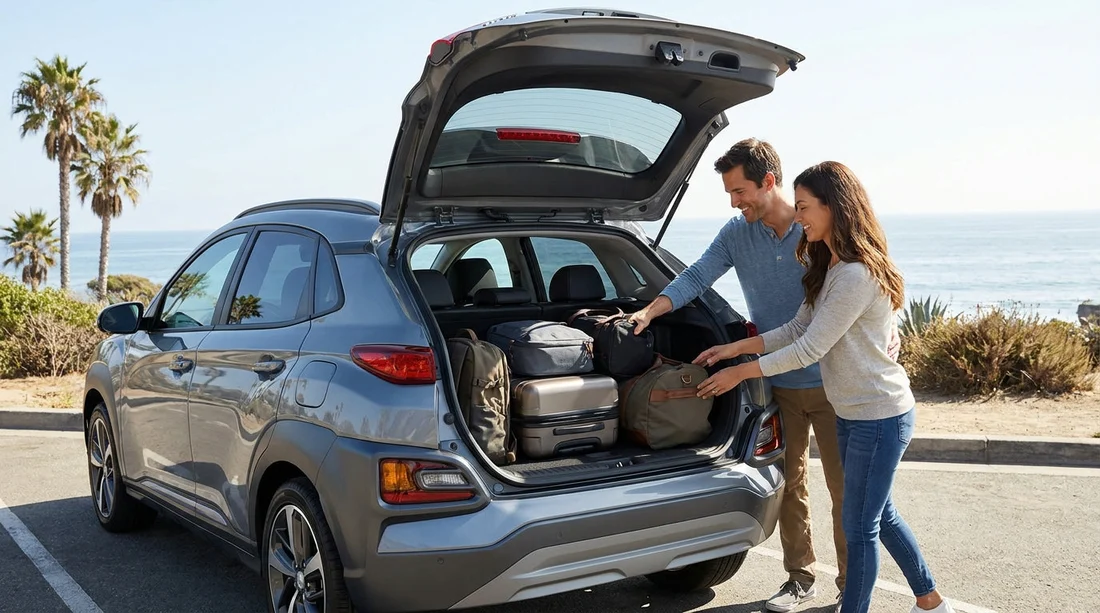
Quick Summary:
- Expect about three medium suitcases with rear seats up.
- Class codes vary, so similar labels can mean different boot shapes.
- Match suitcase dimensions to boot floor area and loading height.
- For four adults with hard cases, consider a larger category.
When you choose car hire in California, “compact SUV” sounds straightforward, but luggage space can differ a lot between models and suppliers. The key is to think in real suitcases, not just passenger count. A compact SUV can be perfect for a couple doing a coastal road trip, yet feel tight for four adults flying into Los Angeles with rigid checked luggage.
This guide explains typical boot space for compact SUVs, why class codes can affect what you actually receive, and how to choose the right size so your bags fit without blocking the rear view.
What counts as a “compact SUV” for car hire?
In US rental fleets, compact SUVs are usually the smaller crossover style vehicles that sit above a compact car but below a midsize SUV. Common examples include models similar in size to a Nissan Rogue Sport, Hyundai Kona, Kia Seltos, Toyota C-HR, or Jeep Compass. Exact models vary daily, so you are typically reserving a category rather than a guaranteed vehicle.
That category approach is why it helps to look at capacity ranges. Two compact SUVs can share the same label, yet have noticeably different boot height, floor length, and cargo opening shape.
If you are comparing options around Los Angeles, the category is often shown alongside airport pickup pages such as car hire at LAX and broader regional searches like car hire in California. Use those results to compare class notes and luggage guidance, then apply the practical sizing steps below.
Typical boot space: litres, cubic feet, and suitcase equivalents
Compact SUV boot volume with the rear seats up often lands around 25 to 35 cubic feet, roughly 700 to 1,000 litres, measured to the window line. With the rear seats folded, many jump to around 55 to 70 cubic feet, roughly 1,550 to 2,000 litres. These numbers are helpful for comparison, but suitcase fit depends more on floor length, width between wheel arches, and height under the parcel shelf.
With seats up: plan for 2 large checked suitcases plus 1 carry-on, or 3 medium suitcases, plus a couple of soft backpacks. If your large cases are hard-shell and deep, the third piece may need to be a small carry-on or duffel.
With seats folded (and no rear passengers): plan for 4 to 6 checked suitcases depending on size mix, plus smaller bags. This is the point where compact SUVs become surprisingly capable for two people carrying a lot of gear.
With a full car: when you have four or five adults, most of the “extra” luggage ends up in footwells. That works for soft bags but is risky for long drives, because loose items can shift during braking.
Why “class codes” can change luggage space
Rental fleets use category names and internal codes that are not perfectly standardised across brands. Even when the display says “compact SUV”, the underlying class code can map to different vehicles by supplier and location. That is why two listings with similar pricing can have very different practicality for luggage.
Compact SUV vs midsize SUV: midsize usually adds meaningful boot depth and a wider opening, especially useful for hard-shell cases. If you have more than three structured suitcases, midsize often reduces stress.
“Or similar” disclaimers: even within a code, you might get a model with a sloping rear window that reduces usable space. The litre figure might look fine, but the practical stack height under the shelf can be lower.
If you are specifically aiming for SUV categories around Los Angeles, the SUV category page can help clarify what “compact” tends to include at that airport, for example SUV rental in California at LAX.
How to choose based on your suitcases (a simple method)
Instead of guessing, match your luggage to three measurements: suitcase size, boot floor rectangle, and loading height.
1) Know your suitcase dimensions. A typical carry-on is about 22 x 14 x 9 inches. A medium checked suitcase is often around 26 to 28 inches tall. A large checked suitcase is often around 30 to 32 inches tall and deeper. Hard-shell cases usually waste more “air gaps” than soft duffels.
2) Prioritise floor length and width. In compact SUVs, the limiting factor is often the distance from the tailgate to the rear seatbacks, plus the width between wheel arches. Two large suitcases lying flat may already fill the main rectangle, leaving only small pockets for backpacks.
3) Check if stacking is realistic. Some compact SUVs have a parcel shelf that sits low, making it hard to stack a second layer without removing the shelf. If you remove it, you gain height but lose privacy, which can matter when stopping in cities.
4) Plan for day-to-day items. On a California road trip you may add groceries, a cooler, beach chairs, or outlet shopping. If your boot starts out completely full, you lose flexibility quickly.
Realistic scenarios for car hire in California
Two adults, two checked suitcases, two carry-ons: a compact SUV is usually comfortable. You can often keep the parcel shelf in place and still fit everything, which helps conceal luggage at stops.
Four adults, four checked suitcases: commonly too much for a compact SUV boot with seats up, unless the cases are small and at least two are soft. A midsize SUV or a people carrier is typically a better fit.
If you are collecting outside LAX, you may also compare availability by airport, such as car rental at Santa Ana (SNA) or in Southern California hubs like Hertz car rental in San Diego, because fleets and vehicle mixes can vary by location.
Compact SUV vs other categories: when to size up
A compact SUV is often the sweet spot for car hire in California because it combines manageable driving size with better luggage flexibility than a saloon. Still, there are clear times to choose a larger category.
Choose a minivan when: you have five or more passengers, bulky items, or you want easy access and maximum usable space. Minivans also handle multiple suitcases better because the floor is long and the opening is tall, even when some rear seats are in use. If that sounds like your trip, see minivan hire in California at LAX for category context.
FAQ
How many suitcases fit in a compact SUV boot? Most compact SUVs fit about 2 large checked suitcases plus a carry-on, or 3 medium suitcases, with the rear seats up. Exact fit depends on the model’s boot shape and parcel shelf height.
Does “compact SUV” mean the same size across all car hire companies? No. Category names and class codes vary, and “or similar” means you could receive different models with different cargo shapes. Always plan with ranges, not a single number.
Can I fit four checked suitcases if I fold the rear seats? Usually yes, if you do not need rear passengers. With seats folded, many compact SUVs can take 4 to 6 checked suitcases depending on how rigid and large they are.
What if I have a stroller, cooler, or sports gear as well? Bulky items quickly use up the boot floor. If you have a full-size pram plus checked luggage, consider a larger SUV or a minivan to avoid constant repacking.
Is it better to size up for a California road trip? If you expect shopping, beach gear, or multiple hard-shell suitcases, sizing up can make daily loading easier and keep luggage below the window line. For light packing, a compact SUV is often ideal.

























































































