


Quick Summary:
- Expect a ZIP prompt, try postcode digits, or pay inside instead.
- Pumps place a temporary pre-authorisation hold, often $75 to $200.
- Select credit, avoid repeated declines, and keep an eye on limits.
- If the pump fails, pay inside or use contactless at the till.
Driving in California with car hire is straightforward until you hit your first self-service petrol station. UK cards usually work, but pay-at-pump terminals are designed around US billing addresses, so you can see a ZIP-code prompt or a puzzling decline even though your card is fine. The good news is that there are reliable ways to get fuel without stress once you know what the terminal is trying to verify.
This guide explains what pay-at-pump is checking, how pre-authorisation holds work with a UK credit card, and the practical alternatives that keep you moving, whether you are picking up near San Francisco Airport (SFO) or starting your trip further south.
What “pay-at-pump” is doing with your card
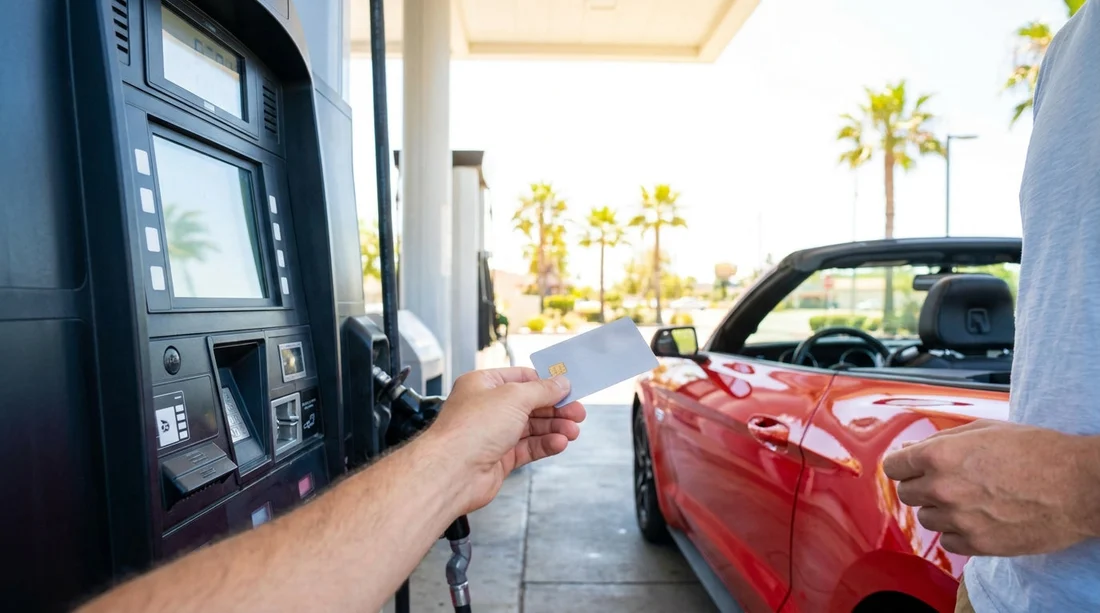
At most California stations, you insert or tap your card at the pump before you select your fuel grade. The pump sends an initial authorisation request to your card issuer. Because the final amount is not known yet, the station usually requests a fixed amount, effectively asking, “Is this card valid, and is there enough available credit for a full tank?”
After you finish fuelling, the station sends the final charge, and the earlier authorisation hold is replaced by the real amount. That is why your app might show two entries briefly, or show a higher amount than you actually spent.
Why UK cards get a ZIP-code prompt in the US
Many US pumps ask for “ZIP” as a simple address verification step for card-present transactions. A UK billing address does not have a five-digit ZIP code, so the terminal may not be able to validate the input. What happens next depends on the station, the payment network, and your card issuer.
Common outcomes include the pump accepting your entry anyway, the pump asking again and then declining, or the pump allowing the transaction but only after you select “credit”. If you are using car hire in California, it is worth learning a couple of workarounds so you are not forced to drive around on low fuel late at night.
What to enter when asked for a ZIP code
There is no universal answer, but there are approaches that often work.
Try the numbers from your UK postcode. Some pumps accept numeric input only, so people enter the digits from their postcode and add zeros to make five digits. This works at some terminals and fails at others, so treat it as a quick attempt, not a guarantee.
If the terminal offers “ZIP” or “PIN”, choose ZIP. UK chip-and-PIN rules do not map neatly to US pump systems, and choosing PIN can cause an unnecessary decline.
Select “credit” rather than “debit”. “Debit” in the US often expects a US debit card with a PIN and ZIP verification. Even when you are using a credit card, the pump may ask you to choose, and “credit” is typically the smoother route.
When in doubt, pay inside. If you are prompted for ZIP and it fails twice, stop retrying and go to the cashier. Repeated declines can trigger fraud checks and slow you down.
Pre-authorisation holds: what to expect with a UK credit card
The biggest surprise for UK travellers is the size of the hold. In California, it is common for a pay-at-pump authorisation to be around $75 to $200, and some stations can go higher. The hold is not the final cost of the fuel, it is a temporary reservation of part of your credit limit.
The hold reduces available credit until it releases. If you have a low credit limit, multiple fuel stops can stack holds and make later transactions decline even though you have spent much less.
Release times vary. Some holds drop off within a few hours, others can take several days depending on the station and your issuer. Weekends and bank processing can add time.
Your bank app may show the hold as “pending”. It may look like you have been overcharged, but the final posted amount should match the fuel you pumped.
If you are doing longer drives, for example after picking up around San Jose Airport (SJC), plan for these holds so you are not surprised when a restaurant or hotel deposit hits your available balance as well.
Step-by-step: smooth pay-at-pump with a UK credit card
1) Choose a well-lit, busy station when possible. Newer terminals are more likely to support tap-to-pay properly, and you are more likely to have a cashier available if you need to pay inside.
2) Insert or tap, then select “credit”. If the prompt appears, choose credit even if you are using a credit card already.
3) Handle the ZIP prompt quickly. If your first attempt does not work, do not keep experimenting for several minutes. Switch to paying inside so you avoid multiple declines.
4) Fuel, then wait for the receipt prompt. Some pumps ask if you want a receipt. Choose your option, then ensure the nozzle is properly returned. The transaction finalises after you hang up the nozzle.
5) Check your banking app later, not immediately. Expect to see a pending hold first, then the correct final amount. If the hold remains for an unusually long time, contact your issuer with the station name and date.
How this interacts with rental cars in California
Your car hire agreement usually does not affect how the pump processes your card. The station is authorising your payment method, not the vehicle. What does matter is your travel pattern, road trips create repeated fuel stops, and repeated authorisation holds can stack up.
Also remember that car hire itself often involves a security deposit pre-authorisation at pick-up, and hotels frequently place their own holds. If you are collecting in Northern California, such as near Sacramento (SMF), you may see multiple authorisations close together. Keeping an eye on available credit can prevent awkward declines at pumps.
Tips to avoid surprises on your statement
Do not panic if you see $150 pending for a $48 fill. That is usually the initial authorisation.
Keep receipts for a few days. If a hold posts incorrectly, the receipt helps your issuer trace the final amount.
Avoid fuelling little-and-often if your limit is tight. Fewer, larger fills can mean fewer overlapping holds.
Be cautious with “pay at the pump” signage near tourist areas. The process is the same, but busy stations sometimes have longer settlement times.
If you are planning a family trip and choosing a larger vehicle, you might notice bigger fill-ups, so it helps to anticipate larger authorisation holds too, especially with minivan rental at San Jose (SJC) where you are likely covering more miles.
FAQ
Why is the petrol station asking for a ZIP code when my card is from the UK? US pumps commonly use ZIP as a quick address check. A UK billing address may not match the expected format, so the pump can reject the entry and decline the transaction.
How much is the typical pre-authorisation at California pay-at-pump? Many stations place a temporary hold around $75 to $200, sometimes higher. It should be replaced by the final fuel amount after the transaction settles.
How long does the pay-at-pump hold take to disappear on a UK credit card? It varies by station and issuer, from a few hours to several days. If it remains beyond a week, contact your card provider with the transaction details.
What is the easiest workaround if my UK card keeps failing at the pump? Pay inside with the cashier, either prepay a set amount or ask to fill. In-store card terminals often do not require ZIP verification.
Should I use a debit card for fuel when I have car hire in California? A credit card is usually easier because debit holds can tie up actual funds. If you use debit, leave extra balance for temporary holds and other travel deposits.

























































































