


Quick Summary:
- Fill up before entering I‑75, services are limited between coasts.
- Use marked rest areas, check toilets, water, and shade breaks.
- Watch for wildlife near canals, especially dawn, dusk, and rain.
- If you break down, stay in vehicle, call 911 or FHP.
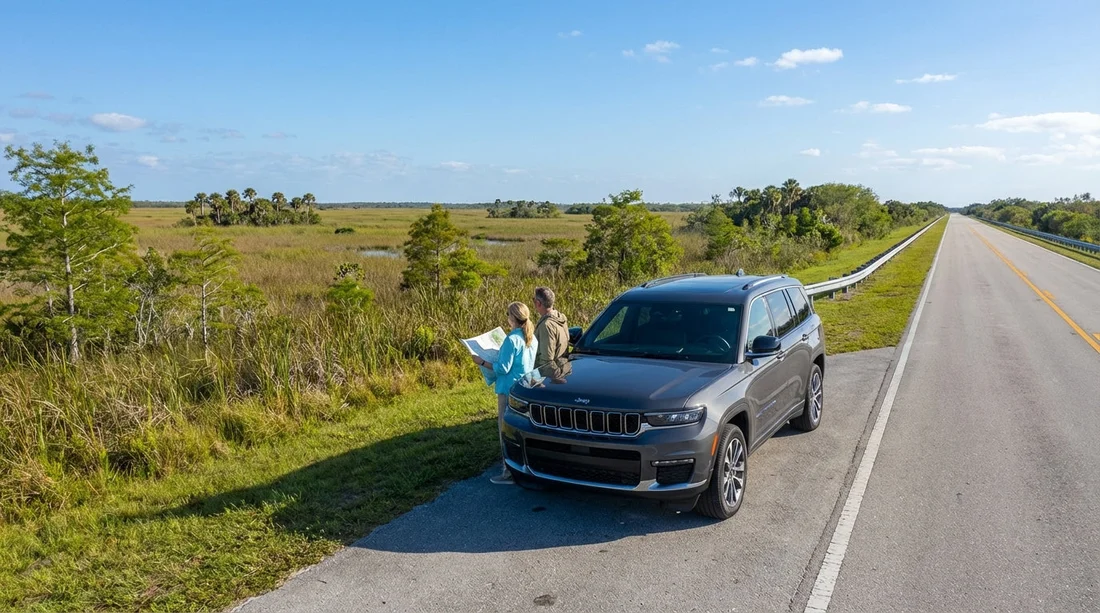
Alligator Alley is the long, straight stretch of I‑75 linking Naples and Fort Lauderdale across the Everglades. It is fast, exposed and surprisingly remote for Florida. With car hire, the drive is straightforward, but it rewards planning: you want a fuel and toilet strategy, you need to anticipate wildlife and sudden storms, and you should know what to do if your mobile signal drops or your vehicle has trouble.
This guide focuses on practical steps you can follow before you join the Alley, while you are on it, and if something goes wrong.
Understand the route, remoteness, and timing
The key thing about Alligator Alley is not difficulty, it is distance between useful exits and services. Once you are in the middle, options are limited and the landscape is open, with canals, marsh and long bridges. That combination means hazards can appear quickly and help can feel far away, even though you are on an Interstate.
Build extra time into your plan. Afternoon traffic can bunch up near each end, and heavy rain can slow everyone to a crawl. If you can choose, many drivers find late morning easier: good visibility, less wildlife movement than dawn or dusk, and fewer lightning-heavy downpours than later in the day.
If your trip starts or ends near Miami, collecting from Miami car rental locations makes it easy to stock up before you head west. If you are starting on the Gulf Coast side, having a clear pick up plan around Tampa can help you avoid last-minute detours, for example car hire at Tampa Airport.
Fuel planning checklist, do this before entering the Alley
Do not treat Alligator Alley like an urban motorway where you can always grab the next exit. A good rule is simple: start the crossing with plenty of fuel in the tank, even if your gauge says you could “probably make it”. Traffic delays, air conditioning use, and slow-moving storm conditions can all increase consumption.
Before you join I‑75:
Fill up in Naples, Fort Lauderdale, or the last built-up area that suits your direction of travel. If you are driving a larger vehicle, topping up matters even more, as SUVs can use more fuel at highway speeds. If your group is travelling with luggage, a roomy option can be helpful, and you can compare vehicle choices via pages like SUV rental in Doral.
While on the Alley:
Keep an eye on the distance-to-empty readout, but do not rely on it alone. Strong headwinds and constant air con can shift the estimate. If you see a service plaza and you are below half a tank, it is usually sensible to stop, refuel, and reset your margin. This is especially important if you are also planning a long onward drive north or south after reaching the other side.
Toilet, water and comfort stops, where to stop safely
In Florida heat, “just push through” can turn into a distraction problem. Plan comfort breaks so you are not tempted to stop on the shoulder, and so the driver stays fresh.
Best practice for stops: use official rest areas and service plazas rather than pulling off onto grassy verges. The shoulder may look wide, but passing traffic is fast and the ground near canals can be soft or uneven. Keep a small bag accessible with water, wipes, and any essential medication so you are not unpacking the boot in the heat.
What to do at each stop: take two minutes for a quick vehicle walk-around. Check tyre condition at a glance, look for fluid drips, and confirm all lights are working if you are heading into evening. If you have kids, reset seatbelts and child locks before pulling away, because the straight road can lull everyone into complacency.
Heat and hydration: carry more water than you think you need. Even a short delay with the engine off can feel intense. If you must wait, crack windows slightly and use sunshades if you have them. Do not leave people or pets in a parked car.
Wildlife and road-edge risks, what to watch for
Alligator Alley runs alongside waterways and marsh, so wildlife is not a novelty, it is part of the driving environment. The most important safety principle is: do not swerve for animals. A sudden lane change at motorway speed is often more dangerous than braking firmly in a straight line.
When wildlife risk is highest: dawn, dusk, and immediately after rain when visibility drops and animals may move. Scan further ahead than usual. If you see brake lights, assume there may be a hazard beyond them, not just slower traffic.
Common hazards:
Alligators and turtles can appear near the edges, especially where water is close to the road. Birds may swoop or gather near the shoulder. Deer can cross unexpectedly, particularly in lower light. Treat any dark shape near the verge as a potential mover and ease off the accelerator early rather than leaving braking to the last second.
Do not approach wildlife: even if you are at a rest area, keep distance from canals and do not feed animals. The safest photo is one taken from a secure viewpoint well away from the waterline.
Sudden storms, lightning and visibility, how to drive it
Florida storms can build quickly, and on the Alley you are exposed with few visual cues. A clear sky can turn into heavy rain in minutes. The risk is not only water on the road, but also reduced visibility, spray from lorries, and sudden braking chains.
If rain starts: turn headlights on, reduce speed smoothly, and increase following distance more than you think necessary. Avoid using hazard lights while moving unless visibility is extremely poor and traffic is crawling, because it can confuse other drivers at speed. Keep both hands on the wheel, as gusty winds can hit when you cross bridges.
Hydroplaning avoidance: do not use cruise control in rain. Steer gently and avoid sharp inputs. If you feel the tyres lose grip, ease off the accelerator and keep the steering straight until traction returns. Hard braking can worsen a skid.
Lightning safety: if you stop at a plaza during a thunderstorm, stay inside the vehicle or inside a building rather than standing in open areas. Do not linger by metal railings or near water edges.
Limited signal and breakdown planning, what to do step by step
Most of the time you will have service, but you should assume there may be patches with weak signal or slow data. Prepare so you are not dependent on a single app or one bar of reception.
Before you set off: download offline maps for the route, save key numbers, and keep a charging cable accessible. If your car hire includes roadside assistance information, take a photo of it and keep the paper copy in the glovebox. Check you know how to operate hazards, lights, and the bonnet release.
If you break down:
1) Signal early, move as far right as safely possible, and stop well away from bends or bridge approaches.
2) Put hazard lights on and keep your seatbelt fastened.
3) Stay inside the vehicle with doors locked if traffic is close and fast. Exiting onto the shoulder can be dangerous.
4) Call 911 if there is immediate danger, a crash, injury, or a vehicle stopped in a risky position. Otherwise, contact Florida Highway Patrol for assistance and then your car hire roadside support when you can. If signal is weak, try a text message, or move the phone to a window and attempt again.
5) Set up a warning triangle only if you can do so safely and away from traffic. If you cannot, prioritise staying inside and visible with hazards on.
If you get a puncture: only change it if you are in a genuinely safe, level spot with ample shoulder and low risk. Many drivers choose to wait for professional help on high-speed roads. Check your hire vehicle for a spare or inflation kit and know what you have before you need it.
Choosing the right hire vehicle for the Alley
Any well-maintained car can handle I‑75, but comfort and stability matter when conditions change. In summer, strong air conditioning, good wipers, and tyres in good condition are more important than engine power. If you are carrying several passengers, luggage, or beach kit, a larger vehicle can reduce fatigue and keep the cabin organised.
When collecting in the city, convenience can matter too. If you are staying in central Miami, you might compare options like Alamo car hire in Brickell so you can get on the road without extra transfers.
Pre-drive checks in the car park: test indicators, headlights, brake lights, wipers, and air con. Set mirrors properly and pair your phone for hands-free calls before moving. If you notice any warning lights, report them before you leave.
Responsible driving habits that reduce risk
The Alley’s straightness can make speed drift up. Stick to posted limits and be extra cautious around large trucks, as spray in rain can hide vehicles ahead. Keep left-lane passing disciplined and return to the right when you are not overtaking, because faster traffic can appear quickly.
Plan your playlist, snacks and navigation before you enter the long central stretch. If you need to change drivers, do it at a proper stop. Fatigue is a bigger issue here than many visitors expect, because there are fewer visual “milestones” than on coastal roads.
If your wider trip includes Orlando, it can be useful to plan vehicle collection around flight logistics, such as National car rental at Orlando MCO, then schedule the Alley crossing as a dedicated travel leg rather than squeezing it between attractions.
FAQ
Is Alligator Alley safe to drive with car hire? Yes, it is a major Interstate and generally well maintained. The main risks are speed, sudden storms, wildlife near the edges, and the feeling of remoteness, so planning stops and staying alert matter.
Where should I stop on I‑75 across the Everglades? Use official service plazas and rest areas for fuel, toilets and breaks. Avoid stopping on the shoulder or near canal edges, even if the view looks tempting.
What should I do if I hit heavy rain or a thunderstorm? Slow down gradually, increase following distance, turn headlights on, and avoid cruise control. If visibility becomes very poor, take the next safe exit or service plaza and wait it out.
What if my phone signal drops and I break down? Put hazards on, move as far right as safely possible, and stay in the vehicle with your seatbelt fastened. Call 911 for danger or injury, and contact roadside support when you can regain signal.
What wildlife might I see, and how should I react on the road? You may spot alligators, birds and occasional deer near waterways. Do not swerve for animals, brake firmly in a straight line if needed, and keep your focus far ahead.

























































































