


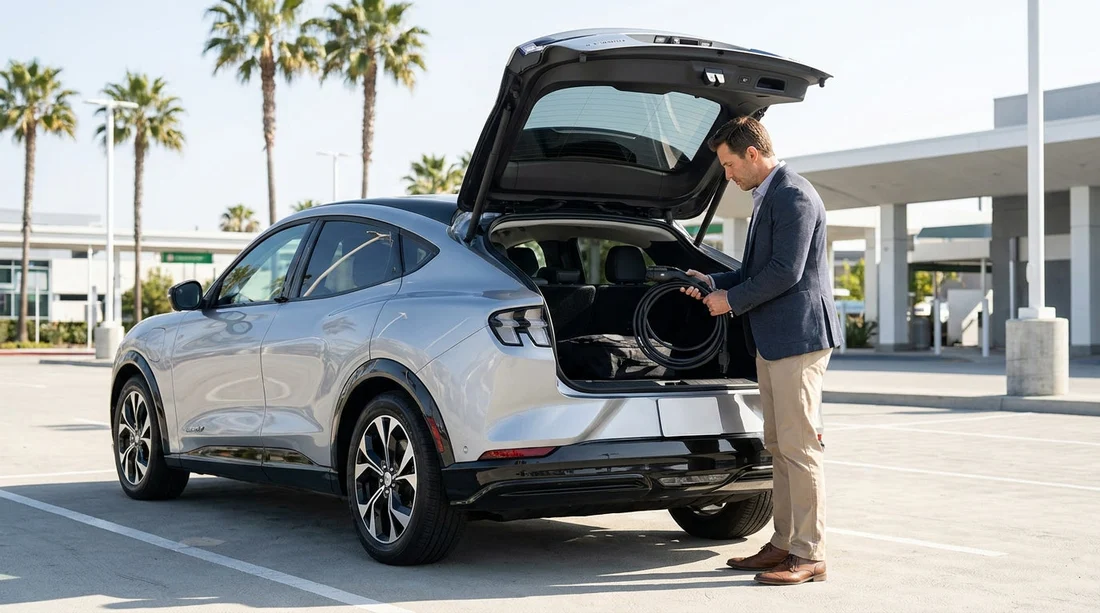
Quick Summary:
- Most California EV rentals include a basic charging cable, not fast chargers.
- Confirm connector types, access cards, and return rules before pick-up.
- Public fast chargers use the station cable, not rental accessories.
- Plan first charging stops early, especially after late airport arrivals.
Electric car hire in California is common now, but charging equipment can still cause confusion at the desk. Many electric rental cars do include a cable, yet you should not assume you will receive every adapter you might want, nor that you can charge everywhere with what is supplied. Policies vary by rental partner, vehicle model, and even pick-up location, so preparing a short checklist before collection saves time and avoids surprises.
This guide explains what charging kit is typically provided with an EV rental, what you should confirm in advance, and how to prepare for charging across California, from airports to city centres.
What charging equipment is typically included with an electric rental car?
For most EV rentals in California, the most common item provided is a portable charging cable intended for slower charging. This is often described as a “mobile connector”, “portable EVSE”, or simply “charging cable”. It usually plugs into a standard household socket, and sometimes also supports a higher-power plug if an adapter is included. The important point is that this cable is for AC charging, not DC fast charging.
DC fast charging equipment is built into public charging stations, not carried in the vehicle. When you pull up to a rapid charger, you generally plug the station’s cable into the car. So even if your rental includes no portable cable at all, you can still use most public rapid chargers as long as the car supports that connector and you have an accepted payment method.
Often included: a basic portable charging cable for home-style outlets.
Sometimes included: one or more adapters for different household plug types, or a charging-network card if the fleet uses a specific programme.
Not usually included: extension leads, special high-power adapters, or a guarantee of complimentary charging credits.
Connector types in California and why they matter
Before pick-up, it helps to know what charging inlet your EV uses, because that dictates which stations you can use easily. In California, the most relevant connectors are J1772 for AC Level 2, CCS for DC fast charging on many non-Tesla EVs, and NACS for Tesla-style charging on many newer vehicles.
If you are arranging car hire into California for a longer road trip, knowing whether your vehicle is best suited to CCS, NACS, or both can influence route planning and charging app setup. It is also worth confirming whether the portable cable, if provided, matches typical sockets where you are staying.
What to confirm before car hire pick-up
Because charging accessories can be misplaced between rentals, and because not every trim level is supplied the same way, confirm these items as part of your pre-arrival plan.
1) Is a portable charging cable included in the vehicle? Ask whether it is physically in the boot at pick-up, not merely “normally included”.
2) Which connector does the car use for public AC charging? This affects whether you need an adapter to use common J1772 posts at hotels and car parks.
3) Is DC fast charging enabled and supported on this model? Most modern EVs support it, but you want clarity if you are relying on rapid chargers between cities.
4) How should the vehicle be returned? Some rentals require a minimum state of charge, for example returning at or above a stated percentage. Others are flexible but may add fees if the battery is low.
5) Is there a charging network account, RFID card, or code provided? Many sites accept contactless card payments, but not all. If an account is required, you want it before you leave the lot.
If you are picking up near a major hub, it can also be useful to check location-specific expectations. For example, with airport-area collections such as car hire at San Jose Airport (SJC), you may arrive late and need a predictable first charge. Similarly, if your plans start around the Bay Area, reviewing options like car hire at San Francisco (SFO) can help you consider where the nearest rapid chargers sit relative to terminals and nearby hotels.
How charging works on the road, even if no cable is supplied
If your rental does not come with a portable cable, you are not stuck. In practice, most travellers in California rely on public infrastructure. For fast charging, you plug in the station’s attached cable, authenticate payment, and charge. For Level 2, many posts also have a cable attached, though some destinations provide “bring your own cable” sockets. Standard outlet charging is slow, but it can be useful overnight if you have permission and the portable cable.
The key preparation step is to match your accommodation plan to the charging kit you will have. If you cannot confirm a cable will be present, choose accommodation with dedicated EV bays or nearby rapid charging.
Preparing for charging in California: a practical checklist
Once you have confirmed your car’s connector and whether a portable cable is included, you can prepare in a way that reduces friction during the rental. Set up payment before you land, download one or two charging apps, plan your first charge near pick-up, and check return-day charging options if a minimum battery level is required.
For travellers starting in Northern California and heading inland, it can be useful to consider where you are collecting and what the surrounding infrastructure looks like. Options such as car hire in Sacramento (SMF) can suit routes toward wine country, Lake Tahoe, or the Central Valley, where spacing between rapid chargers may be greater than in coastal cities.
What to do at the desk or lot if the cable is missing
If you expected a portable charging cable and it is not in the vehicle, raise it before leaving. Ask staff to check the boot, under-floor storage, and any side compartments. If they cannot provide one, decide whether your itinerary relies on outlet charging. If it does, request a different vehicle that includes the cable, or adjust plans to rely on public Level 2 sites with attached cables and rapid charging.
If you are comparing vehicle categories for a family trip, remember that availability varies by location and fleet. For larger groups who still want a straightforward refuelling experience, options like minivan rental in Sacramento (SMF) may be more practical, while EV car hire can be ideal when you have reliable charging at your accommodation.
FAQ
Does an electric rental car in California usually come with a charging cable? Often yes, but not always. Many rentals include a portable AC charging cable, yet it can vary by vehicle and location, so confirm before pick-up.
Do I need the cable to use public rapid chargers? No. DC fast chargers have their own tethered cables, you simply plug the station’s connector into the car and pay.
What should I check at pick-up to avoid charging problems? Confirm the car’s connector type, whether a portable cable and any adapters are present, and the return battery-level policy stated in your car hire agreement.
Can I charge an EV rental from a normal household socket in California? Sometimes, if you have the portable cable and the property allows it. It is slow, and you should get permission from your accommodation before using an outdoor or shared socket.
What if I cannot get a cable but my hotel only offers “bring your own” charging? Plan to use nearby public chargers with attached cables, prioritise rapid charging before overnight parking, or change accommodation to one with dedicated EV charging bays.

























































































