


Quick Summary:
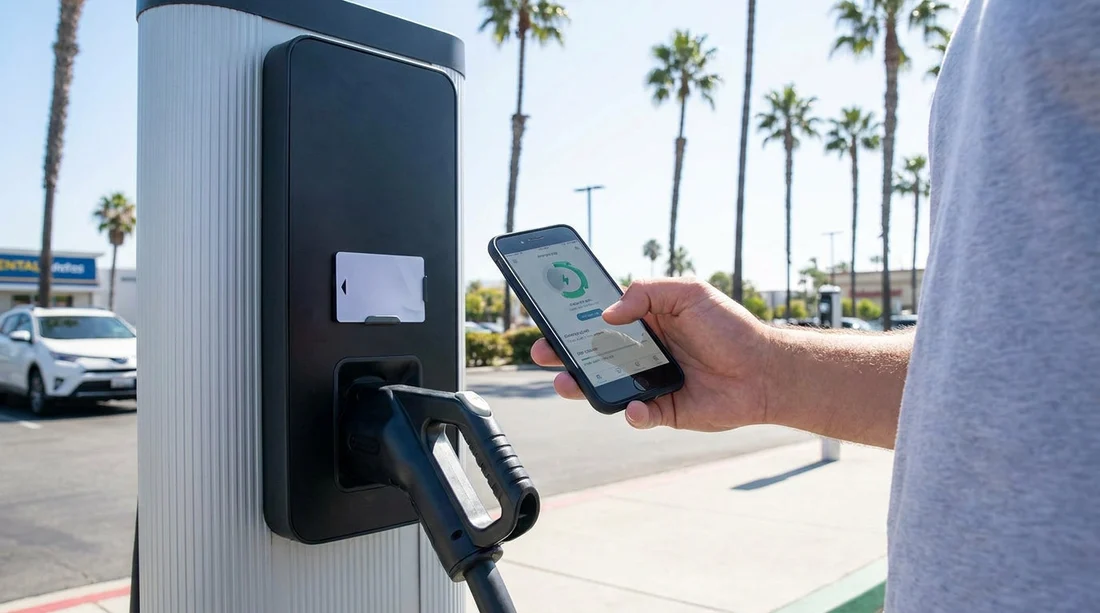
- Assume you will need charging apps, card inclusion varies by supplier.
- Create accounts for major California charging networks before you collect.
- Add a payment method and enable location services for faster activation.
- Ask at pick-up whether the car has plug-and-charge enabled.
Electric car hire in California is straightforward once you understand one key point, public charging access is usually tied to the driver, not the vehicle. Some rental fleets include a charging card or a key fob for a specific network, but many do not, and even when they do, it may not cover every fast charger you encounter. The most reliable approach is to arrive with your own charging apps set up, with payment verified, so you can charge immediately after leaving the airport or city branch.
California also has a wide mix of charging operators. That variety is great for availability, but it means there is no single universal card that works everywhere. Your experience can differ depending on where you collect, where you are driving, and whether your EV supports plug-and-charge functionality.
If you are collecting near a major hub, it helps to plan for charging from the first day. For instance, travellers picking up around San Francisco can check practical collection options through car hire at San Francisco Airport (SFO), and those starting in Southern California often compare routes and charging density near car hire at Los Angeles (LAX) or car rental in San Diego. If your trip begins in Silicon Valley, National car hire in San Jose (SJC) is another common starting point for EV drivers.
Do EV rentals in California usually include a charging card?
Typically, no, you should not assume an electric rental comes with a charging card that works across networks. Some suppliers occasionally provide a card, fob, or in-car account for one network, but policies vary by brand, location, and even vehicle model. Because of this inconsistency, relying solely on a provided card can lead to delays when you arrive at a charger that needs a different app.
What you can reasonably expect is that the car is supplied with the correct charging cable for AC charging and the correct connector for DC fast charging in the US. The access method, however, is usually down to you.
How public charging access actually works for a rental EV
Public charging is mainly controlled by the charger operator, not the rental company. Each operator has its own way to start a session and take payment. In California, you will usually see these access options.
1) Network app with stored payment. You open the app, select the charger, and start the session. This is the most common method and the most predictable for travellers.
2) Tap-to-pay credit or debit card. Some fast chargers allow contactless card payment. It is convenient, but it is not universal, and readers from the UK should note that some US sites are less reliable with overseas cards.
3) RFID card or key fob. This is what many people mean by a “charging card”. It can be quicker than opening an app, but you need the right card for that network.
4) Plug-and-charge. Some cars and networks support automatic authentication when you plug in. If enabled, it is the smoothest option, but it depends on the car, the network, and whether the feature is active on that vehicle’s account.
Apps to set up before you collect your EV
Search the app store for the biggest US charging networks and install at least two of them, plus one route planning app that filters by connector type and charger power. Before you travel, create an account, add a payment method, and enable permissions such as location services and notifications.
As a practical baseline for California, aim to have an app that covers a large fast-charging footprint, plus a second network as redundancy. That way, if a site is busy, out of order, or requires a membership tier for best pricing, you have alternatives.
What to ask at the rental counter or pick-up bay
It is worth spending 60 seconds clarifying charging access while you still have staff nearby. Ask whether the EV comes with any charging card, fob, or in-car charging account, and confirm which network it works with and whether there are usage fees charged back after return.
Also confirm whether plug-and-charge is enabled, what connector the vehicle uses for fast charging, and whether any adapter is included. Finally, check the current state of charge so you can plan your first top-up without pressure.
Costs, holds, and billing surprises to avoid
Charging costs can vary significantly by network, charger speed, time of day, and local pricing rules. Watch for pre-authorisation holds, idle fees if you stay plugged in after charging finishes, and higher prices when you start a session through a third-party app.
For car hire budgeting, it can help to set expectations similar to fuel, you will have a base cost to “refuel”, plus occasional convenience costs if you charge in premium locations or during busy periods.
So, do you need your own app?
In most California scenarios, yes, you should plan to use your own apps even if a charging card is sometimes provided. The card, if present, may only work on one network and may not be the cheapest option. By arriving with two network apps and a route planning tool already set up, you avoid the most common EV rental pain point, being stuck at a charger creating accounts while your phone signal drops or your card is declined.
If you do receive a charging card, treat it as a bonus that can simplify certain stops, not as your only access method. Think of your apps as your universal backup that travels with you across the state.
FAQ
Do I need a US phone number to use charging apps in California? Usually not, but some apps verify via SMS. If verification is required, a UK number often works with roaming, but it is best to set up accounts before flying and check you can log in.
Can I just pay with a contactless card at the charger? Sometimes, especially at newer fast-charging sites, but it is not guaranteed. Having at least one charging app ready is the safest approach for EV car hire.
What if the rental EV is a Tesla? Access depends on how the vehicle is configured. Some Tesla charging can be seamless, but you should still have backup options for non-Tesla chargers and confirm any in-car payment setup at pick-up.
Will charging costs be billed by the rental company or the charging network? Most often you pay the charging network directly through your app or card. If the rental provides a card or account, charges may be passed through later, so ask how billing is handled.
Should I fully charge the EV before returning it? Follow your rental agreement. Many EV rentals specify a minimum state of charge or offer a recharge service fee. Plan a final charge with extra time in case nearby stations are busy.

























































































