


Quick Summary:
- Check each tyre’s tread depth and look for uneven wear patterns.
- Inspect sidewalls for cuts, bulges, cracking, or exposed cords.
- Confirm tyre pressures and match sizes, including the spare and jack.
- Turn ignition on and verify TPMS warning light behaves normally.
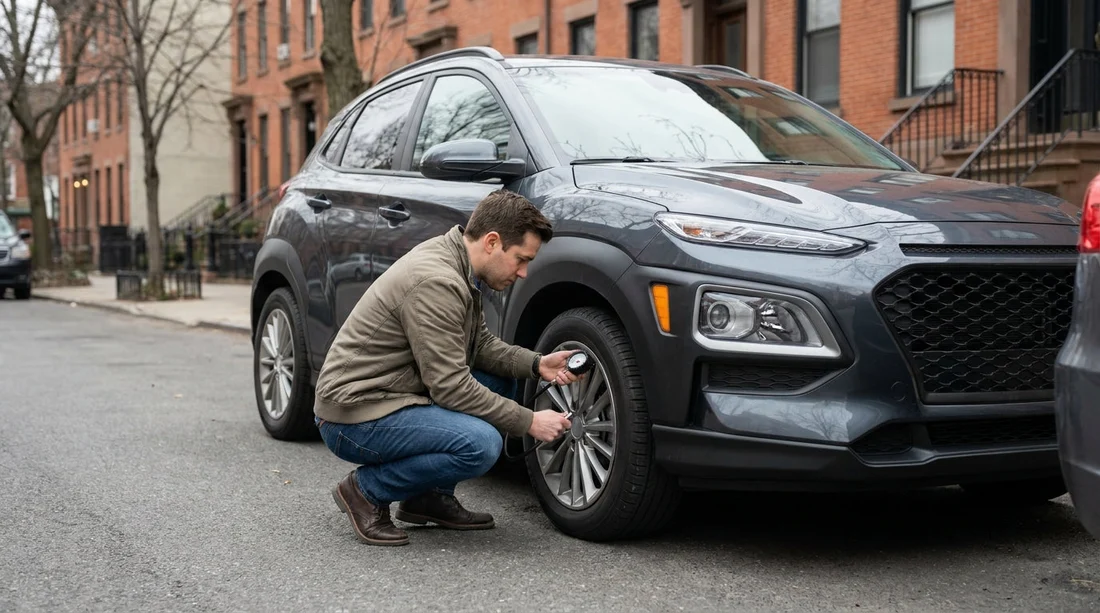
Tyres are the one part of your rental car in New York that directly affect braking, steering and stability from the first block you drive. A quick pre-pick-up inspection takes only a few minutes, and it is the easiest moment to flag a problem while you are still in the lot and staff can record it. This checklist focuses on tread, sidewalls and warning lights, plus a few practical extras that help you avoid hassle later.
If you are collecting near the airports, the same checks apply whether you are arranging car hire at New York JFK or picking up across the Hudson. Airport routes quickly put tyres under stress with high-speed merges, pothole scars and construction plates, so it pays to start with a clean bill of health.
1) Walkaround first: match tyres, sizes and general condition
Before getting into details, take a slow lap around the car and compare all four tyres. You are looking for obvious mismatches that can hint at a rushed replacement, for example one tyre that is a different brand, a noticeably different tread pattern, or a sidewall height that does not match the other three. Mismatched tyres can still be safe, but they can also affect grip balance and noise. If something looks inconsistent, take a photo and ask the desk or lot attendant to note it.
Also check that all valve caps are present. Missing caps can allow dirt and moisture into the valve core over time, leading to slow leaks.
2) Tread depth: do a quick, practical check
Tread depth matters most in wet weather, and New York can throw heavy rain at you with little warning. You do not need specialist tools to do a basic check at pick-up.
Start by finding the tread wear indicators, which are small raised bars across the grooves. If the tread is close to those bars, the tyre is nearing the end of its usable life. Next, look for uneven wear. Run your eyes along the inner and outer edges of the tread. If one edge is far more worn than the other, it can suggest alignment issues. Cupping, which looks like scalloped dips around the tread, can suggest worn suspension components and may cause vibration.
Practical tip, check at least three points on each tyre, inner edge, centre, and outer edge. If any tyre looks borderline or uneven, photograph it from close-up and include the odometer in another photo for context.
3) Sidewalls: focus on bulges, cuts and cracking
Sidewall damage is one of the most important things to catch before you leave, especially in a city environment where kerb contact is common. Inspect the outer sidewall on each tyre, then turn the steering wheel to full lock to see more of the front tyres’ inner shoulders.
Look for:
Bulges or bubbles, which can indicate internal damage from a pothole impact. This is a safety issue and should be reported immediately.
Cuts or gashes, particularly if you can see fabric or cord. Even a cut that is not leaking can worsen quickly.
Cracking, a web of fine lines that can show age-related deterioration. Light superficial cracking might be cosmetic, but deep cracks are a concern.
Kerb rash on the rim, which can sometimes go along with sidewall bruising. If the wheel is heavily scuffed, spend extra time checking that tyre.
If you spot anything worrying, do not assume it is fine because the car is on a rental lot. Ask for a different vehicle or a documented inspection note. This is especially relevant for larger vehicles, where tyre condition affects stability. If you are comparing options like minivan hire at Newark EWR, pay attention to sidewalls because heavier loads increase heat and stress.
4) Tyre pressures: confirm they are reasonable and consistent
Correct pressure supports safe handling and reduces the chance of a tyre warning light appearing mid-trip. A quick visual check is not enough, because modern tyres can look fine while significantly underinflated. If the lot has an airline or gauge, use it. If not, you can still do two useful checks.
First, look at the tyre sidewall for obvious deformation, such as a flattened contact patch or wrinkling. Second, once you start the car, check whether the tyre pressure monitoring system reports pressures in the dashboard menu. Many vehicles show individual psi readings. If one tyre reads much lower than the others, or if all are low, raise it with staff before departing.
Do not inflate to the pressure printed on the tyre sidewall, that is the maximum rating. The correct figure is on the driver’s door jamb sticker, which lists recommended pressures for front and rear. If the vehicle is loaded with luggage and passengers, especially on longer highway stretches, correct pressure matters even more.
5) Warning lights: verify TPMS behaviour before moving
With the ignition on, look for the TPMS icon. It usually illuminates briefly during the self-check, then turns off. If it stays on, or if it flashes, treat that as something to resolve before you drive away. A solid light often indicates low pressure in one or more tyres. A flashing light can suggest a sensor fault, which may mean you cannot rely on the system for alerts.
Ask the attendant to check and document it. If you are departing from a busy hub like car rental at Newark EWR, it is better to spend five minutes sorting a warning light than to deal with it later on a bridge approach or in fast traffic.
6) The spare tyre or repair kit: confirm what you actually have
Rental cars vary, some have a full-size spare, some have a compact spare, and many newer vehicles have only a sealant and compressor kit. Open the boot and check which applies to your car. Confirm that the jack, wheel key and towing eye (if applicable) are present. If there is a compact spare, check its pressure if you can, these are often neglected.
Also look for the locking wheel nut key if the car has locking bolts. Without it, a puncture becomes a recovery issue rather than a simple tyre change.
7) Documenting issues properly before leaving the lot
If you find any tyre, wheel or warning-light issue, document it clearly. Take photos in good light of the full tyre, close-ups of the damage, and a wider shot showing the licence plate or a unique marker on the vehicle. Then ask for the condition to be recorded on your rental paperwork or in the digital check-out system.
Be specific with wording, for example “front right tyre has sidewall bulge” or “rear left tread worn more on inner edge”. Vague notes like “scratched wheel” are less helpful if a dispute arises later.
If you arranged budget car hire in New York at JFK, these checks are still important. Price point does not change the basics of safe tyres, and a careful inspection protects you regardless of vehicle category.
8) Quick New York driving context: why these checks matter here
New York roads can be hard on tyres. Potholes can cause sidewall damage without immediately deflating the tyre. Steel plates in construction zones can reduce traction when wet. Kerbs and tight parking can scuff rims and pinch sidewalls. Seasonal temperature swings can also change pressures enough to trigger a warning light.
Because of this, aim to start your trip with tyres that look evenly worn, have clean sidewalls, and show no active warnings. If your pick-up is in New Jersey and you plan to drive into the city, you may also face stop-start traffic and frequent lane changes, which reward predictable, balanced grip. Options like car rental at New Jersey EWR can be convenient, and the same tyre checklist helps you leave the lot with confidence.
FAQ
How long should a tyre check take at rental pick-up? Allow five to ten minutes for a walkaround, tread and sidewall check, then another minute to confirm the TPMS light turns off after start-up.
What tread wear pattern is the biggest red flag?Severe uneven wear, such as a smooth inner edge while the rest has tread, can indicate alignment issues and should be reported before you leave.
If the TPMS light is on, can I still drive?It is safer to resolve it first. A solid light may mean low pressure, and a flashing light can mean the system cannot alert you to real pressure loss.
Should I check the spare tyre even if I do not plan to use it?Yes. If you get a puncture, a flat spare or missing jack turns a simple stop into a recovery situation, especially inconvenient in New York traffic.
What should I do if I notice a bulge on a sidewall?Do not drive off. Ask the staff to inspect it and provide another vehicle or a documented fix, because a bulge can indicate internal damage.





























































































