


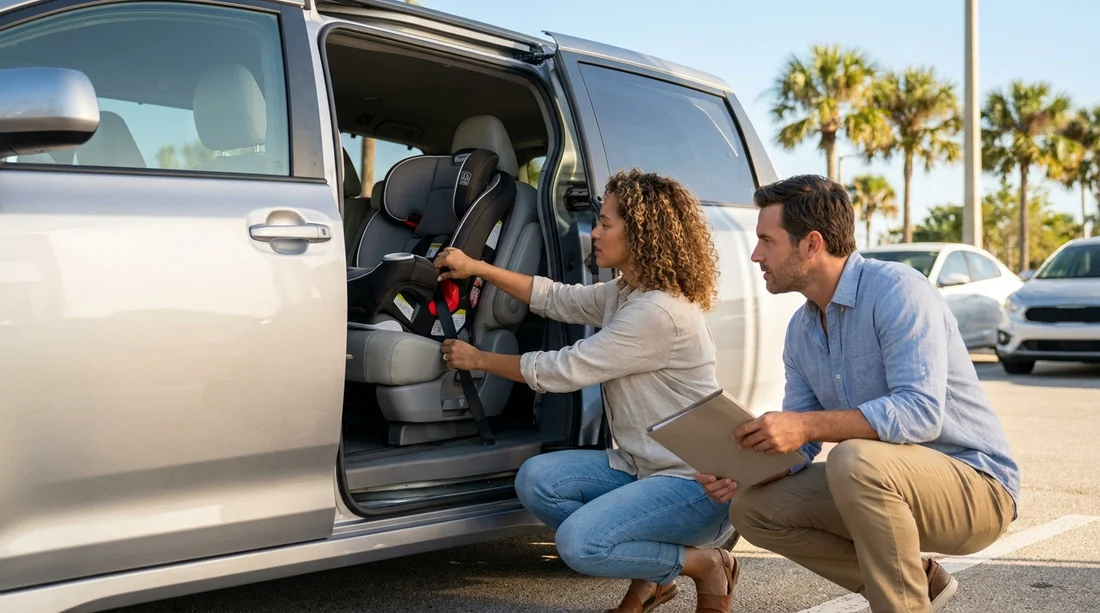
Quick Summary:
- Confirm the seat matches your child’s height, weight, and age group.
- Check installation tightness, seat belt or LATCH routing, and locking.
- Verify harness fit, chest clip position, and straps lay flat.
- Choose the safest rear position, correct recline, and avoid active airbags.
Picking up a rental car in Florida with a child seat can feel routine, but it is worth slowing down for a few minutes. A seat that is the wrong type, loosely installed, or mismatched to your child’s size can reduce protection. Because car hire fleets see frequent turnover, you should treat the pick-up handover as the moment to verify everything is compatible and secure, before you drive away.
The checks below focus on what you can realistically confirm at the counter or in the car park, without special tools. If anything looks wrong or you cannot get the fit tight enough, ask the agent to swap the seat or the vehicle. A different back seat shape, belt design, or headrest can make installation much easier.
1) Confirm you have the right seat type for your child
Before touching the belts, verify the seat category matches your child. In Florida, the key is using a restraint appropriate to your child’s age and size, then installing it correctly. At pick-up, look for the manufacturer label on the seat shell, which typically lists height and weight ranges.
Rear-facing or forward-facing: If your child still fits rear-facing, it is often the safer option. Ensure the rental seat supports rear-facing use and that it includes the correct belt path for rear-facing installation.
Harnessed seat or booster: A booster is for children who have outgrown a harnessed seat, and it relies on the car’s seat belt fitting properly. If your child still needs a harness, do not accept a booster as a substitute.
Expiry and condition: Child seats have an expiry date. Find the date stamp or label and make sure it is in date. Also check the shell for cracks, missing pieces, or frayed straps. If the seat looks heavily worn, request a different unit.
If you are arranging car hire around South Florida, the pick-up process can be busy, especially at major hubs. If you are collecting near Miami, allow time to do these checks without rushing. You can see general location information on Hola Car Rentals in Miami (MIA).
2) Inspect the seat’s labels and instructions before installing
Even if you have installed seats before, different models route belts differently. At pick-up, take 30 seconds to locate the instruction stickers on the side of the seat.
Correct belt path: Rear-facing and forward-facing belt paths are different, and mixing them up is a common error. The label often uses colour coding or arrows.
Recline guidance: Many rear-facing seats have a recline indicator line or bubble level. Using the wrong angle can affect breathing comfort for smaller children and can change how crash forces are managed.
Top tether guidance: If the seat is forward-facing with a harness, it usually requires a top tether strap. Confirm the seat has the tether attached and that the hook is present and undamaged.
3) Check the installation method, LATCH or seat belt, and make it tight
Rental cars in the US often offer LATCH anchors (lower anchors plus a top tether) in the rear seats, but not every seating position has them. You can install with LATCH or with the seat belt, depending on your seat and the car. The goal at pick-up is the same: a secure fit at the belt path.
Using LATCH: Confirm you have clipped the connectors to the correct lower anchors and that they are not attached to anything else, such as cargo loops. Tighten the strap firmly, then test movement.
Using the seat belt: Thread the belt through the correct belt path and buckle it. Then make sure the belt is locked. In many cars, you pull the shoulder belt all the way out and let it retract to engage a ratchet lock. If the belt does not lock that way, the seat may have a built-in lock-off you need to use.
The tightness test: Grip the seat near the belt path and push and pull side-to-side and front-to-back. It should not move more than about 2.5 cm (1 inch) at that point.
Vehicle choice can affect how easy it is to achieve a tight installation, especially when travelling with more luggage or more than one child. Minivans can offer easier access and more flexible anchor positions. If you are planning theme park driving, see fleet context on van rental for Disney Orlando (MCO), which can be relevant when considering space for child seats.
4) Confirm the top tether is used for forward-facing harness seats
If your child is forward-facing in a harnessed seat, locate the tether anchor in the car. It might be on the rear shelf, the back of the vehicle seat, the floor, or the ceiling depending on the model. Attach the tether hook and tighten it so it removes slack, without bending the seat frame.
Why this matters: the tether helps reduce forward head movement in a crash. At pick-up, confirm the strap is not twisted, the hook is fully engaged, and the adjuster is holding tension.
5) Check harness condition and fit on your child
Once the seat is installed, place your child in it to check harness fit. This is best done while still at the car hire location, because you may discover the seat is the wrong size or has stiff adjusters.
Strap height: For rear-facing, harness straps generally come from at or below the shoulders. For forward-facing, they come from at or above the shoulders. Follow the seat’s label, because exact guidance can vary by model.
Snugness: Tighten until you cannot pinch a fold of webbing at the shoulder. The straps should be flat, not twisted.
Chest clip placement: Position it at armpit level. Too low can allow harness spread in a crash, too high can be uncomfortable.
Buckle and adjuster: Make sure the buckle tongues click in positively and that the harness adjuster pulls smoothly and holds tension.
6) Verify the safest seating position and airbag considerations
The rear seat is typically the safest place for children. At pick-up, ensure you are not placing a rear-facing seat in front of an active airbag. If you must use the front passenger seat in a larger vehicle, confirm the passenger airbag can be switched off and that it is actually deactivated, but in most cases you should choose a rear position instead.
Headrest interference: Some car headrests push the child seat forward. If the seat cannot sit flush when forward-facing, try a different seating position or adjust the vehicle headrest if permitted.
Seat belt buckle stalk length: Long or flexible buckle stalks can change the seat’s angle or stability. If the buckle ends up inside the belt path in a way the seat manual forbids, switch positions or use LATCH if allowed.
7) Do a final walkaround before leaving the car park
Before you drive away, do a quick, repeatable routine: seat does not wobble at the belt path, correct recline indicator, top tether tight for forward-facing harness seats, harness snug with chest clip at armpit level, and no heavy items loose in the cabin.
If you are collecting at an airport location, aim to do these checks in good light and with enough space around the vehicle. While this article is about Florida, the same process helps at other major pick-up points. For example, you can compare pick-up expectations at Budget car rental in Orlando (MCO) or, outside Florida, at car hire at San Francisco Airport (SFO).
FAQ
Q: How tight should the child seat be before I leave the rental lot?
A: Test at the belt path. If you can move it more than about 2.5 cm (1 inch) side-to-side or front-to-back, it needs tightening or reinstalling.
Q: Should I use LATCH or the vehicle seat belt in a Florida rental car?
A: Either can be safe if installed correctly and within the seat’s limits. Use whichever gives the tightest fit and matches the seat instructions, and do not use both unless the seat manual permits it.
Q: What should I check on a booster seat at pick-up?
A: Ensure your child meets the booster’s height and weight range, confirm the lap belt sits low on the hips, and the shoulder belt crosses the centre of the chest without rubbing the neck.
Q: Can I put a rear-facing seat in the front passenger seat?
A: Avoid it whenever possible. If there is an active front airbag, do not place a rear-facing seat there. The rear seat is the safer default choice.
Q: What if the rental child seat looks old or the straps are frayed?
A: Do not use it. Check the expiry date label and the condition of the shell and harness, then request a different seat that is in date and undamaged.





























































































