


Quick Summary:
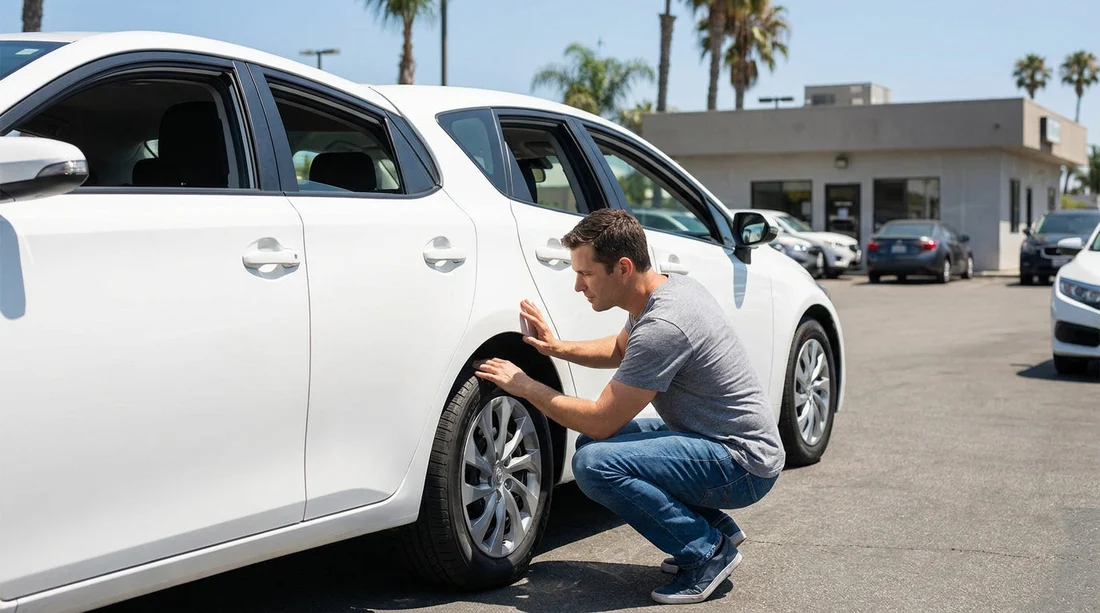
- Walk around, photograph every panel, and ensure damage is recorded.
- Confirm fuel level, mileage, and return policy match your paperwork.
- Test lights, wipers, horn, air con, and dashboard warning lights.
- Check tyres, spare kit, and essential documents before leaving the lot.
Picking up car hire in California often feels quick, especially at busy airport desks and multi-storey car parks. Taking five to ten minutes for a few checks can help you avoid disputes later, improve safety on the freeway, and make sure you are driving the vehicle you actually agreed to. The aim is simple, match the condition and terms on your paperwork to what is in front of you, then document anything that does not match.
1) Match the car to your paperwork at the counter
Before you even walk to the bay, read the rental agreement and confirm the essentials. Check the vehicle class, make and model (or equivalent), registration plate, pick-up location, and the date and time of return. If you are arriving through a busy hub, it can help to know the location details in advance, for example car hire at San Jose Airport (SJC) can involve a shuttle and a large pick-up facility where cars are easy to mix up.
Next, confirm the fuel policy and the fuel level you are receiving. Many disputes come from a simple mismatch between “full to full” and “prepaid fuel”, or a contract that says “full” while the gauge is clearly not. Also check any mileage limits, tolling set-up, and whether you added extra drivers. If your car has a different plate number than the document, go back to the desk to correct it before you drive.
2) Walk-around inspection, do it in a set order
Start at the front left corner and move clockwise. Look at the bumper, grille, bonnet, wings, doors, mirrors, sills, wheels, and rear bumper. In California sunlight, light scratches can disappear, so change your viewing angle and check reflections. If you are in a shaded garage, use your phone torch.
Photographs are your best backup. Take wide shots of all four sides, plus close-ups of any marks. Make sure you capture the registration plate in at least one photo per side so the images clearly relate to your car. Then do the same for the roofline if you have a taller vehicle, as scrapes can happen in parking structures.
Do not assume existing damage is already logged. Ask an attendant to note every issue on the check-out form or in the digital app, and keep a copy. Pay extra attention to alloy wheels and tyres, as kerb rash is common and easy to miss at a glance.
3) Fuel level, mileage, and dashboard basics
Sit in the driver’s seat and check the fuel gauge before starting the engine. If it is not exactly as stated, photograph the gauge with the ignition on. Do the same for the odometer and compare it to what the agreement states. A small difference is normal if the car has been moved, but it should not be wildly off.
When you start the engine, look for warning lights that stay on. A brief light-up on start is normal, but persistent alerts for tyre pressure, engine, ABS, airbags, or battery should be queried before you leave. It is much easier to swap a car in the car park than after you have merged onto a busy route like I-5 or US-101.
4) Lights, indicators, brakes, and visibility checks
Do a quick functional check. Turn on headlights (low and high beam), indicators, brake lights, and hazards. If you are alone, back up to a wall and use reflections, or ask a staff member. Test the horn, wipers, washers, and demister. In coastal California, foggy mornings happen, and clear visibility is not optional.
Check the windscreen closely for chips, especially in the driver’s line of sight. Also check mirrors for cracks and ensure they adjust properly. If you have child seats, confirm they are securely fitted and appropriate for the child’s size.
5) Tyres, tread, pressure, and the spare kit
Tyres are a safety and cost issue. Look for obvious cuts, bulges, or cords. Tread should be even across the tyre, not worn more on one edge. If the tyre pressure warning light is on, ask for it to be addressed rather than assuming it will “go away”. Low pressure can worsen handling and fuel economy, and can trigger unwanted stops.
Then locate the spare kit. Many modern rentals have a tyre inflator and sealant instead of a full-size spare. Make sure you know what is provided and where it is stored, usually in the boot floor. If you are heading to more remote stretches, such as long drives between cities, understanding this upfront matters. Travellers collecting in Southern California hubs, such as car hire in San Diego, often drive straight onto freeways, so sorting this before departure is far easier than at the roadside.
6) Check the keys, locks, and essential accessories
Confirm you have the correct key type and any spare key if provided. Test remote locking and boot release. If the car uses keyless start, check the fob battery warning is not showing. Also confirm you have any accessories you paid for, such as a sat nav unit, USB cable, or toll transponder if applicable.
Open the fuel flap and confirm the correct fuel type is clearly labelled. Misfuelling is rare but expensive, and a quick glance prevents confusion, especially if you are tired after a flight.
7) Paperwork you should keep handy in the car
Before you pull away, organise the documents you might need. Keep the rental agreement, the condition report, and emergency contact details accessible but safe. Save the pick-up photos in an album so you can find them quickly if needed.
Verify insurance and protection details in plain terms. Know whether you have a deductible, whether windscreens and tyres are included, and what you must do after an incident. If you are unsure, ask for clarification at the desk and get any changes in writing. This is also a good moment to confirm where and how to return the car, including after-hours procedures.
8) A quick California-specific driving readiness check
California has busy multilane roads, varied speed limits, and frequent merging. Adjust your seat, steering wheel, and mirrors before moving. Pair your phone safely if you are using hands-free, and set up navigation while parked. If the car has driver assistance features such as lane keeping or adaptive cruise, take a moment to understand the controls so you are not learning them at 60 mph.
If you are travelling with a larger group, ensure you have the right size vehicle and luggage space before leaving. Options like minivan hire in Santa Ana (SNA) can be practical, but only if the seating configuration matches your needs and the rear seats fold as expected. Check that seat belts latch correctly in every seating position you plan to use.
9) If something is wrong, solve it before you exit
If you spot damage that is not recorded, a tyre issue, a warning light, or missing equipment, stop and sort it immediately. Be calm and specific, show your photos, and ask for the report to be updated or for a different car. It is reasonable to request a swap if the issue affects safety, legality, or the contract terms.
If you are comparing providers or locations, Hola Car Rentals brings together options across California, including pages such as Budget car hire in California (LAX). Regardless of brand, the same rule applies, document the condition and confirm the terms before you drive away.
FAQ
How long should these checks take at pick-up? Around five to ten minutes. A structured walk-around plus a few cabin checks is usually enough if you stay focused.
What photos should I take for proof? Take wide shots of all sides with the plate visible, plus close-ups of any scuffs, wheel marks, windscreen chips, fuel gauge, and odometer.
What if the fuel level is lower than stated on the contract? Photograph the gauge and return to the desk or attendant to have the fuel level corrected in writing, or have it topped up before you leave.
Should I report tiny scratches and wheel scuffs? Yes. Minor marks can be hard to judge later, so it is safer to have everything noted, especially on bumpers, doors, and alloys.
What paperwork should stay with me while driving in California? Keep the rental agreement, condition report, and emergency numbers accessible. Also keep your driving licence and any required ID as per the rental terms.





























































































