


Quick Summary:
- In Florida, you may turn right on red after stopping fully.
- Check for “NO TURN ON RED” signs and obey them.
- Yield to pedestrians, cyclists, and all traffic with a green light.
- Treat red arrows as stricter, do not turn unless permitted.
If you drive in the UK, a red light normally means stop and wait, with no turn allowed. Florida is different, because many junctions allow a right turn on a red signal, provided you follow a specific set of rules. This is one of the most important adjustments to make before you leave the car hire counter, because it affects everyday city driving from airports, beaches, and hotel areas.
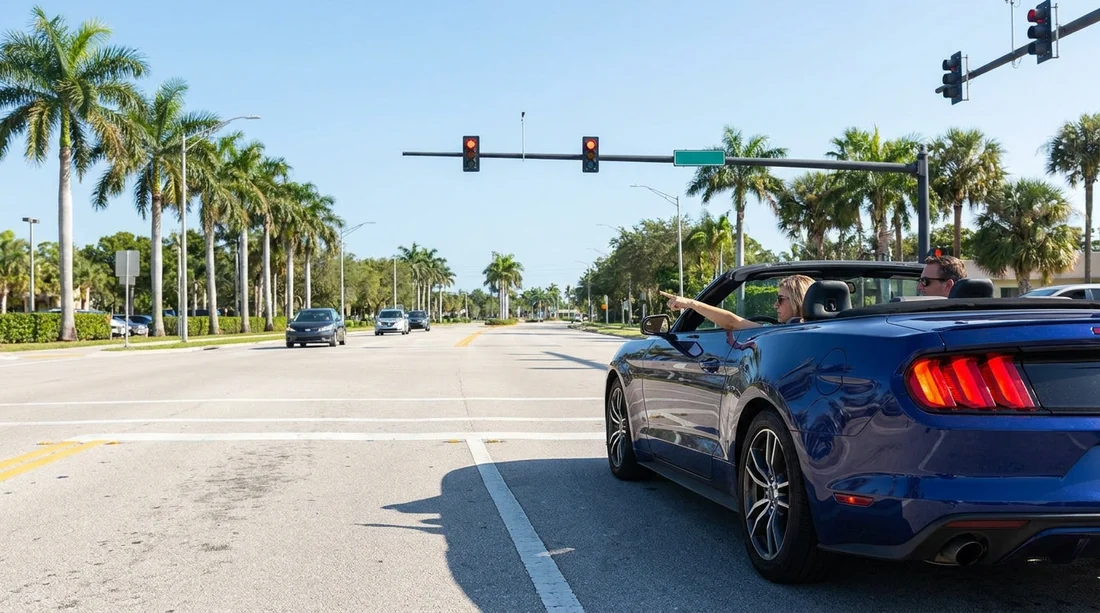
“Right on red” simply means you can make a right turn at a red traffic light, after coming to a complete stop, when it is safe and legal to do so. Think of it like treating the red light as a stop sign for right turns only. You are not gaining priority, you are joining traffic only when there is a safe gap and no prohibited sign.
Drivers collecting near Miami often encounter multi-lane junctions straight away. If you are arranging car hire around Miami, it helps to know typical traffic-light layouts before setting off, especially if you are arriving tired after a flight. You can compare pick-up points and surrounding road types on pages like car hire Florida (Miami) and car hire near Miami Beach, then plan a simple first route with fewer complicated turns.
What UK drivers should do at a red light in Florida
Use this consistent routine, and you will handle most right-on-red situations confidently:
1) Stop fully before the line. A rolling stop is risky and can be ticketed. Stop behind the thick white stop line, or before the pedestrian crossing if that is first. If you pull too far forward, you may block pedestrians or reduce your view.
2) Look for a “NO TURN ON RED” sign. If you see it, you must wait for green. These signs are common near busy crossings, school zones, or complex multi-lane junctions.
3) Check for pedestrians and cyclists first. In tourist areas, people can step off the kerb unexpectedly, and Florida crosswalks can stay busy even when traffic is heavy.
4) Yield to traffic with priority. Vehicles coming from your left on a green light have priority. So do vehicles making a permitted U-turn if signage allows it. Only turn when you can complete the manoeuvre without forcing anyone to brake.
5) Turn into the correct lane. If you are turning right onto a multi-lane road, aim for the nearest right-hand lane unless signs or road markings tell you otherwise. Then move lanes later when safe.
This routine matters in both cities and quieter resort roads. If you are collecting a family vehicle, such as around Orlando, you may find it easier to pause and reset at each junction rather than rushing to keep up with local drivers. For airport-area collection details and typical road layouts nearby, you can reference minivan rental at Orlando before you travel.
Red arrows, slip lanes, and other details that catch people out
Red arrow signals: A red arrow for right turn is a stronger instruction than a plain red light. In many places you must wait for a green arrow. Some junctions still allow a right turn after stop unless a sign forbids it, but as a visitor it is safest to treat a red arrow as “no turn” unless you clearly see permission.
Dedicated right-turn slip lanes: Some junctions have a separate right-turn lane with a triangular island. It may have a yield sign rather than traffic lights. In that case, you are not doing “right on red”, you are merging under yield rules. Slow down, check for pedestrians crossing the slip lane, then join traffic when clear.
Multiple right-turn lanes: If two lanes can turn right, follow your lane markings. The outside turning lane should end up in the outside destination lane. Avoid changing lanes mid-turn.
One-way streets: In parts of Florida, you may also be allowed to turn left on red from a one-way street into another one-way street, but signage and local rules vary. If you are not fully sure, wait for green. It is rarely worth the stress when you are new to the area.
How this differs from UK habits
UK driving teaches you to treat traffic lights as absolute instructions. Florida’s right-on-red rule asks you to make a judgement, similar to pulling out of a side road under “give way” rules. The key difference is that you are doing it from a signal-controlled junction that still has crosswalks and turning traffic. That makes observation more important than speed.
Another adjustment is lane width and vehicle size. If you are in a larger hire car, the turning arc may feel wider than a UK corner. Take it slowly, and do not let any horn behind you push you into a risky gap.
Practical tips before you leave the counter
Before you drive away, quickly build right-on-red into your “first 10 minutes” plan:
Choose an easy exit route. Airports and busy pick-up points can feed straight into large junctions. If you can, plan a route with fewer immediate turns and less complex interchanges, so you can settle into US signage and lane positioning first.
Ask where the nearest quiet road is. Some locations have a calmer loop road nearby where you can adjust mirrors, get used to the indicators and wipers, and practise stopping precisely at lines.
Know your pick-up area traffic pattern. For example, Tampa’s roads often have wide multi-lane layouts and frequent right turns at signals. If Tampa is your starting point, see the local pick-up context at car rental Tampa and anticipate more right-on-red opportunities than you might expect.
Remember that impatience is not a rule. Florida drivers may expect you to turn on red when it is legal, but you are allowed to wait until you feel it is safe. The rule permits the turn, it does not require it.
Common “no turn on red” situations in Florida
You are more likely to see restrictions in these places:
Busy pedestrian zones: Beachfront areas, shopping districts, and places with lots of crossing foot traffic.
Limited visibility junctions: If buildings, parked vehicles, or landscaping block the view of oncoming traffic.
Complex signal phasing: Where the light timing includes protected turns, frequent U-turns, or multiple crosswalk phases.
School zones and special crossings: Where safety is prioritised and drivers are expected to wait for green.
When you see a restriction, follow it exactly. In the US, ignoring a posted sign is treated more seriously than misjudging an unfamiliar layout.
What to do if you miss the turn or feel unsure
If you are unsure whether right on red is permitted, the simplest and safest choice is to wait for the green signal. If you miss a planned turn, continue straight and reroute. Florida roads are generally designed for rejoining main routes easily, and navigation apps cope well with missed turns.
If someone behind you honks, do not treat it as instruction. You cannot see what they see, and you are responsible for your own gap selection. Keep your wheels straight while waiting, so you are less likely to be pushed into the junction by a bump from behind.
FAQ
Can UK drivers always turn right on red in Florida? No. You may turn right on red only after a complete stop, and only if there is no “NO TURN ON RED” sign and the way is clear.
Do I have to stop first, even if the road looks empty? Yes. You must come to a full stop behind the line or crossing, then check and yield before turning.
Who has priority when I turn right on red? Pedestrians in the crosswalk have priority, and so does all traffic on the road you are joining that has a green light or lawful movement.
What if there is a red right-turn arrow? Treat it as a stronger “do not turn” instruction unless you clearly see a sign stating a turn is permitted after stopping.
Is it illegal to wait for green even if right on red is allowed? Usually no. The rule permits the turn, it does not force it. If you are uncertain or visibility is poor, waiting for green is the safer choice.





























































































