


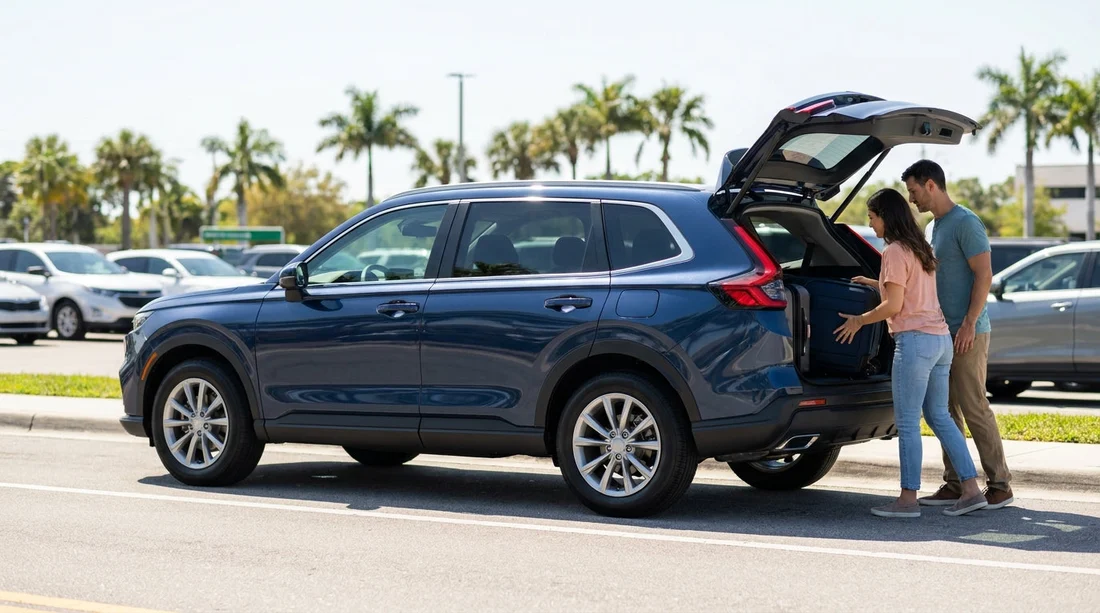
Quick Summary:
- Expect a compact-to-mid-size SUV with five seats and higher ride height.
- Plan for 2–3 medium suitcases, plus smaller bags in the cabin.
- Check if it is two-wheel drive, as many Florida SUVs are.
- Compare rear legroom and cargo specs if travelling with adults and luggage.
When you see “intermediate SUV” during car hire in Florida, it can feel a bit vague. That is because most rental companies sell categories, not guaranteed models. The label is a shorthand for a typical size band, seating count, and luggage space. In practice, an intermediate SUV is usually a step up from a compact SUV for passenger comfort, while staying easier to park than a full-size SUV.
Florida driving often means a mix of motorways, city parking, and long days out to beaches or theme parks. The “intermediate SUV” category is popular because it balances interior space with reasonable fuel consumption and straightforward handling. Still, the exact boot shape, rear legroom, and trim details can vary by brand and model availability on the day.
Below is what “intermediate SUV” usually maps to, what you can realistically pack, and what to check in your confirmation so you pick the right car hire option for your trip.
What “intermediate SUV” usually maps to in Florida
In Florida, an intermediate SUV typically sits between a compact SUV and a standard or full-size SUV. It is commonly a two-row vehicle with five seatbelts, a higher seating position than a saloon, and a boot that is more usable than a small crossover.
Rental fleets vary, but this category often includes vehicles similar in overall footprint to a mid-size family car, with extra headroom and a squarer cargo area. You might see models in the same general bracket as a Toyota RAV4, Nissan Rogue, Hyundai Tucson, Kia Sportage, or similar. Treat these as reference points only, not promises of an exact make or model.
If you are collecting near the theme parks and planning lots of motorway time, you may start your search by location specific pages such as car hire at Orlando Airport (MCO), where intermediate SUVs are a common choice for mixed itineraries.
Size expectations: footprint, driving feel, and parking
An intermediate SUV is usually around the “mid-size” end of everyday driving. Compared with a compact SUV, you can expect a little more shoulder room and a slightly longer wheelbase, which tends to make it feel calmer on high-speed roads.
For Florida city stops, the size is still manageable. You are unlikely to feel the bulk you would associate with a large three-row SUV. That matters if you are visiting places with tighter parking, such as beach areas or popular nightlife districts. If your plans include dense coastal neighbourhoods, browsing options around car rental in Miami Beach can help you keep the category practical for street parking and garage ramps.
Ground clearance is another reason people pick this class. In day-to-day Florida conditions, you are not using it for off-roading, but the higher ride height can improve visibility in traffic and make entering and exiting the vehicle easier.
Seating expectations: five people, but comfort depends on who
Most intermediate SUVs are marketed as five-seaters. That usually means two seats in the front and a three-seat bench in the back, with three seatbelts and headrests. The key question is comfort, especially if you plan to fill all seats for longer drives.
As a rule of thumb, two adults in the rear is comfortable. Three adults across the back can work for shorter hops, but shoulder room and the width of the middle seat vary. If your group is four adults plus luggage, you will often be better off with two in the back and one in the front, rather than expecting three adults in the rear for long motorway runs.
Child seats also change the calculation. Two child seats in the back row are usually fine, but three across can be challenging depending on seat width and anchor placement. If you need multiple child seats, consider checking whether a larger people carrier category suits you better.
Luggage capacity: what actually fits in the boot
The biggest uncertainty with “intermediate SUV” is boot space, because two vehicles in the same category can have different cargo floor heights, spare wheel arrangements, and tailgate shapes. Still, there are realistic expectations you can use when planning.
Typically, an intermediate SUV boot will take about two to three medium suitcases (around 24–26 inches) plus a couple of small soft bags. If you are carrying four large suitcases, you may find the boot becomes tight unless the suitcases are slimmer, or you stack higher and accept reduced rear visibility. Some travellers end up placing a bag on the rear seat, which is workable, but not ideal for comfort or security.
For airport runs, consider how many cases your group will have after shopping, beach gear, and prams. If you are flying into South Florida and planning longer coastal drives, looking at car rental at Fort Lauderdale (FLL) listings can be helpful, as intermediate SUVs are frequently used for airport transfers and day trips.
2WD vs AWD and why it matters in Florida
Many intermediate SUVs in Florida are front-wheel drive or two-wheel drive. All-wheel drive may appear in the same class sometimes, but it is not guaranteed. For most Florida itineraries, 2WD is perfectly adequate on paved roads.
Where AWD can make a difference is in heavy rain, which Florida gets often, and on slippery surfaces such as painted lines and standing water. However, tyres and careful driving matter at least as much as the drivetrain. If AWD is essential for your plans, you should look for wording that explicitly confirms it, rather than relying on the category name alone.
Also pay attention to the tyre and safety features you care about, such as blind-spot monitoring or adaptive cruise control. These vary by trim level and may not be guaranteed in any rental category.
Fuel economy and running costs
Intermediate SUVs generally use more fuel than a compact car, but less than a full-size SUV. Many models are petrol, with some hybrids appearing in fleets. You can expect a sensible compromise, especially if you are doing a mixture of city and motorway driving.
If you are comparing categories purely on cost, remember that the daily rate is only one part of the decision. The right-sized car hire can reduce stress, prevent awkward packing, and make longer drives more comfortable. A slightly larger vehicle can be better value for a family if it avoids needing a second car.
How to make sure the category fits your trip
Because “intermediate SUV” is a category, the most practical approach is to match your trip requirements to non-negotiables. Start with passenger count, then luggage, then the type of driving you expect to do.
If your group is five people with beach chairs and suitcases, an intermediate SUV may be borderline. If your group is four people with moderate luggage, it is often ideal. If you need more guaranteed space for multiple large cases, you may want to consider a larger category.
For bigger groups, Florida minivan categories can be a straightforward solution, especially for child seats and luggage. You can compare options such as minivan hire in Florida (Miami) if your priority is easy access to the third row and a deeper cargo well.
Finally, think about where you will park. If you will be in areas with tighter parking lots, an intermediate SUV is usually less stressful than a larger SUV, while still giving you the elevated driving position many people want.
FAQ
Is an intermediate SUV the same as a mid-size SUV? Often yes. In Florida car hire, “intermediate SUV” commonly overlaps with what many people call a mid-size SUV, though exact dimensions vary by fleet.
How many suitcases fit in an intermediate SUV? Plan on 2–3 medium suitcases plus smaller bags. If you have four large suitcases, you may need a bigger category or pack more softly.
Can five adults travel comfortably in an intermediate SUV? It will seat five, but comfort depends on rear seat width. Four adults are typically comfortable, while five adults may feel tight on longer drives.
Will an intermediate SUV in Florida have AWD? Not necessarily. Many are 2WD. If AWD is essential, look for confirmation of AWD in the vehicle details rather than relying on the category label.
Is an intermediate SUV a good choice for theme parks and beaches? Yes for most groups of two to four people. You get a practical boot, easy motorway cruising, and manageable parking compared with larger SUVs.





























































































