


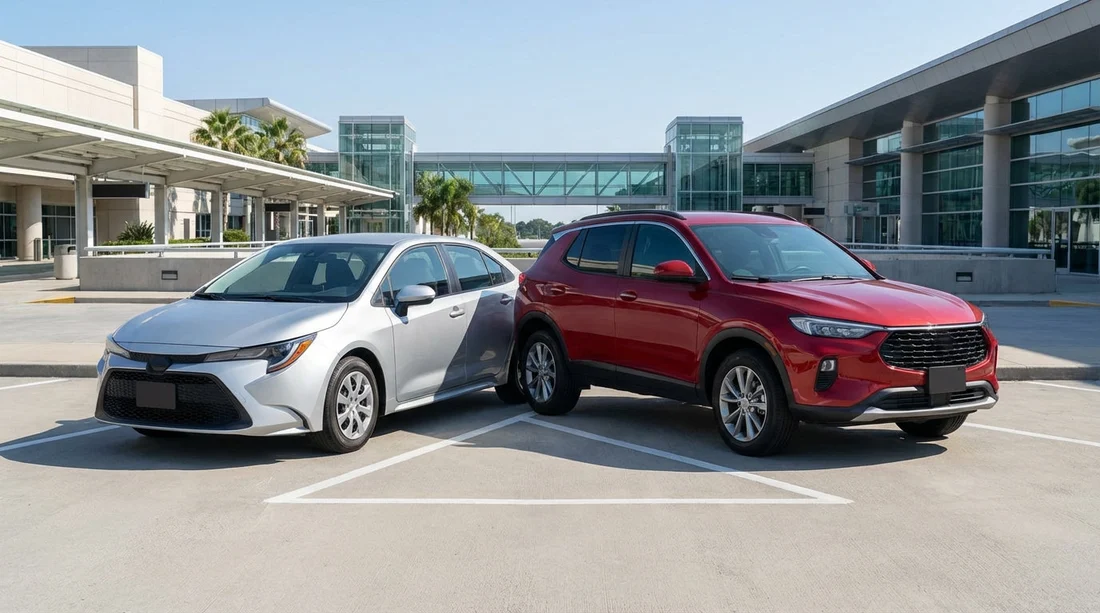
Quick Summary:
- ACRISS codes use four letters to describe class, body, transmission and fuel.
- Match the first letter to size, from Mini to Luxury.
- Use letters two and three to confirm doors, boot, and gearbox type.
- Check the fourth letter for fuel or air-con, then compare luggage needs.
When you compare car hire options in the United Estates, you will often see short codes such as ICAR, SFAR, or CDAR next to the vehicle name. These are ACRISS codes, an industry standard used by many rental brands and booking systems. The aim is simple, a consistent shorthand that tells you what type of vehicle you are likely to receive, even when the exact make and model can vary.
In practice, ACRISS helps you predict whether a car is compact or full size, whether it has two or four doors, whether it is automatic or manual, and sometimes whether it includes air conditioning or what fuel it uses. If you learn to read the four letters, you can avoid common surprises, such as selecting a sporty looking image but receiving a two door coupe, or choosing a cheap category that only guarantees a manual transmission.
For travellers comparing categories on Hola Car Rentals pages such as United States car rental or the UK-focused car hire United States landing page, decoding ACRISS is one of the quickest ways to judge whether a category suits your route, passengers, and luggage.
What is an ACRISS code?
ACRISS is the trade body behind a vehicle classification system used across the car rental industry. The code is typically four letters. Each position has a meaning:
1st letter: vehicle category (size and sometimes prestige).
2nd letter: vehicle type (body style, such as sedan, SUV, convertible).
3rd letter: transmission and drive (automatic or manual, and sometimes 4WD/AWD).
4th letter: fuel and air conditioning (for example, petrol with air-con).
Not every booking display spells the code out, but if you see a four-letter set ending in AR, MR, or similar, it is usually ACRISS.
How to read the first letter, the vehicle category
The first letter is the broad category, which is the closest thing to “size”. In the United Estates, categories can overlap slightly between brands, but this is the typical pattern:
M Mini, very small cars, limited boot space.
N Mini elite, a higher trim mini category.
E Economy, small hatchbacks or small sedans.
H Economy elite, nicer economy models.
C Compact, common for city plus highway trips.
D Compact elite, upgraded compact category.
I Intermediate, more rear legroom, bigger boot.
J Intermediate elite, upgraded intermediate.
S Standard, often a mid-size sedan in US terms.
R Standard elite.
F Full size, typically a larger sedan.
G Full size elite.
P Premium, larger and higher trim, sometimes near-luxury.
U Premium elite.
L Luxury.
W Luxury elite.
The most useful takeaway is that C, I, S, and F are the common mainstream steps up in space. If you are travelling with multiple checked bags, an intermediate or above is usually safer than economy, especially if you are booking in a category that might be a sedan rather than a hatchback.
How to read the second letter, body style
The second letter tells you what type of vehicle it is. This matters as much as size, because luggage capacity and access differ widely between, say, an intermediate sedan and an intermediate SUV.
Common second-letter meanings you will see on US car hire listings include:
B 2 door.
C 2 or 4 door.
D 4 door.
W Estate or wagon.
V Passenger van.
L Limousine.
S Sport.
T Convertible.
F SUV.
J Open air all terrain.
K Commercial van.
P Pick-up.
This is where codes like SFAR start to make more sense. The S is the size category, the F points to an SUV body. If you expected a sedan, that second letter is the clue you should look for.
If you specifically need more load space, you may be better off comparing categories on a dedicated van page like van hire United States, where the body style is more consistently aligned with luggage capacity.
How to read the third letter, transmission and drive
The third character is about the gearbox and sometimes the driven wheels. In the United Estates, automatic is common, but you should never assume it without checking, especially on smaller categories or specialist cars.
Typical third-letter meanings include:
A Automatic, unspecified drive.
M Manual, unspecified drive.
N Manual, 4WD.
C Manual, AWD.
B Automatic, 4WD.
D Automatic, AWD.
If you are driving in snow-prone areas or mountain routes, you may prefer AWD or 4WD, but note that many mainstream categories do not guarantee it unless that third letter specifies it. Also remember that “SUV” does not automatically mean AWD in rental fleets.
How to read the fourth letter, fuel and air conditioning
The fourth letter can be overlooked, but it can explain why two very similar categories are priced differently. It often indicates fuel type and whether air conditioning is included.
Common fourth-letter meanings you may encounter:
R Unspecified fuel with air conditioning.
N Unspecified fuel without air conditioning.
D Diesel with air conditioning.
Q Diesel without air conditioning.
H Hybrid with air conditioning.
I Hybrid without air conditioning.
E Electric with air conditioning.
C Electric without air conditioning.
L LPG with air conditioning.
On US bookings, air conditioning is normally included, so you will often see R as the final letter. Still, it is worth checking when comparing budget categories or older fleet types.
Decoding the examples, ICAR and SFAR
Now you can decode the two examples from the title:
ICAR
I = Intermediate category (space step up from compact).
C = 2 or 4 door (body style not strictly fixed).
A = Automatic transmission.
R = Air conditioning, fuel unspecified.
ICAR therefore usually means an intermediate automatic car with air conditioning, and the supplier can fulfil it with different models that fit that broad definition.
SFAR
S = Standard category (often mid-size in US terms).
F = SUV body style.
A = Automatic transmission.
R = Air conditioning, fuel unspecified.
SFAR is a standard SUV, automatic, with air conditioning. It does not promise AWD, because the third letter would need to indicate that.
Other common US codes you may see
A few more codes tend to appear frequently on comparison sites, including supplier-specific pages such as Budget car hire United States and similar listings across brands.
ECAR Economy, 2 or 4 door, automatic, air-con. Often small sedans or hatchbacks.
CDAR Compact, 4 door, automatic, air-con. Common everyday category.
IDAR Intermediate, 4 door, automatic, air-con. Good for longer drives and luggage.
FDAR Full size, 4 door, automatic, air-con. Better rear space, typically larger boot.
PCAR Premium, 2 or 4 door, automatic, air-con. Higher trim, sometimes larger engines.
IFAR Intermediate SUV, automatic, air-con. Useful if you want ride height with moderate size.
PFAR Premium SUV, automatic, air-con. More space, often three-row capable but not guaranteed.
If you are trying to ensure three rows of seats, an SUV code alone is not enough. A minivan category is usually clearer for that use case, and you can cross-check typical options on minivan hire United States.
What ACRISS codes do not guarantee
ACRISS is helpful, but it is not a promise of a specific vehicle. It also leaves out details that matter to travellers. Here are the main limitations to keep in mind:
Exact model and features vary. A category can be fulfilled by multiple makes and trims. Images are illustrative.
Luggage space is only implied. ACRISS does not specify litres of boot capacity, and “2 or 4 door” does not tell you whether it is a hatchback. If luggage is critical, stepping up a class or choosing an estate, SUV, or van body letter is safer.
AWD and 4WD are not assumed. You must see the correct third-letter indicator. Many US SUVs in rental fleets are 2WD.
Passenger count is not explicit. ACRISS does not directly state seating capacity. A standard SUV may be five seats, while three-row seating may require a larger category.
“Elite” is about positioning, not just size. Elite categories often mean newer, higher trim, or premium models within the same size band, but they do not always add meaningful boot space.
Practical tips for choosing the right ACRISS category
Start with luggage, not price. For airport arrivals in the United Estates, the biggest day-one pain point is fitting suitcases. If you have two large cases plus carry-ons, intermediate or standard is often a more comfortable baseline than economy.
Use the second letter to avoid mismatches. If you want easy rear access for child seats, avoid two-door codes. Look for D (4 door) or C (2 or 4 door) rather than B (2 door).
Confirm automatic if you need it. Even though automatics are common, check that the third letter is A or another automatic code. This matters for travellers who cannot drive manual.
Do not rely on SUV for winter traction. If you truly need AWD or 4WD, look for the appropriate third letter, and review local requirements such as tyre and chain rules separately.
When in doubt, compare like with like. If you are comparing suppliers, keep the ACRISS code constant across quotes. That makes it easier to judge value between inclusions and terms, rather than accidentally comparing different car classes.
FAQ
Are ACRISS codes the same across all US car hire companies? They are intended to be standard, and most major companies follow them. Small differences can occur in how fleets are assigned to a category, so treat the code as a guide, not a specific model guarantee.
Does ICAR always mean a four-door car? No. The second letter C means 2 or 4 doors, so the supplier can provide either. If you want four doors, look for IDAR, CDAR, or another code with D in the second position.
Does SFAR mean the SUV is AWD? No. SFAR only tells you it is a standard SUV with automatic transmission and air conditioning. AWD or 4WD would normally be shown by a different third letter than A.
Why do similar codes have different prices? Price can change due to category demand, fleet availability, and inclusions, and the fourth letter can indicate differences like fuel type. Also, “elite” categories may cost more for newer or higher-spec vehicles.
What should I choose if I need lots of luggage space for a family trip? Consider an SUV category with an F in the second position, or move to a people carrier or minivan category for the clearest space upgrade. Always match the code to the number of passengers and suitcases you expect.





























































































