


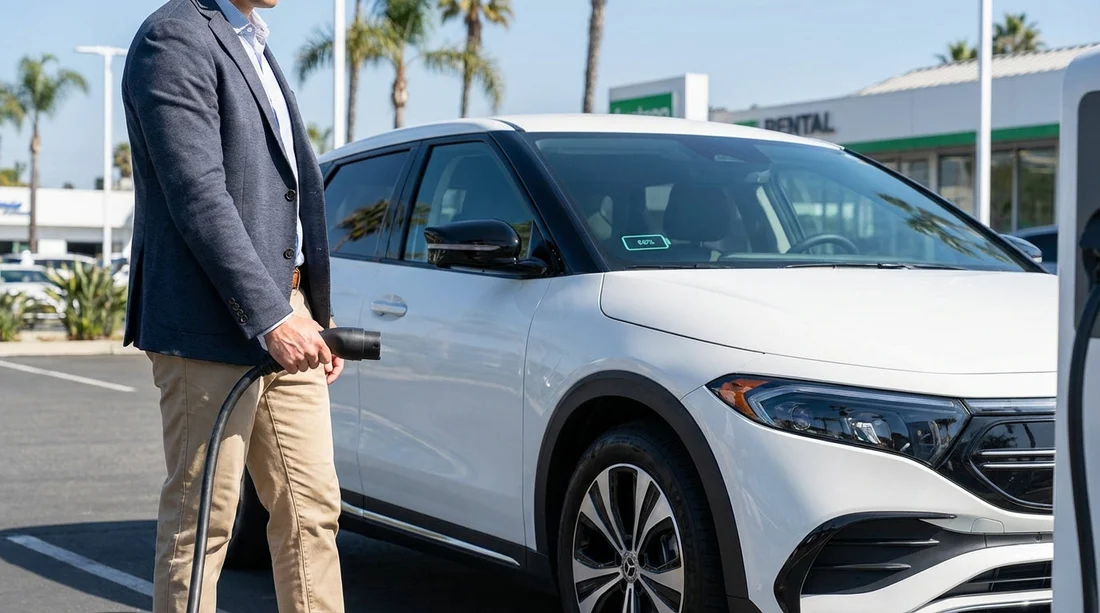
Quick Summary:
- Expect 70 to 90% charge, though some pick-ups start around 50%.
- Confirm the return policy, fee options, and minimum state of charge.
- Photograph the battery percentage and estimated range before leaving the car park.
- Plan your first charge stop within 30 to 60 miles if needed.
Picking up an electric vehicle for car hire in California is usually straightforward, but the one detail that can reshape your first day’s route is the state of charge (SoC) you receive at the desk. Unlike petrol cars that can be handed over with a full tank policy, EV fleets operate on charging windows, charger availability, and the practical reality that charging to 100% can take time and may be avoided to protect battery health.
This guide explains what charge level you can commonly expect at pick-up in California, what to confirm before you drive away, and how charging realities affect trip planning from Los Angeles to the Bay Area and beyond.
Typical pick-up charge levels for EV car hire in California
In California, many EV rentals are handed over somewhere between 70% and 90% SoC. This range tends to balance operational efficiency with customer usability.
That said, it is not unusual to receive an EV at 50% to 80%, especially during peak travel periods, late-night arrivals, or when the previous customer returned the vehicle low.
Receiving 90% to 100% can happen, but you should treat it as a bonus rather than a guarantee. Some operators avoid charging to 100% routinely, because the last portion can be slower.
If you are collecting at a major airport location, your EV car hire experience may start with a short shuttle ride and then a choice of vehicles in a designated area. Airport sites like Los Angeles LAX and San Francisco SFO often have high turnover, which can make the exact SoC more variable than at smaller city branches.
Why EV rentals are not always “full charge” at pick-up
There are practical reasons EVs do not follow a universal “full-to-full” approach.
Charging time and charger access matter. Even with DC fast charging, getting from 80% to 100% can be comparatively slow.
Battery management also plays a role. Many manufacturers recommend daily charging to around 80% to 90% and saving 100% for long trips.
Unpredictable returns affect handover. If the previous driver returns low and the lot is busy, the vehicle might be cleaned and dispatched before it reaches a higher target.
What to confirm at the counter before you accept the keys
Because policies vary, the most important step is to clarify the charging terms in plain language, then match them to what the car actually shows.
1) The stated pick-up SoC target. Some companies promise a minimum percentage. Others offer “as available” with no minimum.
2) The return requirement. You may be asked to return the EV at a similar SoC to pick-up, above a set threshold (for example, 70% or 80%), or return at any charge level but pay a fee to cover charging.
3) Whether you can prepay charging. Prepaid options can be convenient if your schedule is tight, but check the cost and whether it covers any return level or only low returns.
4) The included charging equipment. Confirm the presence of a Level 1 cable (standard plug), a Level 2 cable if applicable, and any adaptors. Also ask whether the vehicle is compatible with Tesla Superchargers, and if so, how billing works.
If you are collecting in Southern California, you may be comparing operators at Hertz at LAX or Alamo at LAX. Regardless of brand, the clearest protection is confirming the written policy in your rental agreement and matching it to the dashboard display before departure.
What to check in the car park, and what to document
Before you leave, take two minutes to validate the basics. This is particularly helpful for EV car hire, where small percentage differences can translate into meaningful miles.
Check the battery percentage and estimated range and take clear photos of the instrument cluster. The percentage is the key number, because range estimates can vary based on recent driving patterns.
Confirm the charging port and connector type. Many non-Tesla EVs use CCS for rapid charging in the US, while Teslas use the North American Charging Standard (NACS).
How pick-up charge level affects planning in California
California has excellent public charging coverage in major metros and along intercity corridors, but your first 24 hours can still be smoother with realistic assumptions.
If you receive 80% to 90%, you can usually reach your accommodation, do local driving, and plan a convenient charge later.
If you receive 50% to 70%, build an early charge stop into your day. Choose a charger near a meal stop, supermarket, or attraction so the charging time is not wasted.
If you receive below 50%, treat charging as your first errand. Plan to arrive with a comfortable reserve for rerouting.
Return-day charging: how to avoid last-minute stress
The easiest return is the one you plan before the final day.
Identify a reliable fast charger within 5 to 15 miles of the return point. That gives you time to charge, then drive to the lot without dropping too much SoC.
Charge to the required threshold, not necessarily 100%. If the policy requires 80%, aiming for 82% to 85% gives a buffer for detours.
Keep receipts or session history if your charging network provides them, and take a final photo of the SoC at drop-off.
Choosing an EV for your trip: realistic expectations
For car hire in California, the best EV is the one that fits how you will travel. If you will do mostly city driving with predictable parking, a smaller battery can be fine.
When you compare pick-up locations, remember that airport logistics can influence handover charge level. For example, a busy site like Payless at San Diego SAN may operate differently from other brands at the same airport, so treat the written terms and the actual dashboard SoC as your source of truth.
FAQ
What battery percentage should I expect at pick-up for EV car hire in California? Many renters receive around 70% to 90%. During peak periods, 50% to 80% is also common, and 100% is not guaranteed.
Is an EV rental supposed to be fully charged when I collect it? Not always. Some operators set a minimum charge or a target band, while others provide the vehicle at the available charge level and apply a return policy or fee structure.
What should I confirm at the counter about charging? Confirm the pick-up SoC, the required return SoC, whether prepaid charging is offered, how fees are calculated, and what charging equipment or access is included.
How do I protect myself from unexpected charging fees? Photograph the battery percentage at pick-up and at drop-off, keep any charging receipts, and ensure the return requirement is written in your agreement.
How should a lower pick-up charge change my travel plan? If you start below about 70%, plan an early fast-charge stop within your first hour or two, ideally paired with food or errands, and keep a comfortable buffer for traffic or queues.





























































































