


Quick Summary:
- Stop for flashing red lights unless a physical median separates directions.
- A painted centre turn lane is not a divider, both directions stop.
- Stay stopped until red lights stop, or the bus moves again.
- Illegal passing can bring heavy fines, points, and possible suspension.
If you are using car hire in Pennsylvania, few road rules matter more than school bus stopping laws. They are enforced aggressively, and the situations that confuse visitors are common: multi lane roads, centre turn lanes, and highways split by medians. The key is to decide whether traffic directions are separated by a physical barrier. If they are not, you stop, even if the road feels wide.
To keep this practical, this guide explains what counts as a “divided highway” in Pennsylvania, what does not, and what to do in quick scenarios. It also summarises typical penalties so you understand the risk of guessing wrong.
What triggers the legal duty to stop?
In Pennsylvania, you must stop when a school bus is stopped and displaying flashing red signal lights and a stop arm. This requirement applies whether you are behind the bus or approaching it from the opposite direction, unless an exception for a divided highway applies.
In everyday terms, treat flashing red lights and the stop arm as a temporary stop sign that controls the road. You must come to a complete stop and stay there until the bus resumes motion, or the red lights stop flashing. Do not edge past the bus, even slowly, unless a police officer or other authorised person clearly directs you through.
Visitors collecting a vehicle at Philadelphia Airport car hire often encounter school routes quickly, especially in suburban corridors. Expect frequent stops during morning and afternoon school travel times.
Divided highway vs centre turn lane, the Pennsylvania distinction
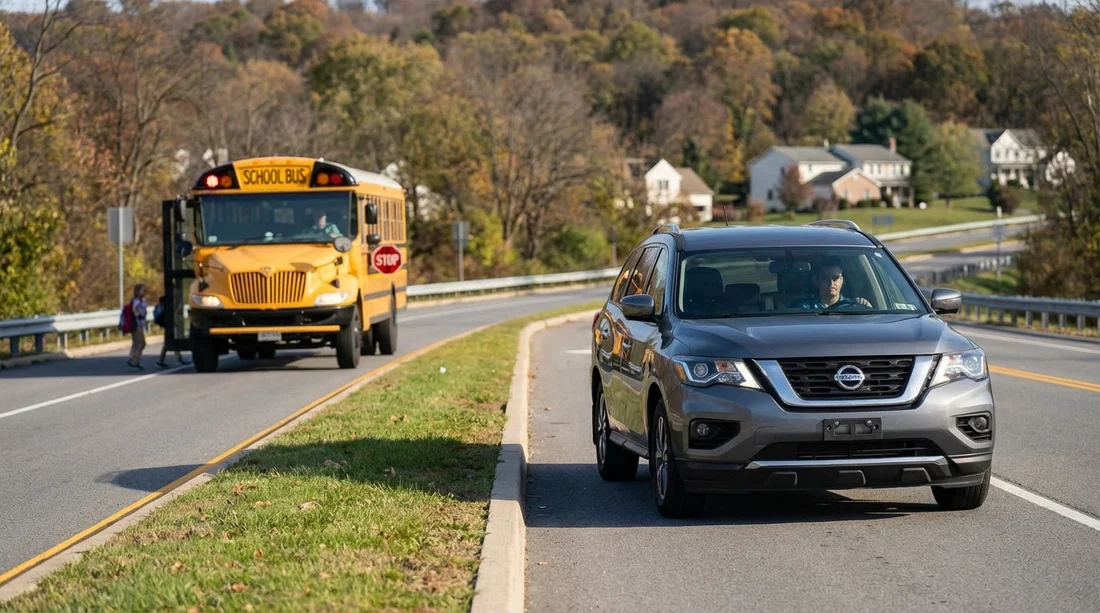
The confusion usually comes from the word “divided.” In Pennsylvania, a divided highway generally means the two directions of traffic are separated by a physical barrier or an unpaved median area. The opposing lanes are not simply separated by painted lines.
What usually counts as divided: a raised median curb, a guardrail, a concrete barrier, or a wide grass or paved median separating directions.
What usually does not count as divided: double yellow lines, a painted buffer, or a centre two way left turn lane (the lane with turn arrows allowing left turns from both directions).
If you are on the opposite side of a truly divided highway, you typically do not have to stop for the bus on the other side. If there is no physical separation, both directions stop.
Quick scenarios: do I stop on a split highway?
Scenario 1: Four lane road, two lanes each way, painted double yellow centre line. Yes, stop. This is not a divided highway, and opposing traffic must stop when the bus displays red lights.
Scenario 2: Five lane road with a centre turn lane. Yes, stop. A centre turn lane is not a divider. Both directions must stop because there is no physical barrier separating directions.
Scenario 3: Six lane boulevard with a raised median curb. If you are travelling in the same direction as the bus, you stop. If you are on the opposite side of the raised median, you generally do not stop, because the roadway is divided by a physical barrier.
Scenario 4: Highway with a wide grass median between directions. Same rule as above. Same direction stops. Opposite direction is typically exempt because the grass median divides the highway.
Scenario 5: Roadworks create temporary cones between directions. Treat this cautiously. Cones are not always considered a physical divider in the same way a median is. If there is no substantial barrier and the layout is unclear, the safest approach is to stop when you see the bus red lights, unless you are clearly on the far side of a separated carriageway.
Scenario 6: You are turning at an intersection as the bus stops. If the bus is stopped with red lights and the stop arm out, you must stop before passing the bus’s position. Turning does not automatically exempt you. If you can complete your turn without passing the bus, you may be able to proceed, but if your path would take you by the bus, stop.
What if I am behind the bus?
If you are behind the bus, you must stop regardless of whether the road is divided. The divided highway exception is about vehicles approaching from the opposite direction. Behind the bus, stop at a safe distance, do not change lanes to pass, and remain stationary until the red lights stop flashing.
This matters on multi lane roads where drivers assume they can pass on the left. In Pennsylvania, passing a stopped school bus with red lights is prohibited, even if you have more than one lane in your direction.
How far back should I stop?
Pennsylvania law is often described using a practical rule: stop at least 10 feet from the bus. In reality, you should stop far enough back to see the bus’s stop arm and give children space to cross. If you are driving a larger vehicle such as an SUV, increase your gap and avoid creeping forward.
If you are unfamiliar with US road widths, be cautious in neighbourhood streets. With SUV rental in Philadelphia, the higher seating position can help you spot the bus lights early, but the longer stopping distance still matters.
What are the fines and penalties for passing a stopped school bus?
Penalties can change, and local courts have discretion, but Pennsylvania treats this offence seriously. A typical outcome for unlawfully passing a stopped school bus includes a substantial fine, licence points, and a potential licence suspension. Costs can escalate once court fees and insurance impacts are considered.
Commonly cited consequences include:
Fine: often several hundred dollars, and it can be higher in certain circumstances.
Points: passing a school bus can add points to your driving record, which may affect insurance and licensing.
Suspension: a licence suspension is possible, even for a first offence, depending on the charge and circumstances.
For visitors on car hire, a citation can also create practical problems. Your home licence might not be “suspended” back home in the same way, but the state action and unpaid fines can still cause complications for future travel or driving privileges. It is also common for rental companies to pass through administrative fees tied to processing fines or toll violations, so it pays to avoid preventable tickets.
School bus cameras and enforcement realities
Many Pennsylvania school districts use bus mounted camera systems designed to capture vehicles that pass while red lights are flashing. If an offence is recorded, enforcement can follow even if an officer did not witness it in person.
This is another reason the divided highway distinction matters. A driver on the opposite side of a physically divided highway may be lawful to proceed, but a wide road with only paint in the middle is still a stopping situation, and cameras do not care that you thought it “looked divided.”
Practical decision checklist for visitors
Use this quick mental checklist when you spot a stopped school bus:
1) Are the red lights flashing and the stop arm out? If yes, prepare to stop immediately.
2) Am I behind the bus? If yes, stop. Do not pass, even in another lane.
3) Am I coming the other way? If yes, ask whether there is a physical median or barrier separating directions.
4) Is there only a painted centre turn lane or double yellow lines? If yes, stop. Painted markings do not create the divided highway exception.
5) When can I go again? Only when the red lights stop flashing or the bus moves.
If you are unsure, stop. A brief delay is far cheaper than a school bus passing citation.
Why this matters when driving from Philadelphia into suburbs
Many travellers pick up a vehicle in the city and then drive out to towns across the Delaware Valley. Those suburban arterials often have five lanes with a centre turn lane, which looks like a split roadway if you are used to different UK markings. In Pennsylvania, that layout usually still requires both directions to stop for a bus with red lights.
If you are comparing providers for Avis car hire in Philadelphia or Hertz car hire in Philadelphia, the driving rule is the same regardless of brand. What changes is your familiarity with the roads, so plan extra time during school commute hours and expect sudden stops on multi lane routes.
Common mistakes visitors make
Mistake 1: Assuming more lanes means you can pass. Lane count does not matter if you are behind the bus. You stop.
Mistake 2: Treating a centre turn lane as a median. A two way left turn lane is not a divider, and you stop from both directions.
Mistake 3: Rolling forward while waiting. Stay fully stopped. Children can cross unexpectedly, and creeping can be interpreted as an attempt to pass.
Mistake 4: Moving as soon as doors close. Wait for the red lights to stop flashing. The bus may keep the red lights on while children finish crossing or reach a safe point.
FAQ
Do I have to stop for a school bus on the other side of a divided highway in Pennsylvania? Usually no, if the opposite directions are separated by a physical median or barrier. If there is only paint or a centre turn lane, you must stop.
Is a centre two way left turn lane considered a divided road? No. A centre turn lane is not a physical divider in Pennsylvania, so traffic in both directions must stop for a bus with flashing red lights.
What if the school bus has amber lights flashing instead of red? Amber lights warn that the bus is preparing to stop. Slow down and be ready to stop, but you are required to stop when the red lights are flashing and the stop arm is out.
How long must I remain stopped? Stay stopped until the bus’s red lights stop flashing or the bus moves again. Do not proceed just because you think boarding has finished.
What penalties can I face for passing a stopped school bus? Penalties can include a significant fine, licence points, and possible licence suspension, plus added costs like court fees and insurance impact.





























































































