


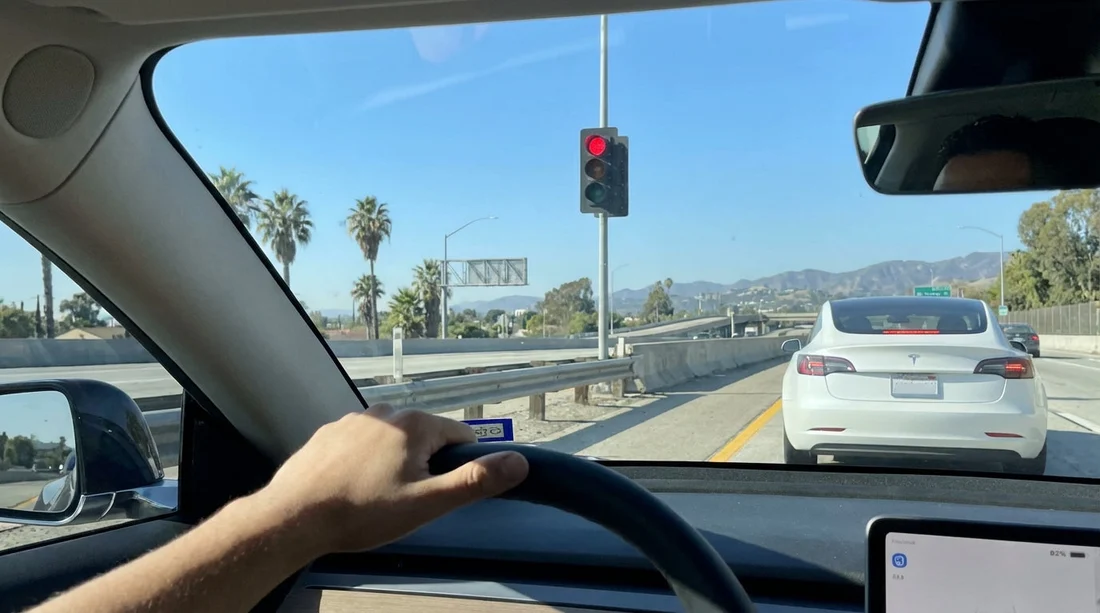
Quick Summary:
- Ramp meters are stoplights on on-ramps, controlling cars entering freeways.
- Stop at red behind the limit line, then go on green.
- Usually one car per green, sometimes two when signed.
- Follow queue rules, and use HOV bypass lanes only if eligible.
If you are new to Los Angeles driving, ramp metering lights can feel like a trick question. You have found an on-ramp, you are accelerating towards the motorway, and then a traffic signal tells you to stop. In LA, that is normal. Ramp meters are standard on many freeways, especially during peak hours, and they are designed to create smoother merges by spacing vehicles.
This matters for car hire drivers because a metered on-ramp is one of the few times you will stop on an acceleration lane, and doing the wrong thing can cause sudden braking, confusion, and risky merging behaviour. The good news is that the rules are consistent once you know what to look for.
In simple terms, a ramp meter is a traffic light placed partway down an on-ramp. It releases cars one at a time, or sometimes two at a time, so that the mainline traffic keeps moving and each driver has a predictable gap to merge into. You are expected to treat it like any other signal: stop on red, proceed on green, and follow any signs about how many cars are released per cycle.
If your trip starts at the airport, it is worth knowing that the first few miles after picking up a vehicle can include metered ramps. For reference, Hola Car Rentals pages that cover pick-up options include Los Angeles LAX car rental and Enterprise at Los Angeles LAX, which are common starting points for visitors heading straight onto the 405, 105, or 110.
What are ramp metering lights in Los Angeles?
Ramp metering lights are signals installed on freeway on-ramps. They usually have two red lights stacked vertically, and a single green light. When they are active, the red lights hold vehicles back and the green light releases vehicles in a controlled rhythm.
LA freeways carry very high volumes, and the most disruptive moment for traffic flow is often the merge. If too many vehicles enter at once, everyone brakes, shockwaves form, and speeds drop. Metering aims to prevent that by feeding the freeway in smaller, evenly spaced doses.
You will typically see an electronic or fixed sign reading “RAMP METERED WHEN FLASHING” or similar wording. There may also be a “WAIT FOR GREEN” sign. When the ramp meter is off, you treat the ramp like a normal on-ramp and merge when safe without stopping.
Do I stop at a red signal on the ramp?
Yes. When the ramp meter is active and the signal is red, you must stop behind the limit line just like at an ordinary intersection. If there is no clearly painted line, stop before the signal head and before entering the merge area. Do not creep forward past another driver’s front bumper, and do not stop so far back that you block cars behind from lining up efficiently.
It can feel counterintuitive because you are on an acceleration lane, but the metered section is intentionally designed with enough space to stop and then accelerate again. The key is to keep your wheels straight, hold the brake firmly, and be ready to move promptly on green so you do not waste the gap the system is creating.
Do not treat a red ramp meter as a yield, and do not run it because you think you can merge “safely anyway.” In California, ramp meters are traffic control signals. A red indication means stop, and a green indication means proceed if it is safe to do so.
How many cars go per green?
Most of the time in Los Angeles, it is one car per green. You will see each vehicle move up to the line, get a green, and then go. The cadence can be surprisingly quick, often a few seconds per car, but it changes with traffic demand.
Sometimes, especially on wider ramps, there will be a sign stating “2 CARS PER GREEN.” When that sign is present, two vehicles may proceed for each green, typically side-by-side if there are two metering lanes, or one after the other if the design permits. In that case, the lead car should go immediately, and the second car should follow without hesitation while maintaining a safe following distance.
If there is no “2 cars” sign, do not assume two vehicles may go. A common mistake from first-time visitors is tailgating through on a single green. That defeats the spacing the meter is trying to create and raises the chance of a rear-end collision if the first vehicle hesitates.
Queue rules: where do I line up, and can I change lanes?
Metered ramps often have painted lanes to organise the queue, and sometimes a second lane opens near the signal to increase throughput. Follow the markings and merge into the queue early and calmly.
Important etiquette and safety points for car hire drivers:
Join the back of the queue. If traffic is backed up, do not drive up the shoulder or use a turn lane to cut in at the last second. LA drivers will protect their space, and sudden cuts create hard braking on a ramp that is already stop-and-go.
Keep the intersection clear. Some on-ramps back up onto surface streets. Do not block cross traffic or sit in the middle of an intersection to “hold your place.” If the ramp is full, wait behind the stop line on the street until space opens.
Stay in your lane to the meter. Once you have chosen a metering lane, avoid weaving unless signs direct you. Lane changes in a short, queued ramp are where small bumps happen, especially with unfamiliar hire vehicles and different blind-spot layouts.
Leave room but stay attentive. You do not need to bumper-to-bumper, but large gaps invite cut-ins. Keep a reasonable gap, watch mirrors, and keep your steering straight when stopped.
HOV and carpool bypass lanes: who can use them?
Some Los Angeles ramps have a dedicated HOV (High-Occupancy Vehicle) bypass lane or a “CARPOOL ONLY” approach that lets eligible vehicles skip the metered queue, or reach a separate meter with a faster release. These lanes are regulated, and the occupancy requirement is posted, commonly 2+ or 3+ people, sometimes limited by time of day.
Do not use an HOV bypass lane unless you meet the posted requirement. Enforcement exists, and penalties can be expensive. Also, do not assume that having a larger vehicle from car hire qualifies you. Eligibility is about occupancy (and in some corridors, specific decals), not vehicle size.
If you are not eligible, stay in the general queue even if the bypass lane looks empty. Cutting into it late can force a dangerous merge back out when the lane ends.
When are ramp meters active?
Ramp meters are typically active during weekday peak travel times, and sometimes during special events, heavy congestion, or incidents. Many ramps have a sign indicating when metering may occur, such as “MON-FRI 6AM-9AM, 3PM-7PM,” though exact times vary by corridor.
Assume metering can be active if you see flashing beacons or electronic signage indicating the ramp is metered. If the lights are dark and the “when flashing” beacon is off, proceed as a normal on-ramp and merge with care.
Visitors often experience their first metered ramp when leaving the airport area. If you are comparing pick-up points or routes, Hola Car Rentals also provides options around Southern California, including California LAX car rental and Santa Ana SNA airport car rental, which can influence which freeways and ramps you encounter.
Step-by-step: how to drive a metered on-ramp smoothly
1) Read the signs early. Look for “RAMP METERED” notices, “WAIT FOR GREEN,” and any “2 CARS PER GREEN” instruction. Also check for HOV lane markings and occupancy requirements.
2) Choose the correct lane and commit. Get into the appropriate queue lane early. If you need to stay right for an upcoming exit or to avoid an HOV restriction, do it before the queue tightens.
3) Stop correctly at the limit line. When red, stop with your front bumper behind the line. Do not stop in the crosshatched area beyond the line, and do not roll through.
4) Move promptly on green. When your light turns green, go. Hesitation wastes the designed gap and causes the next driver to launch late, making the merge harder for everyone.
5) Accelerate decisively after the meter. Once released, build speed to match freeway traffic. Do not crawl down the ramp. The whole point of metering is to give you space to accelerate and merge at the correct speed.
6) Merge by matching speed, then signalling. In LA, signalling is expected, but it is most effective when you are already close to the speed of traffic. Check mirrors and blind spots, signal, and take the gap created for you.
7) Keep scanning after you merge. LA interchanges can place an on-ramp merge immediately before an off-ramp diverge. Be ready for drivers crossing multiple lanes. Hold your lane and create space if someone makes a late move.
Common mistakes first-time Los Angeles drivers make
Stopping too early. Some drivers stop far before the line because they are unsure. That reduces ramp capacity and causes confusion. Roll forward to the line when safe to do so.
Running the red. Treating the meter like a suggestion can cause side-swipe conflicts at the merge and potential citations.
Tailgating through a single green. If it is one car per green, wait your turn. Spacing is what makes the merge work.
Overly timid acceleration. After the green, accelerate briskly. Entering the freeway 15 to 20 mph slower than traffic is one of the biggest risk factors for a near-miss.
Using the HOV bypass incorrectly. If you are in a car hire vehicle with only one occupant, a carpool-only bypass is not yours to use. Follow the posted occupancy rules.
How ramp meters affect your journey planning in LA
Metering can add a few minutes at busy ramps, but it often saves time overall by reducing stop-and-go waves on the freeway. For you as a visitor, the main impact is psychological: do not panic when you see a red light on a ramp, and do not assume the system is broken when traffic is queued.
If you are navigating with sat-nav, it may reroute you to different on-ramps. Each ramp can have different geometry: some have long acceleration lanes and plenty of room, while others are shorter and require sharper attention. Give yourself extra space, avoid sudden lane changes, and prioritise a calm, predictable driving style.
Finally, remember that Los Angeles freeway driving is about cooperation at scale. Ramp meters exist to make that cooperation easier. When you follow the signal, accelerate confidently, and merge at speed, you will feel the rhythm of the freeway quickly, even if it is your first time driving in the city with a car hire.
FAQ
Q: Are ramp metering lights the same as normal traffic lights?
A: Yes, treat them as official traffic control signals. Stop on red at the limit line and proceed on green, following any posted instructions.
Q: What does “2 cars per green” mean on an LA on-ramp?
A: It means two vehicles may proceed for each green cycle when signed. If there is no sign, assume one vehicle per green.
Q: What if the ramp meter is dark or not flashing?
A: If the signal is not operating and signs indicate metering only when flashing, drive the ramp normally and merge when safe without stopping.
Q: Can I use the HOV bypass lane in a hire car?
A: Only if you meet the posted occupancy requirement and any other posted restrictions. Vehicle type does not override the carpool rules.
Q: What should I do if the on-ramp queue backs up onto a surface street?
A: Wait without blocking intersections, keep lanes clear for cross traffic, and join the queue safely rather than cutting in at the last moment.





























































































