


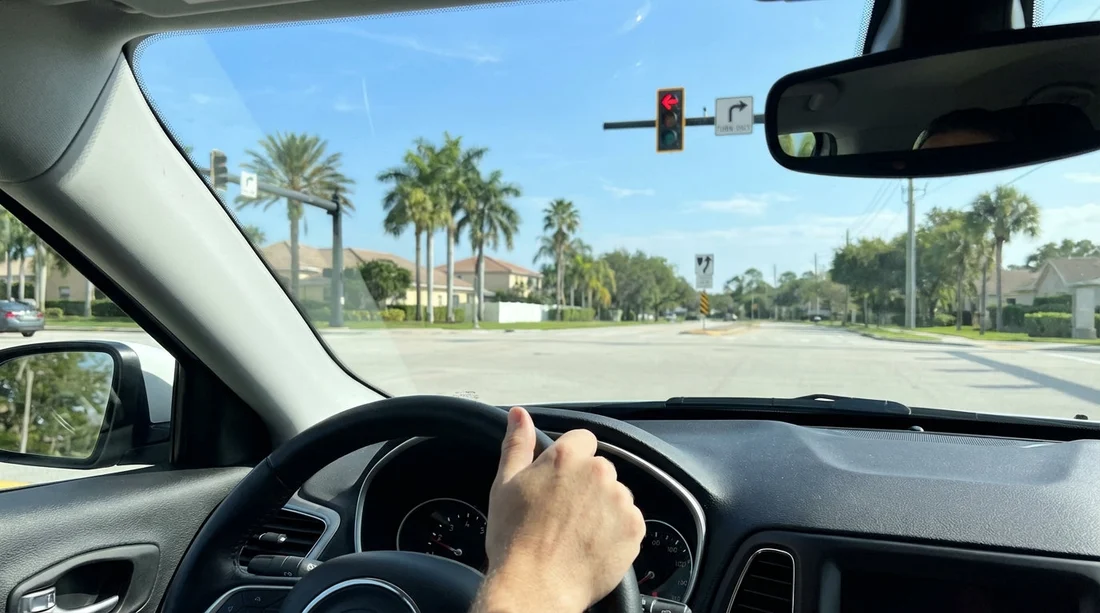
Quick Summary:
- In Florida, a red arrow can allow right turns after stopping.
- Come to a complete stop at the line, then check all approaches.
- Yield to pedestrians, cyclists, and all cross traffic before turning.
- Wait if signs say No Turn on Red, or a turn lane is restricted.
If you are driving a car hire in Florida, the right turn question comes up fast, especially at busy junctions near airports, beaches, and theme parks. Many visitors know the basic idea of “right on red”, but the red arrow adds doubt. The key is that Florida treats a red arrow as a “stop” indication, and a right turn may be permitted after stopping, unless something specifically forbids it. The details matter, because the difference between a careful stop-then-yield and a rolling turn is exactly what police, cameras, and insurance adjusters look for.
This guide explains what a red arrow means compared with a standard red light, the exact stop-and-yield steps to follow, and the signs and lane controls that make it an automatic wait. The rules are the same whether you are in your own vehicle or a car hire, but visitors are more likely to miss the local sign placement, especially where multiple turn lanes and pedestrian phases are in play.
If your trip starts around Orlando, Miami, Tampa, or Fort Lauderdale, you will likely drive through high-volume signalised intersections soon after picking up keys. If you are collecting near Orlando International Airport (MCO), the road layout changes quickly and red arrows are common on slip lanes and multi-lane turns.
Red arrow vs standard red light in Florida
A standard circular red light means you must stop. After stopping, you may turn right on red if the turn is otherwise allowed, and if you yield properly. A red arrow is also a stop signal, but it is tied to a specific movement, the arrow direction. A red right arrow tells you the right turn movement has a red signal.
In Florida, the practical rule for drivers is this: after a complete stop, a right turn on a red arrow is generally allowed in the same way a right turn on a circular red is allowed, unless a sign prohibits it. Many states differ, which is why visitors often hesitate. In Florida, focus less on the arrow shape and more on whether there is any “No Turn on Red” type restriction, and whether the lane you are in is allowed to turn right at all.
Where it feels different is that agencies often use red arrows to control conflict points, for example when pedestrians get a dedicated crossing phase or when nearby traffic has a protected left. You may be allowed to turn, but you must be ready to wait because the intersection is designed for heavy foot traffic or unusual sightlines.
The stop-then-yield sequence you should follow every time
Whether you see a red arrow or a circular red, treat the right turn like a disciplined mini-procedure. Doing it the same way each time helps you avoid the two most common hire-car mistakes: stopping too far forward, and turning without a full scan for pedestrians stepping off late.
Step 1: Stop completely at the correct place. Your wheels must stop turning. Stop behind the thick white stop line, or before the crosswalk if there is one. If there is no line, stop before entering the intersection. A “rolling stop” is still a violation and can also put you in the crosswalk, forcing pedestrians to walk around your bumper.
Step 2: Check the sign environment before you even look for a gap. Scan for “No Turn on Red”, “Right on Red Arrow After Stop” style signage, lane-use signs above the lanes, and any time-of-day restrictions. If a sign forbids it, that is the end of the decision, you must wait for green.
Step 3: Yield to pedestrians and cyclists first. In Florida, people often cross at the last moment, and many crossings are wide. Look both ways across the crosswalk. Also check for cyclists approaching from behind on the right, especially in urban areas such as Coral Gables, where you might use a local collection point like Coral Gables (GBL) and immediately encounter pedestrian-heavy streets.
Step 4: Yield to all cross traffic that has the right of way. You are entering on a red indication, so you yield to vehicles coming from your left, including those making U-turns if they are permitted. Also watch for vehicles turning left across your path from the opposite direction, because their green arrow phase can overlap with your temptation to turn right.
Step 5: Confirm you are turning into the correct lane. Florida expects you to turn into the nearest available lane, unless markings indicate otherwise. If you swing wide into a second lane, you create side-swipe risk with vehicles turning beside you. Multi-lane right turns are common near major interchanges around Tampa International Airport (TPA).
Step 6: Go only when the gap is clearly safe. “After stop” does not mean “when you feel pressured”. If sightlines are blocked by large vehicles, landscaping, or parked cars, it can be safer and fully legal to wait for the green.
When you must wait, even if it feels like a simple right turn
Florida allows right on red in many situations, but there are clear cases where you must not turn until you get a green indication. The most important are sign-based, lane-based, and geometry-based restrictions.
1) A “No Turn on Red” sign. This is the most straightforward. If you see “NO TURN ON RED”, you must wait for green, even after stopping. The sign can apply to a specific lane or to the entire approach. Do not assume it is only for trucks or only during busy periods unless it explicitly says so.
2) Time-of-day restrictions on the sign. Some junctions allow right on red outside peak pedestrian times, then forbid it at set hours. If the sign states hours, treat it like a rule, not advice. Visitors can miss this because the sign may be mounted near the signal head rather than at eye level.
3) A red arrow with a posted prohibition. Sometimes an approach uses a red arrow to emphasise that the turn is controlled, and a companion sign forbids turning on red. If the sign is present, you wait, regardless of traffic gaps.
4) You are not in a right-turn-allowed lane. Lane-use signs can require “Right Turn Only”, allow “Right or Straight”, or prohibit turning from certain lanes. If you are in a lane that is straight-only, you cannot turn right on red or green. This often catches visitors in unfamiliar multi-lane approaches near Miami International Airport (MIA), where last-second lane changes are risky.
5) A dedicated right-turn signal controlling a slip lane or channelised turn. Some right turns are separated by an island. You may still have to obey the specific signal for that lane. If the signal is red and there is a sign prohibiting a turn on red, you wait. If there is no prohibition, you may still turn after a full stop, but only if the design allows you to see and yield properly.
6) When you cannot yield safely. Even if turning is permitted, you must wait if you cannot see approaching traffic, cannot see the full crosswalk, or if traffic is moving quickly and gaps are short. Florida’s legal permission is conditional on yielding, and if you cannot yield reliably, waiting is the correct choice.
Common confusion points for visitors driving a car hire
“But it’s a red arrow, doesn’t that mean no turning?” In Florida, a red right arrow means stop, and the right turn can still be allowed after stop unless a sign says otherwise. Many drivers come from places where a red arrow is an absolute prohibition, so they wait, which is safe, but can confuse local traffic behind you. Safety first is fine, but knowing the Florida rule reduces stress and helps you decide confidently when you do have a clear, legal gap.
“Do I need to stop if the road looks empty?” Yes. A complete stop is required. If there is a camera or an officer nearby, the difference between stopping and rolling is what gets enforced.
“What about pedestrians when I have a gap in car traffic?” Pedestrians can have the walk signal while you face a red. They may also be finishing their crossing late. Your obligation is to yield to them every time. This is especially relevant near tourist areas and large hotels, and around theme park corridors such as the routes you might take after picking up at Disney area Orlando (MCO).
“If the person behind honks, can I go?” No. You are responsible for yielding and making a legal turn. Pressure from behind does not change the rule, and it is often a cue to pause and re-check the crosswalk and blind spots.
Practical right-on-red arrow checklist for Florida intersections
Use this quick mental checklist when you are in a car hire and you meet a red right arrow:
Stop: Full stop behind the line or crosswalk.
Sign: Look for “No Turn on Red” and any time restrictions.
Lane: Confirm your lane is permitted to turn right.
People: Check crosswalk fully, including late crossers and cyclists.
Traffic: Yield to cross traffic and watch for permitted U-turns.
Turn: Enter the nearest lane unless markings direct otherwise.
If any part is uncertain, blocked, or rushed, waiting for the green is the safest and still lawful choice.
How right-on-red arrow affects planning and driving style
Knowing this rule helps you plan calmer routes. In dense areas, a series of red arrows can slow progress, but they also reduce collision risk when used with heavy pedestrian phases. If you are new to Florida roads, choose extra following distance and reduce last-minute lane changes, because the biggest risk around red arrow turns is being in the wrong lane and trying to fix it at the stop line.
Also remember that a car hire might feel wider or longer than what you drive at home, particularly if you have upgraded luggage space. Take turns deliberately and avoid cutting the corner, because Florida kerbs and islands on channelised turns can be closer than they look at night or in rain.
FAQ
Can you turn right on a red arrow in Florida in a hire car? Yes, in Florida a right turn on a red arrow is generally allowed after a complete stop, provided you yield properly and there is no sign prohibiting the turn.
What is the exact difference between a red arrow and a normal red light? Both require you to stop. The arrow applies to a specific movement, such as the right turn lane, and is often used where conflicts are higher, but the stop-then-yield concept can still apply.
Which sign makes it an automatic “wait for green”? A “NO TURN ON RED” sign, including versions with time periods shown, means you must not turn until the signal turns green for your movement.
Do you have to stop completely before turning right on red in Florida? Yes. You must come to a full stop behind the stop line or crosswalk, then proceed only when you can yield safely to pedestrians and traffic.
If it is legal, do I have to turn right on red arrow? No. Turning on red is a permission, not a requirement. If visibility is poor or you are unsure, waiting for green is acceptable and often safer.





























































































