Quick Summary:
- Pay-now often charges rental earlier, but the deposit hold is at pick-up.
- Pay-later pays at the desk, and a deposit hold is still taken.
- Hola requires a credit card to secure liability, fuel, and extras.
- Hold amounts change with cover level, vehicle group, and driver profile.
When you arrange car hire in Miami, it is easy to assume “pay-now” means everything is settled before you land. In reality, the credit-card deposit hold is a separate step from paying for the rental itself. Whether you prepay online or pay at the counter, a supplier typically places a temporary authorisation on a credit card at pick-up to cover risks that are not fully known until the vehicle is handed over.
This article explains what usually happens with a deposit hold for pay-now versus pay-later car hire in Miami, when the hold is applied, why Hola still asks for a credit card at pick-up, and which factors can increase or reduce the amount you see pending on your statement.
Pay-now vs pay-later, what is actually different?
Pay-now and pay-later describe when the main rental cost is charged, not whether a deposit hold is needed. With pay-now, the base rental is typically taken in advance, often at the time of booking. With pay-later, the base rental is paid when you collect the vehicle. In both cases, the supplier may still need a credit-card authorisation at the counter.
In Miami, this difference matters for budgeting and statement timing. Pay-now often gives you earlier certainty on the rental price, while pay-later keeps the main charge until travel day. The deposit hold, however, is usually triggered by the vehicle handover process, so it commonly happens at pick-up regardless of payment method.
If you are collecting at the airport, pick-up procedures can be fast-paced and card verification is standard. For location-specific details, see Miami Airport car rental. If you are staying by the coast, you may prefer to compare options via car hire in Miami Beach.
When the credit-card deposit hold is placed
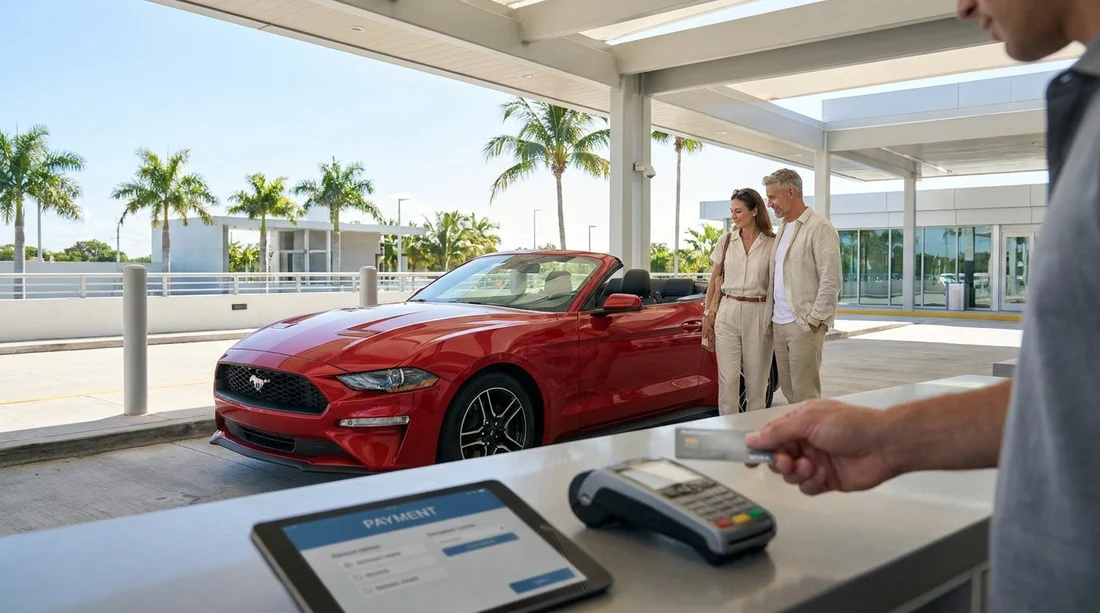
In most Miami car hire scenarios, the hold is placed at the rental desk or kiosk during pick-up. This is when the supplier verifies the driver’s identity, checks licence details, and finalises anything that changes the risk profile, such as adding an extra driver or selecting different protection products.
With pay-now: you may have already paid the rental charges, but the deposit authorisation is typically still taken at pick-up. This is because the supplier is about to release a high-value asset to the driver, and they need a way to cover security and conditional costs.
With pay-later: the desk often processes two things at pick-up, the rental charge plus the deposit authorisation. On your statement, that can look like a larger total impact on available credit, even though part of it is only a temporary hold.
The hold is usually released after the vehicle is returned, subject to the supplier confirming the car comes back in the expected condition and with the expected fuel level. Release timing varies by bank, so you might see the pending amount disappear within days, or it may take longer depending on your card issuer’s processing speed.
Why Hola still requires a credit card at pick-up
Even if you have paid for the rental in advance, the supplier typically requires a credit card in the main driver’s name at pick-up. The reason is that some costs cannot be fully determined until the end of the rental, and the supplier also needs assurance that contract terms can be enforced.
Common reasons for a deposit hold include:
Security for the vehicle and excess: Many rentals include cover, but still involve an excess, or a residual risk that the driver may be liable for. The hold is a way to secure that potential amount.
Fuel and refuelling: If the vehicle is returned with less fuel than required by the chosen policy, a charge may apply. The hold provides a payment route without needing a separate billing process.
Extra time, late returns, and contract changes: Traffic, flight delays, and itinerary changes can lead to additional rental days or late fees, which are easier to settle when a card authorisation exists.
Tolls, admin fees, and incidentals: Miami and South Florida driving can involve toll roads, and suppliers may need to pass on toll charges or admin fees based on post-rental information.
This is also why debit cards can be less consistently accepted for car hire, even when the rental is paid upfront. A credit card authorisation is designed to be temporary and flexible, and it is widely used for security deposits in travel.
What can change the hold amount in Miami car hire
The deposit hold amount is not always fixed. It can change based on the details of your rental on the day you collect the car, especially if you alter coverage, vehicle category, or driver details.
1) Vehicle group and value
Larger or higher-value vehicles often attract a higher deposit hold because repair and replacement costs are potentially higher. If you switch from an economy car to an SUV, premium model, or people carrier, the required authorisation can increase. Travellers needing extra space sometimes look at options like van rental in Doral, where deposits may differ by vehicle size and class.
2) Protection and excess-reduction choices
Your chosen protection package can reduce the excess you are responsible for, which may reduce the deposit hold. Conversely, declining certain cover options can mean the supplier requires a larger hold to match the higher potential liability. The key point for pay-now versus pay-later is that these choices are usually confirmed at pick-up, so the hold can be recalculated even if you prepaid.
3) Driver profile and documentation
Age restrictions or young-driver policies, licence tenure, and the ability to present the correct documents can influence the deposit. If the supplier categorises the booking as higher risk based on driver age bands or other factors, the required hold can rise. Always bring the physical payment card, a valid driving licence, and any supporting identification requested in your rental terms.
4) Pick-up location and supplier policies
Different suppliers and locations can apply different deposit structures, even within the same city. For broader comparisons across the state, see car hire in Florida. If you are renting through a particular supplier brand, deposit practices can also vary, for example Thrifty car hire in Florida may show different requirements by vehicle type and season.
How to interpret the hold on your statement
A deposit hold is usually shown as “pending” or “authorised” rather than “posted”. That matters because it reduces your available credit even though it is not a completed payment. With pay-later rentals, you might see both the posted rental charge and a separate pending hold. With pay-now rentals, you will often see only the pending hold at pick-up, assuming the base rental charge was settled earlier.
If the hold remains for longer than expected after return, it is usually due to bank processing time rather than the supplier actively keeping funds. Keeping your return paperwork can help if you need to query timing with your card issuer, because it shows the actual return date and condition notes.
Practical ways to avoid surprises with deposit holds
First, treat the deposit hold as part of your travel budget, not as an error. Ensure your card has enough available credit to cover it, especially if you plan to use the same card for hotels or other travel holds in Miami.
Second, confirm that the card is in the main driver’s name. If the name on the booking and the name on the card do not match, the supplier may decline the card, request a different card, or apply different conditions.
Finally, return the vehicle on time and in line with the agreed fuel policy. Late returns and refuelling charges are among the most common triggers for additional charges that convert part of the hold into a final payment.
FAQ
Q: If I pay-now for car hire in Miami, why is there still a deposit hold?
A: Pay-now usually covers the rental cost, but the supplier still needs security for potential extra charges and liability that depend on how the car is returned.
Q: Is the deposit hold charged to my card, or just temporarily blocked?
A: It is typically a temporary authorisation that reduces available credit. It only becomes a charge if costs are later applied under the rental agreement.
Q: When will the deposit hold be released after I return the car?
A: Suppliers generally release it after check-in, but your bank controls how quickly the pending authorisation disappears, which can take several days.
Q: What most commonly increases the deposit hold amount at pick-up?
A: Switching to a higher vehicle class, declining excess-reduction options, adding drivers, and certain driver profile factors can all raise the hold.
Q: Can I avoid a deposit hold by choosing pay-later instead of pay-now?
A: Usually not. Pay-later changes when the rental is paid, but the deposit hold is tied to vehicle handover and still commonly applies.