


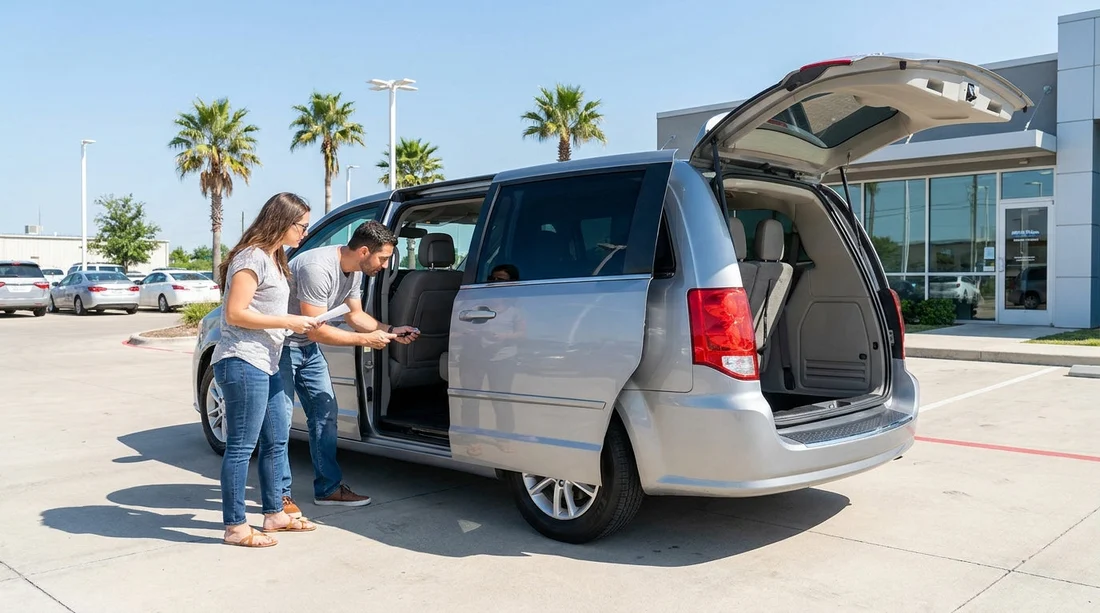
Quick Summary:
- Count seatbelts and head restraints, then confirm usable seats match paperwork.
- Check ISOFIX points and rear-row access when travelling with children.
- Test-fit your largest suitcase in the boot before leaving the bay.
- Verify vehicle class and plates, then photograph condition before departure.
When you pick up a car hire in Texas, the quickest way to avoid a stressful first mile is to confirm the vehicle genuinely fits your group, not just on paper, but in real-world seating and luggage space. “Seats” can be confusing because some models are advertised by maximum capacity, while your trip might need five adults plus car seats, or a third row that is technically present but barely usable. A two-minute counter check and a short walk-around can prevent a mid-trip vehicle swap, extra taxi rides, or an uncomfortable drive across Houston, San Antonio, or beyond.
The goal is simple, match what you booked to what you have been handed, before you drive off the lot. That means verifying the number of safe, usable seating positions, confirming the boot capacity for your luggage, and ensuring the vehicle class aligns with your reservation. If you are collecting near Houston airport, the process is the same whether you used car rental Houston IAH listings or another pickup point, and it is worth doing even when the queue is long.
Know what “right number of seats” really means
A rental listing might say “5 seats” or “7 seats”, but your trip requirements might be more specific. Before you even look at the car, clarify what you need in three parts.
1) Seating positions versus passengers. A “five-seat” car should have five seatbelts and five head restraints, but the middle rear seat in many saloons and compact SUVs is narrower and less comfortable for adults on longer drives.
2) Child seats and anchors. If you are using child seats, confirm there are enough ISOFIX or LATCH points and enough width to install them without blocking other seatbelts. A vehicle can have five belts but only two convenient anchor positions.
3) Usable third row. In many “7-seat” vehicles, the third row is best for children and smaller adults. You should physically check legroom, access, and seatbelt reach, not just rely on the badge.
The quick seat counter, 60 seconds at the door
Stand at the open driver’s door and do this count in a consistent order. You are not judging comfort yet, just confirming the number of legal seating positions.
Step 1: Count seatbelts. Visually locate every belt buckle and shoulder belt. For a five-seat car you should find two front belts and three rear belts. For a seven-seat vehicle you should find two front belts, three in the second row, and two in the third row.
Step 2: Count head restraints. Head restraints are a good reality check. If there are only four restraints in a supposed five-seater, investigate. Some rear middle positions have no head restraint, which might be acceptable in some models, but it is a sign that the “fifth seat” may be less practical.
Step 3: Confirm door access to each row. If you need to use the third row, operate the second-row slide or tilt mechanism. Make sure it unlocks and folds smoothly, and that someone can step through without twisting around a fixed child seat.
Step 4: Identify seat layout. Some seven-seaters are “2-3-2”, others “2-2-3”. For families, “2-2-3” can be easier for third-row access. Take ten seconds to note what you actually have.
Walk-around checklist to match class, space and safety
After the seat counter, do a short walk-around that links the interior reality to your booking class. This is especially useful when your reservation says “compact SUV or similar” and you are handed a model that feels closer to an economy hatchback.
1) Check the class on paperwork and vehicle. Your confirmation typically lists a class, such as economy, intermediate, full-size, SUV, or minivan. Compare that with the vehicle in front of you. If you booked a people carrier, a dedicated option like minivan rental Texas IAH usually signals you should expect true multi-row practicality, not a tight crossover with occasional seats.
2) Check boot volume with seats up. For seven-seat vehicles, open the boot with the third row up. If there is only a shallow well, you may fit just a couple of small bags. Decide whether that works for your group’s luggage. If it does not, you either need a larger vehicle, or you must plan to keep a rear seat folded and reduce passengers.
3) Do a real luggage test. The best test is physical. Put your largest suitcase in the boot, then add one medium case. If you are travelling with a pushchair, try it too. A quick test is faster than arguing later, and it prevents blocking rear visibility with bags stacked to the roof.
4) Check seat folding and latching. Fold and unfold any row you plan to use. Ensure seatbacks lock securely and head restraints are not missing. If you need to create more space, confirm you can fold a split section (for example 60/40) while still keeping enough seats.
Texas-specific pickup realities to factor in
Airport fleets vary. At major pickup points, availability can change fast. If you are collecting from an airport location such as car rental airport Houston IAH, you might be offered a different model than you expected, while still within the same class. Your checklist helps you decide whether “similar” is truly similar for your passengers.
Third-row comfort matters. A third-row passenger on a long drive to Austin, the Hill Country, or the Gulf Coast will notice cramped knees quickly. If the third row is for adults, consider whether a minivan or larger SUV is more appropriate than a compact seven-seater.
A seat and luggage checklist you can repeat at every pickup
To make this routine, use the same order every time you pick up car hire in Texas.
Inside: count seatbelts, count head restraints, check third-row access, confirm child-seat anchors, and sit in every row you plan to use.
Outside: open the boot, test-fit the largest suitcase, check folding seats latch properly, and photograph the vehicle condition.
Paperwork: verify class, passenger rating and any notes about “or similar”, and confirm the registration matches the vehicle you are taking.
If you want to compare fleets by supplier at a given airport, browsing pages such as Dollar car hire Houston IAH can help you understand typical classes and availability patterns, but the final confirmation still happens in the bay with your own eyes and luggage.
FAQ
How do I quickly verify the number of seats in a rental car? Count seatbelts first, then confirm head restraints and that each seating position is accessible and usable. Paper specs are less reliable than the physical belt count.
Is a “7-seat” SUV always suitable for seven adults in Texas? Not always. Many third rows are tight and best for children. Sit in the third row before leaving, and check rear ventilation and legroom for longer Texas drives.
What if the car has the right seats but not enough luggage space? Test-fit your largest bags with the seats in the configuration you need. If luggage blocks rear visibility or must be stacked dangerously, ask for a larger class or a different model.
How can I tell if the vehicle class matches my booking? Compare the class on your confirmation to the vehicle type you received, and check passenger and luggage practicality. “Or similar” can vary, so verify seating and boot space on the spot.
Should I take photos even if everything looks fine? Yes. Photograph exterior panels, wheels, and the interior seating layout. It helps if you later need to discuss a mismatch or show pre-existing damage.





























































































