Quick Summary:
- LDW usually covers theft and collisions, not stains or burns.
- Smoking evidence can trigger cleaning fees even if you bought LDW.
- Confirm what counts as interior damage and how charges are calculated.
- Inspect, photograph, and report pre-existing marks before driving away.
When arranging car hire in Florida, many drivers assume Loss Damage Waiver (LDW) protects them from any mishap. In reality, LDW is mainly designed to limit your financial responsibility for damage to the vehicle’s body and for theft, subject to the contract terms. Interior issues such as stains, burns, odours, torn upholstery, or smoke residue are often treated differently and can fall under exclusions or separate “cleaning” and “restoration” charges.
This guide explains the common LDW exclusions related to interior damage, how smoking evidence is handled, what “cleaning charges” can mean, and what to confirm before you sign for your Florida rental.
What LDW generally covers, and what it does not
LDW (sometimes called CDW) is typically an optional waiver offered by the rental company. It usually reduces or waives the amount you would otherwise pay if the vehicle is damaged in a collision, vandalised, or stolen, provided you complied with the agreement.
However, interior damage often sits in a grey area. Many rental terms treat it as neglect, misuse, or avoidable contamination, rather than an “accident” covered by LDW. Even when interior damage is not explicitly excluded, the company may categorise it as a cleaning or reconditioning cost rather than “damage” in the collision sense.
If you are collecting a vehicle for Florida car hire at a major pickup point such as car hire Orlando MCO or car rental airport Fort Lauderdale FLL, the counter paperwork can move quickly. Take a moment to locate the sections on LDW coverage and exclusions, and the parts about cleaning, smoking, and interior condition.
Common LDW exclusions for stains, burns, and interior damage
While exact wording differs by supplier, the exclusions below are commonly found in rental agreements and can apply in Florida:
1) Stains and spills
Food, drink, sunscreen, makeup, ink, pet accidents, or muddy water can leave stains that require specialist cleaning or replacement. Many agreements treat this as a chargeable condition issue, not collision damage. Even if the stain happened “by accident”, it may still be excluded if it is classed as contamination or misuse.
2) Burns, melting, and heat damage
Cigarette burns, vape heat marks, melted plastic, or other scorch damage is often treated as avoidable misuse. These repairs can be expensive because they may require replacing upholstery panels or trim.
3) Tears, punctures, and broken interior components
Torn seats, ripped headliners, cracked screens, broken vents, damaged child seat anchor covers, or snapped cup holders may be excluded, or charged as interior damage separate from LDW. Some suppliers also carve out exclusions for “wear and tear” versus “damage”, and disputes happen where a small tear could be argued either way.
4) Odours and contamination
Strong smells from smoke, cannabis, vaping, spilled alcohol, seafood, or other sources can require ozone treatment or deep cleaning. These are frequently billed as cleaning or deodorising charges, not covered by LDW.
5) Unauthorised pets or evidence of animals
If the rental rules restrict pets, hair and odour can lead to additional cleaning fees, regardless of LDW status.
The key takeaway is that LDW is not a blanket “anything that happens to the car” product. For car hire in Florida, interior damage and cleaning commonly sit outside the waiver, unless your specific contract states otherwise.
Smoking evidence, vaping, and how cleaning charges happen
Most Florida rentals are non-smoking. Importantly, “smoking evidence” does not always require staff to see someone smoking. Companies may apply charges if they detect:
Residual smell, ash, burn marks, or cigarette ends. Also, vape residue can still leave odours or a film on interior surfaces, and some policies treat vaping the same as smoking.
Cleaning charges can be triggered even when you purchased LDW because they are often framed as breach of use rules rather than accidental damage. The amount can vary widely depending on the supplier’s schedule of fees, the severity, and whether they deem the car unavailable for hire during treatment.
If you are picking up around Miami, check the local rental documentation carefully, as city driving, beach trips, and nightlife can raise the risk of odours, spills, and sand. Hola Car Rentals has location pages such as car hire downtown Miami DWN and Thrifty car rental Miami Beach MBC that help you orient around pickup areas, but your binding terms will still be the supplier’s agreement you sign at collection.
What to confirm before signing your Florida rental agreement
To avoid surprises, confirm these points before you accept the keys:
Ask for the written list of LDW exclusions. Do not rely on verbal summaries. Look specifically for language around upholstery, interior trim, odours, burns, stains, “cleaning”, “decontamination”, and “biohazard”.
Clarify how cleaning charges are assessed. Is there a fixed fee, a range, or an “up to” amount? Are they charged only if cleaning exceeds normal turnaround, or for any evidence at all?
Confirm the reporting process for pre-existing marks. Ask whether they note interior condition on the check-out form, and how you should document anything you find. If the agent says, “interiors are not inspected,” that is still not protection. You need your own time-stamped proof.
Check whether your chosen product is LDW, and what deductible applies. Some waivers still include an excess for certain damage types. Also, a waiver may be invalidated by prohibited use, unauthorised drivers, or other contract breaches.
Understand what happens if repair involves downtime. Some agreements allow loss-of-use or administrative fees. Even if LDW addresses the physical damage, extra charges might be treated separately.
Practical steps to protect yourself from interior damage disputes
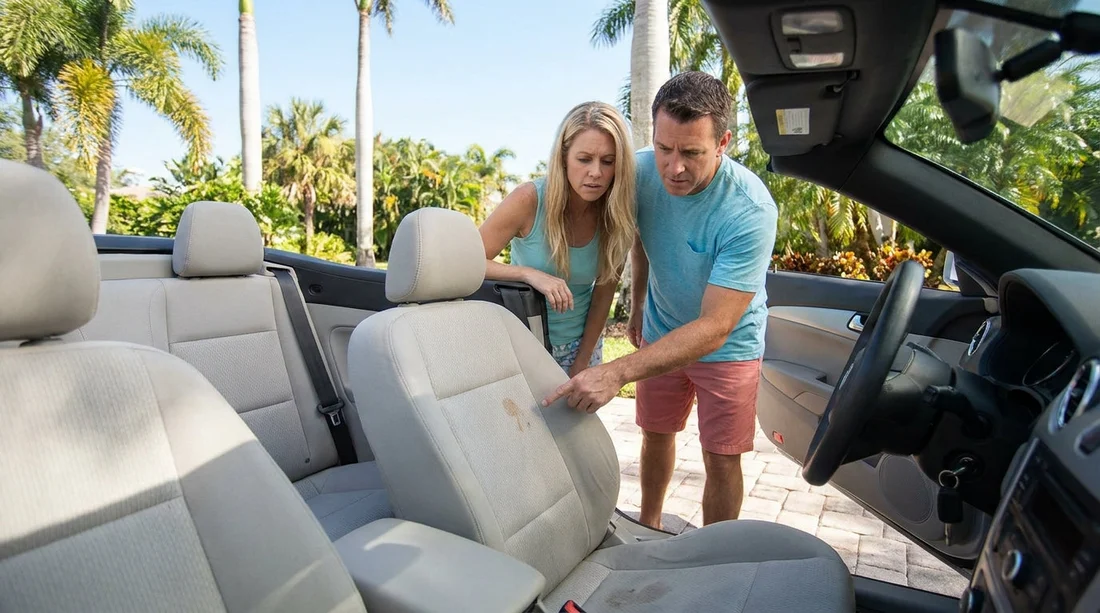
1) Inspect the interior before leaving the lot. Open all doors. Check seats, carpets, door panels, headliner, boot area, and the centre console. Look for sticky patches, stains, burns, tears, strong odours, and sand.
2) Take clear photos and a short video. Capture wide shots and close-ups of any marks. Make sure the date and time are saved in your phone metadata.
3) Get existing issues acknowledged. If you find a stain or burn, go back to the desk or booth immediately and ask for written notation or a vehicle swap.
4) Keep the car “inspection-ready”. Shake out beach towels, keep food sealed, and avoid placing hot items on seats. Use floor mats and do not leave wet items on upholstery.
5) Manage sand and sunscreen residue. Florida trips often involve beaches and pools. Sand grinds into carpets and can be hard to remove. Sunscreen can stain light upholstery. A quick clean-out before return can reduce risk of a charge.
6) Never smoke or vape in the vehicle. Even with windows down, odours linger. If someone else rode in your car, you remain responsible for condition at return.
Bottom line for Florida car hire LDW and interior damage
For Florida car hire, LDW usually focuses on collision and theft related damage to the vehicle’s exterior and structure. Stains, burns, smoke odours, and heavy interior soiling are frequently excluded or billed as cleaning and restoration, even if you purchased LDW. The safest approach is to read the exclusions carefully, confirm the smoking and cleaning fee policy, and document the interior condition before you drive away.
FAQ
Does LDW cover interior stains on a rental car in Florida?
Usually not. Interior stains are often treated as cleaning or reconditioning, and many agreements exclude them from LDW. Check the written exclusions and cleaning fee section before signing.
If I buy LDW, can I still be charged a smoking fee?
Yes. Smoking and vaping evidence is commonly treated as a breach of rental conditions, leading to deodorising or deep-clean charges that sit outside LDW.
What counts as “interior damage” versus normal wear?
Normal wear is minor use consistent with ordinary driving. Burns, tears, strong odours, heavy staining, and contamination are more likely to be classed as damage or chargeable cleaning.
How can I reduce the chance of an interior damage dispute at return?
Inspect and photograph the interior at pickup, get existing marks noted, avoid smoking, and remove rubbish and sand before returning the vehicle.
Should I report a spill or burn immediately during my rental?
Yes. Report issues promptly and follow the supplier’s instructions. Early reporting can document what happened and may reduce misunderstandings about when the damage occurred.