


Quick Summary:
- Many Florida rentals include sealant kits instead of full spare tyres.
- Check the boot, tools, and tyre markings before driving away.
- Ask what roadside assistance covers for punctures and towing support.
- Run-flat tyres can help briefly, but limits still apply.
If you are arranging car hire in Florida, it is sensible to ask one practical question before you leave the rental lot, does the vehicle come with a spare tyre, a space-saver, run-flat tyres, or only a sealant and inflator kit. The honest answer is that it varies by fleet, model, and even by specific vehicle on the day. In Florida, many modern rental cars, especially smaller or newer models, are supplied without a traditional spare to save weight and boot space. Instead, they often carry a puncture sealant kit with a small compressor, or they may be fitted with run-flat tyres.
Because the equipment affects what you can do after a puncture, you should confirm what is in your car before you drive away, and understand what support is available if the sealant does not work or the tyre is unsafe to repair.
Why many rental cars no longer carry a spare
Plenty of rental fleets across the US have shifted away from full-size spares. The reasons are mostly practical. A spare wheel adds weight, which reduces fuel efficiency. It also takes up valuable luggage space, which matters in compact cars and some SUVs. Manufacturers also increasingly ship vehicles without a spare as standard equipment, supplying sealant kits or run-flat tyres instead.
In Florida, where airport fleets turn vehicles quickly, you can see several configurations across similar vehicle categories. Two cars in the same class might be equipped differently depending on their exact trim level and how the manufacturer delivered them. This is why it is better to check the specific vehicle rather than assume.
What you might receive at pick-up in Florida
At pick-up, your car will usually fall into one of these scenarios.
1) Full-size spare tyre. Less common in many modern sedans, but still possible in larger SUVs or older fleet vehicles. This is the easiest option if you know how to change a wheel, but some rental agreements and safety policies may still prefer you contact roadside support rather than change it yourself.
2) Space-saver spare. A narrow temporary wheel, often stored under the boot floor. These typically have speed and distance limits, so they are for getting you to a tyre shop or a swap, not for continuing a long drive around Florida.
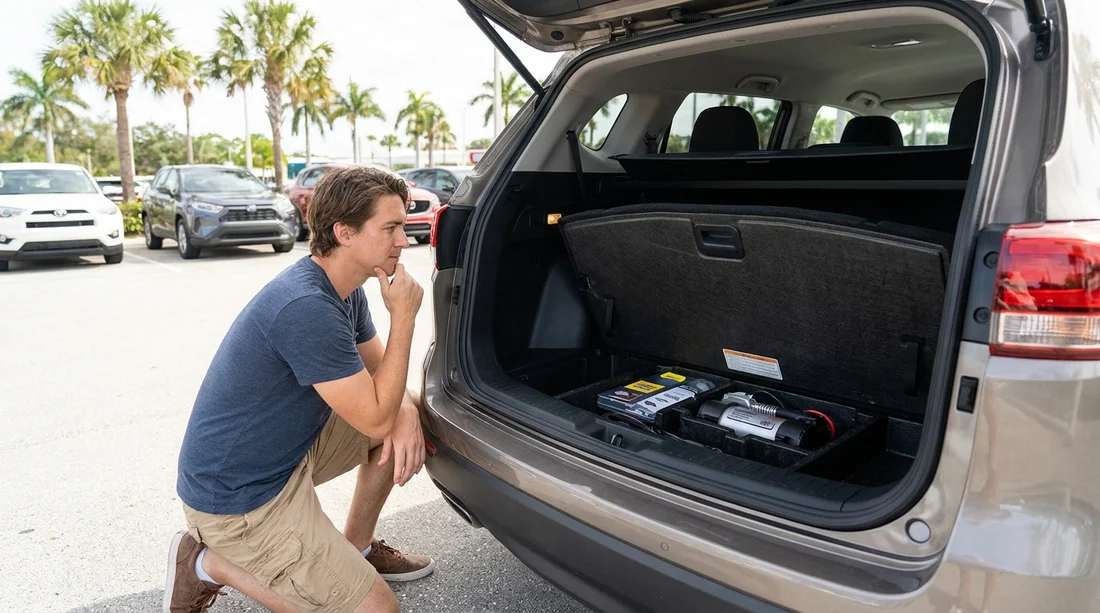
3) Sealant and compressor kit. Common in compact and mid-size cars. You will usually find a canister of sealant and a 12V compressor in a small bag, sometimes with basic instructions. Sealant is designed for small tread punctures, not sidewall damage or large holes. It can also complicate later repairs.
4) Run-flat tyres. Some vehicles are fitted with run-flats that can be driven a limited distance at reduced speed after losing pressure. These usually come with strict limits, and you still need to locate a shop or request a vehicle swap quickly.
If you are collecting from Miami, it is worth reading local guidance and what to expect for your trip type. Hola Car Rentals has a Florida page that is useful for planning and comparing options: car rental Florida MIA.
How to check in two minutes before leaving the lot
Do a quick inspection while you are still in the pick-up area. This is not about being picky, it is about knowing what plan you have if a puncture happens on I-95 or during a drive to the Keys.
Start with the boot. Lift the floor panel and look for a wheel well. If there is a spare, check whether it is full-size or a space-saver. If there is no wheel, look for a sealant kit bag or a compressor, and confirm the kit appears complete and unopened.
Next, check the sidewall markings on the tyres. Run-flats often say “RunFlat”, “RFT”, “SSR”, or a brand-specific marking. If you are not sure, ask staff to confirm whether the tyres are run-flat and what the safe distance and speed limits are once pressure drops.
Finally, locate the locking wheel nut key if the car has locking nuts, and confirm where the towing eye and jack points are shown in the manual. Even if you never use them, knowing what is present avoids stress later.
What to ask the desk or garage staff
Policies differ by brand and location, so the safest approach is to ask clear questions and note the answers. You can ask, “Does this vehicle have a spare wheel, a space-saver, or only a sealant kit?”, and “If I get a puncture, do I call roadside assistance, return to the location, or visit a tyre shop?”
If your itinerary includes long motorway drives, late-night arrivals, or remote areas, ask what happens if the sealant fails, and whether a vehicle swap is the normal solution. It can also be useful to ask whether the car has tyre pressure monitoring, and what warning to expect on the dashboard.
If you are researching providers, you can review general brand options through Hola pages such as National Car Rental United States. While equipment can still vary by vehicle, understanding typical fleet standards helps set expectations.
If you get a puncture, what usually happens
The correct next step depends on what equipment your vehicle has and what type of damage occurred.
With a spare, many drivers assume they can change it and continue. However, rental operators may prefer that you contact roadside assistance, particularly on busy roads where it is unsafe to stop. If you do fit a space-saver, drive conservatively and plan to resolve the issue quickly.
With a sealant kit, follow the instructions carefully. Sealant is intended for small holes in the tread. If the tyre is cut, the sidewall is damaged, or the tyre has come off the rim, do not use sealant. In those cases, you will normally need roadside support or a tow to a service location.
With run-flats, you may be able to drive a short distance, but you should avoid long detours. Run-flat capability is limited, and continued driving on a deflated tyre can damage the wheel and suspension. Treat it as a way to get to safety, not a solution for the rest of your holiday.
How this affects your trip planning and luggage
Knowing whether you have a spare can influence your comfort level on longer routes. Sealant-only vehicles may be perfectly fine for city driving and short hops, but some travellers prefer the reassurance of a spare when they are carrying family luggage or driving late at night.
When comparing different pick-up points and vehicle types, it helps to look at multiple locations and brands to understand typical fleet variety. For example, these pages provide useful context on different airports and suppliers: car hire airport Los Angeles LAX and Avis Car Rental Coral Gables GBL. Even though your trip is in Florida, seeing how fleets differ can clarify why equipment is not guaranteed by class alone.
If you are planning a larger group or carrying bulky kit, it can help to compare a bigger category such as a people carrier or van at another hub: van rental San Francisco SFO.
Practical pick-up checklist for spare or sealant
Before leaving the pick-up area, confirm what puncture solution you have, and what number to call for assistance. Take a quick photo of the tyre condition and the kit or spare in the boot. If the car has a sealant kit, check the sealant expiry date if visible, and ensure the compressor lead and valve connector are intact.
If you have a space-saver, check its inflation state if you can, as temporary spares can lose pressure over time. If anything is missing or looks used, ask for a replacement car or a complete kit before you depart.
FAQ
Do Florida rental cars always include a spare tyre? No. Many vehicles come with a sealant and compressor kit or run-flat tyres instead, and the exact equipment can vary by model and fleet.
Where can I check if my rental has a spare or sealant kit? Look under the boot floor for a wheel well. If there is no wheel, check for a bag containing sealant and a 12V compressor, or confirm run-flat tyres.
Can I use the sealant kit for any puncture? No. Sealant typically works only for small tread punctures. It is not suitable for sidewall damage, large holes, or a tyre that has separated from the rim.
If my car has run-flat tyres, can I keep driving normally? No. Run-flats are limited to a short distance at reduced speed after pressure loss. You should aim to reach a safe place and arrange inspection or assistance promptly.
What should I do first after a puncture in Florida? Get to a safe location, check the tyre warning and visible damage, then follow the rental provider’s roadside assistance process. Avoid changing a tyre on fast roads.





























































































