


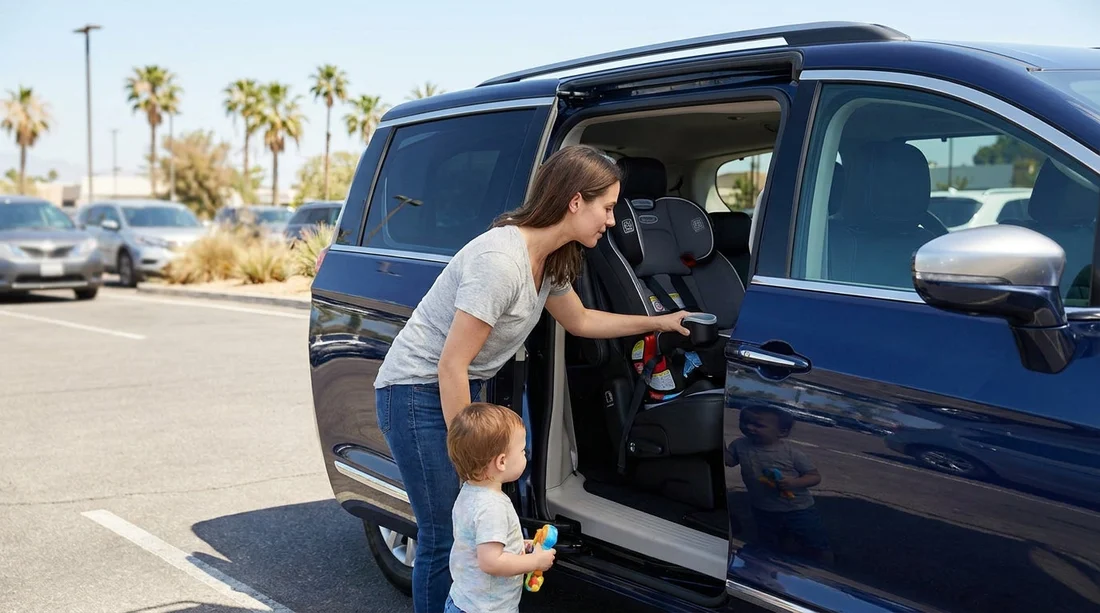
Quick Summary:
- Most hired child seats should meet FMVSS 213, but always confirm.
- Check labels, manufacture date, and visible damage before accepting any seat.
- Install the seat at pick-up and verify tightness, recline, and harness fit.
- Get the seat type, fees, and liability terms confirmed in writing.
When you add a hired child seat to a car hire booking in Texas, it is reasonable to expect it to meet US safety requirements. In practice, the key is not assuming, but confirming. Rental companies typically supply seats intended for the US market, and reputable providers will use models certified to Federal Motor Vehicle Safety Standard 213, often written as FMVSS 213. Your job at the counter and at the car park is to verify the seat is appropriate for your child, is in acceptable condition, and can be installed correctly in the specific vehicle you are taking.
This matters because a child seat can be fully compliant on paper but still unsuitable in real use, for example, if it is the wrong size for your child, missing parts, or does not achieve a secure installation in the back seat. Texas law focuses on proper restraint use by age and size, but compliance and correct use are not the same thing. A quick, methodical check at pick-up protects your child and helps you avoid disputes about damage or missing items later.
If you are collecting at a major hub such as Dallas Fort Worth Airport car rental or Houston IAH car rental, you may find multiple seat types offered. Inventory varies by supplier, so do not rely on a generic label like “infant seat” in your reservation. The safest approach is to treat the child seat like any other safety critical piece of equipment: confirm its standard, check its condition, and confirm it fits your child and the vehicle before you drive away.
What “US safety standards” actually means for child seats
In the United States, child restraint systems sold for normal use in cars must comply with FMVSS 213. Manufacturers show this through required labelling, typically a statement that the restraint “conforms to all applicable Federal motor vehicle safety standards”. For a hired seat, that label is the fastest way to verify it is a US certified model.
FMVSS 213 is different from European standards such as ECE R44/04 or UN R129 (i-Size). If you are visiting from the UK, note that US seats often have different belt routing, chest clip use is standard, and ISOFIX is called LATCH. A US compliant seat is not automatically “better” than an i-Size seat, it is simply certified to the US regime and designed for US vehicles and usage expectations.
Texas does not create its own separate manufacturing standard for child seats. Instead, Texas rules require children to be secured in a child passenger safety seat system according to the manufacturer’s instructions. That makes the instruction manual and the seat label important.
How to confirm the hired seat is compliant and suitable
Start with the labels. Look for the FMVSS 213 compliance statement, the model name or number, and the date of manufacture. Most seats have an expiry date or “do not use after” guidance, commonly six to ten years from manufacture depending on the model. If the seat is expired, refuse it and ask for a replacement.
Next, inspect the shell, harness, buckles, and pads. Reject any seat with cracks, missing chest clip, frayed harness webbing, damaged buckle tongues, or sticky adjusters that will not tighten smoothly. Ensure all key parts are present, including the top tether strap on forward facing seats, and any required inserts for infant seats.
Then check weight and height limits. “Infant”, “toddler”, and “booster” are vague. Your decision should be based on your child’s current weight and height, and the seat’s stated limits.
Fit checks at pick-up: install it before leaving
A seat can be compliant and undamaged, but still fail the most important test: a correct, tight installation in your specific rental car. Plan a few minutes at the car park to install and check the fit. If you are travelling through Texas IAH car rental options, allow extra time, as some locations bring seats from a back office and you may need to swap if the first one is unsuitable.
For rear facing and forward facing seats, aim for less than one inch of movement side to side at the belt path when you tug firmly. Make sure the recline angle matches the indicator on the seat, especially for babies, since too upright can affect breathing, and too reclined can reduce protection. Confirm the harness tightens properly, the chest clip sits at armpit level, and the harness straps are routed correctly for rear facing or forward facing use.
Do not forget the top tether for forward facing harnessed seats. In many US vehicles, tether anchors are on the rear shelf, behind the seat, or on the back of the seat itself. If you cannot find the anchor, check the vehicle manual in the glovebox. If it is missing or inaccessible, ask to change vehicle or seat type.
What to confirm before you sign the rental agreement
Before you sign, ensure the rental agreement or addendum clearly lists the child seat, the type, the price, and any taxes or fees. Confirm whether the seat is guaranteed or “on request”, and what happens if the location cannot supply one.
If your trip includes long highway stretches, a larger vehicle can make installation easier and give you more room for a stable fit, especially with rear facing seats. If you are comparing vehicle classes around Houston, a page like SUV rental at Houston IAH can help you assess options that typically have more rear seat space and clearer anchor access.
Common pick-up issues in Texas and how to avoid them
One common issue is receiving a seat that is not the requested type, for example, a backless booster instead of a high back booster. Another is missing parts, especially tethers, inserts, or belt guides. A third is a seat that is technically the right type but does not fit well in a particular car, especially compact models with angled rear headrests or short seat cushions.
To reduce surprises, arrive with your child’s current height and weight written down, and be ready to request an alternative seat if the first one does not meet limits or fit well. If you are travelling via San Antonio, availability can vary by supplier and season, so checking regional options like Enterprise car rental San Antonio SAT can help you plan for what to ask at the desk. For Fort Worth area pick-ups, Dollar car hire Fort Worth DFW is another reference point for understanding what may be offered at large airport counters.
Finally, keep expectations realistic. A hired seat should be safe, compliant, and serviceable, but it may not be the same premium model you use at home. Your checklist and fit test are what close the gap between “should be fine” and “is properly installed and ready”.
FAQ
Do hired child seats on a Texas car hire booking have to meet FMVSS 213?
Most rental providers supply US market seats that are labelled as compliant with FMVSS 213. Always verify by checking the compliance statement label on the seat before accepting it.
Where do I find the safety standard label on the seat?
Look on the side or back of the plastic shell for a manufacturer label. It usually includes the FMVSS 213 statement, model number, date of manufacture, and usage limits.
What if the seat looks worn or I cannot tighten the harness properly?
Do not use it. Ask for a different seat, and confirm the replacement at the desk before you leave the car park. A harness that will not tighten smoothly is a safety issue.
Can I use LATCH in any seating position in a rental car?
No. Lower anchors are typically only in the outboard rear seats, and some centre seats do not have them. If unsure, use the vehicle seatbelt installation method per the seat instructions.
Should I bring my own child seat to Texas instead of hiring?
Bringing your own gives you known history and fit, but it adds luggage and potential transit damage. Hiring can work well if you confirm FMVSS 213 labelling, check condition, and test install at pick-up.





























































































