


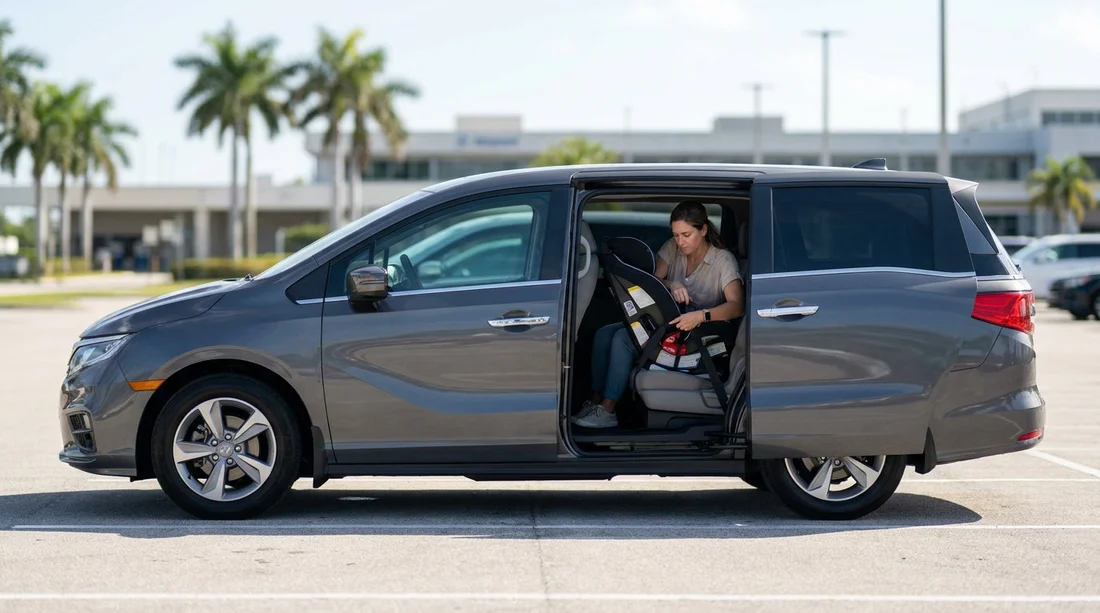
Quick Summary:
- You can bring your own child seat if it installs securely.
- Florida generally requires child restraints for children aged five and under.
- Check LATCH, lock the seatbelt, and aim for under one inch movement.
- Confirm rear seat space, tether anchors, and belt type at collection.
Yes, you can bring your own child seat when you pick up a car hire in Florida, and it can still meet Florida law, provided you use an appropriate restraint and install it correctly. Many parents prefer their own seat because they know its history, they are familiar with the instructions, and the child is already comfortable in it. The key is matching the right restraint to your child and making sure the rental vehicle has the right anchor points and seatbelts to secure it properly.
This guide covers Florida’s core rules, practical fit checks for LATCH and seatbelt installs, and what to confirm at the counter so you do not discover a compatibility issue in the car park.
Florida child restraint rules in plain English
Florida law requires a child restraint device for children aged five and under. In broad terms, children aged five and under must be in a federally approved child restraint device, while children aged six through seventeen must use a seatbelt. The law does not spell out every seat type by age, but best practice is to follow your child seat manufacturer’s limits for weight and height, and use the stage that provides the best fit and protection.
If you are arriving via Orlando, it can help to know your likely vehicle class in advance, because some compact cars have tighter rear-seat space for bulky seats. If you are comparing options, see the collection location details for car hire at Orlando MCO so you can plan for luggage, passengers, and the child seat footprint.
Bring-your-own seat checklist before you fly
Before you travel, check your seat’s labels and manual. Make sure it is within its expiry date and has not been in a crash, and confirm you have all required parts, including any infant insert, the top tether strap if it is a forward-facing seat, and the LATCH connectors if your model uses them.
It is also worth confirming your child’s current height and weight, then matching those numbers to the seat’s rear-facing, forward-facing, or booster limits. If your child is right on the edge of a limit, pick the safer option that still fits within the manufacturer’s allowed range.
LATCH vs seatbelt in a rental car, what to check
Most modern vehicles in Florida have LATCH, which is the Lower Anchors and Tethers for Children system. LATCH is often easiest for parents, but it still requires a correct install. The lower anchors are typically found in the outboard rear seats, and a top tether anchor is needed for most forward-facing harnessed seats.
At pick-up, check three things before committing to a LATCH install. First, locate the lower anchors and make sure they are accessible, not buried behind fixed upholstery. Second, confirm there is a top tether anchor for the seating position you want to use, especially in some SUVs and older models where tether locations can vary. Third, confirm your child seat’s LATCH weight limits, because some seats require switching to a seatbelt installation above a combined child-plus-seat weight threshold.
Seatbelt installation is equally safe when done correctly, and it can be more flexible if the lower anchors are hard to reach or if you need to use the centre seat. With a seatbelt install, you must be able to lock the belt. Many vehicles have switchable retractors that lock when fully pulled out and fed back in. Others use locking latchplates. If you cannot get the belt to lock, you may not be able to secure the seat properly without a locking clip that is approved for your model and you know how to use.
The “less than one inch” fit test
Whether you use LATCH or a seatbelt, do a firm stability check. Hold the seat at the belt path and try to move it side-to-side and front-to-back. The goal is less than one inch of movement at the belt path. Movement at the top of the seat can be misleading, so always test at the belt path.
For forward-facing harnessed seats, always attach and tighten the top tether when the seat requires it. The tether reduces head movement in a crash, and it can make an otherwise acceptable install significantly safer.
Choosing a suitable rental vehicle for child seats
The easiest way to avoid installation frustration is choosing a vehicle with adequate rear-seat space and clear anchor access. Families often prefer a larger saloon, SUV, or people carrier when travelling with multiple seats, because you may need room for rear-facing shells, booster positioning, and the ability to access buckles without scraping knuckles.
If you are travelling with grandparents or extra luggage, a people carrier can help you keep child seats properly positioned without compromising front-seat legroom. You can compare space-friendly options such as minivan rental in Orlando if you expect to install more than one seat or need easier third-row access.
If your trip is based in South Florida, city driving and parking can influence your choice as well. For example, tighter urban parking may push you toward a smaller vehicle, but you still need a rear seat that can accept your child seat securely. See location specifics for car rental in Fort Lauderdale if that is your arrival point.
What to confirm at the counter before leaving
Before you walk out to the vehicle, clarify a few details with the desk agent. Start with the vehicle class you are being assigned and whether it is a model with rear-seat headrests and adjustable seatbacks that might affect a high-back booster fit. Ask if the car has rear-seat LATCH and where the top tether anchors are located, because some are on the rear shelf, the seatback, or the cargo area wall.
Also review the condition report and make sure the rear seats and buckles are in good order. A buried buckle, twisted belt webbing, or a damaged latchplate can make a safe installation difficult. If you spot an issue, it is easier to request a different vehicle before you leave the bay.
If you are collecting in Miami, you might be offered different brands or fleets depending on season. Knowing the operator can help you anticipate vehicle types and anchor layouts. For instance, you can review Enterprise car rental at Orlando MCO when comparing fleet expectations for a family trip that starts in Central Florida.
Common mistakes when using your own seat in Florida
One common error is installing with both LATCH and the seatbelt when the seat does not allow it. Most seats require choosing one method unless the manual explicitly permits both. Another is routing the belt through the wrong belt path, which can look tight but will not perform as designed. It is also easy to forget the top tether on forward-facing seats, especially when switching between vehicles.
For boosters, the most frequent problem is poor belt fit. The lap belt should sit low on the hips, touching the upper thighs, and the shoulder belt should cross the centre of the shoulder and chest. If the shoulder belt cuts into the neck or slips off the shoulder, the booster or seating position may not be suitable.
FAQ
Can I legally use my own child seat with car hire in Florida? Yes. Florida permits you to use your own child restraint, as long as it is appropriate for the child and installed correctly in the rental vehicle.
What are Florida’s main child seat requirements? Children aged five and under must use a child restraint device. Children aged six through seventeen must wear a seatbelt, and best practice is to use a booster until the belt fits properly.
How do I know if the child seat is installed tightly enough? Test at the belt path. A correct install has less than one inch of movement side-to-side and front-to-back, with the belt locked or LATCH tightened.
Do rental cars in Florida have LATCH and top tether anchors? Most modern vehicles do, but anchor locations vary by model and seating position. Confirm lower anchors and top tether points before committing to the car.
What should I check at the counter before I drive away? Confirm the assigned vehicle has suitable rear-seat space, working seatbelts, accessible LATCH anchors, and top tether anchors if you need them, then install and test-fit before leaving.





























































































